Ethnobotanical study of wild edible plants among Oromo communities in Aseko District, Ethiopia
Published in Earth & Environment, Ecology & Evolution, and Materials


Blog Post/News & Views Summary:
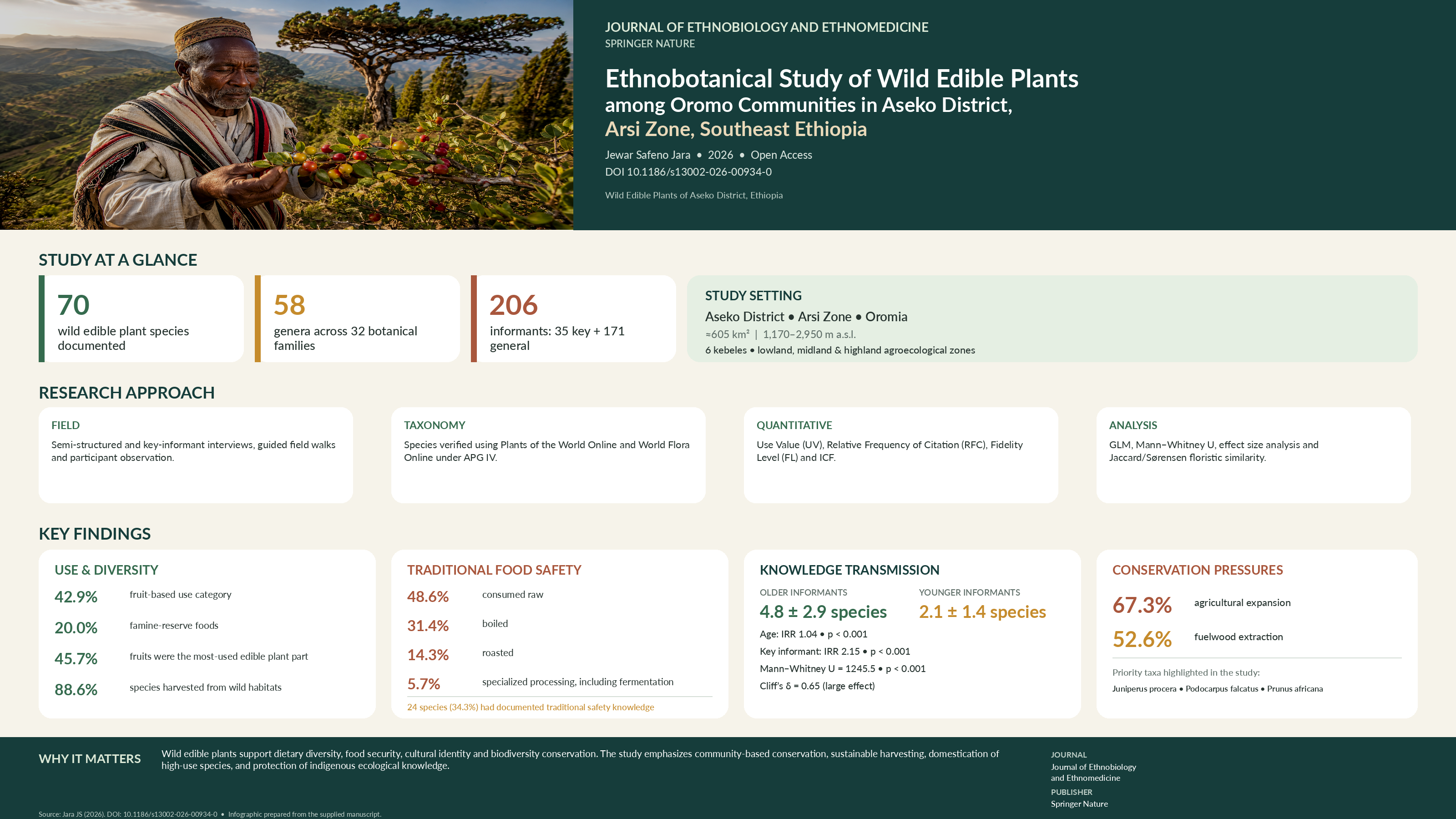
Wild edible plants (WEPs) are the "hidden treasure" of many rural Ethiopian food systems. My new study, published in Journal of Ethnobiology and Ethnomedicine, investigates the diversity, utilization, and cultural significance of these plants among the Oromo communities in Aseko District, Arsi Zone.
🔬 Key Findings:
-
Rich Diversity: We documented 70 species across 58 genera and 32 families.
-
Indigenous Safety: The study revealed remarkable indigenous knowledge of "cultural pharmacology." Traditional techniques like roasting, boiling, and fermentation are used to neutralize toxins in species like Podocarpus falcatus and Kigelia africana, ensuring safe consumption.
-
Knowledge in Decline: Older community members possessed significantly more extensive knowledge than younger generations. This signals a critical erosion of traditional ecological knowledge that requires urgent intervention.
-
Threats: Agricultural expansion (67.3%) and fuelwood extraction (52.6%) pose the greatest threats to these resources.
🌍 Why It Matters:
WEPs are not just "famine foods"; they are strategic resources for climate adaptation, dietary diversity, and cultural identity. This research provides a baseline for integrating these species into conservation policies and community-based livelihood programs.
Read the full study: [Link to the DOI: 10.1186/s13002-026-00934-0]
Follow the Topic
-
Journal of Ethnobiology and Ethnomedicine
This journal publishes original research focusing on cultural perceptions of nature and of human and animal health. It invites research articles, reviews and commentaries concerning the investigations of the inextricable links between human societies and nature, food, and health.

Related Collections
With Collections, you can get published faster and increase your visibility.
Living Food Heritage: Ethnobiological Perspectives on Local Foods Across Cultures and Time
This Collection is dedicated to the memory of Dauro Mattia Zocchi (1990–2026), a researcher in food heritage at the University of Bergamo and the University of Pollenzo (Italy), whose work advanced critical perspectives on food heritage and processes of heritagization.
The Collection explores the evolving concept of food heritage through the lens of local foods, with particular attention to cross-cultural interpretation and temporal dynamics. Local foods are not treated as static artefacts rooted solely in place-based ecological knowledge or artisanal skills; rather, they are understood as living systems continuously reshaped by migration, globalization, environmental pressures, and socio-economic transformations.
Bringing together interdisciplinary perspectives, the Collection examines how local knowledge and food practices are interpreted, valued, and transformed across cultural contexts. It highlights how communities negotiate authenticity, identity, and sustainability while adapting culinary traditions to contemporary realities. Cross-cultural analyses reveal both shared dynamics and context-specific trajectories in the production, perception, and use of local foods.
A central focus is the temporal dimension of food heritage: how recipes, ingredients, techniques, and meanings evolve over time while maintaining connections to the past. The notion of dynamic continuity is proposed to capture how heritage persists not through static preservation, but through ongoing processes of adaptation, reinterpretation, and renewal.
Moreover, the Collection addresses how ethnobiological research on food heritage can be applied to concrete projects and initiatives aimed at improving the well-being of local and rural communities. Contributions engage with applied perspectives, highlighting the potential of local foods to support livelihoods, cultural resilience, and sustainable development.
In honoring Dauro Zocchi’s legacy, this Collection emphasizes the need to approach food heritage as a process rather than a fixed category. It calls for innovative methodological frameworks that integrate ethnobiological, cultural, historical, and ecological perspectives in order to better understand—and responsibly engage with—the role of local foods in a rapidly changing world.
All submissions in this Collection undergo the journal’s standard peer review process, and all manuscripts authored by a Guest Editor(s) are handled by the Editor-in-Chief. As an open access publication, this journal levies an article processing fee (details here). We recognize that many key stakeholders may not have access to such resources and are committed to supporting participation in this issue wherever resources are a barrier. For more information about what support may be available, please visit OA funding and support, or email OAfundingpolicy@springernature.com or the Editor-in-Chief.
Publishing Model: Open Access
Deadline: Mar 25, 2027
Ethnobiological Research in South and South East Asia
This collection seeks to advance ethnobiological research across South Asia and South East Asia—two regions rich in cultural and biological diversity yet underrepresented in global scholarship. By bringing together scientists from countries such as India, Pakistan, Nepal, Bangladesh, Sri Lanka, Bhutan, and the Maldives (South Asia), as well as Myanmar, Thailand, Laos, Cambodia, Vietnam, Malaysia, Singapore, Indonesia, Brunei, the Philippines, and Timor‑Leste (South East Asia), the collection aims to fill a critical gap in the literature while fostering collaborative networks that transcend political and social boundaries.
We invite contributions that explore:
- Traditional ecological knowledge
- Human–nature interactions
- The role of ethnobiology in addressing contemporary challenges, such as biodiversity conservation
- Ethnobiological perspectives on sustainable livelihoods
- Cultural heritage preservation in diverse and rapidly changing environments
Beyond advancing science, this collection aspires to serve as a bridge—supporting dialogue and cooperation among researchers in regions where collaboration is often difficult but deeply needed.
All submissions in this Collection undergo the journal’s standard peer review process, and all manuscripts authored by a Guest Editor(s) are handled by the Editor-in-Chief. As an open access publication, this journal levies an article processing fee (details here). We recognize that many key stakeholders may not have access to such resources and are committed to supporting participation in this issue wherever resources are a barrier. For more information about what support may be available, please visit OA funding and support, or email OAfundingpolicy@springernature.com or the Editor-in-Chief.
Publishing Model: Open Access
Deadline: Nov 27, 2026