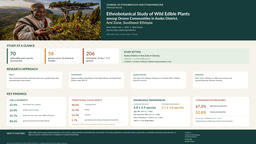
Traditional Plant Remedies Keeping Livestock Healthy in Rural Ethiopia
Published in Earth & Environment, Ecology & Evolution, and Agricultural & Food Science

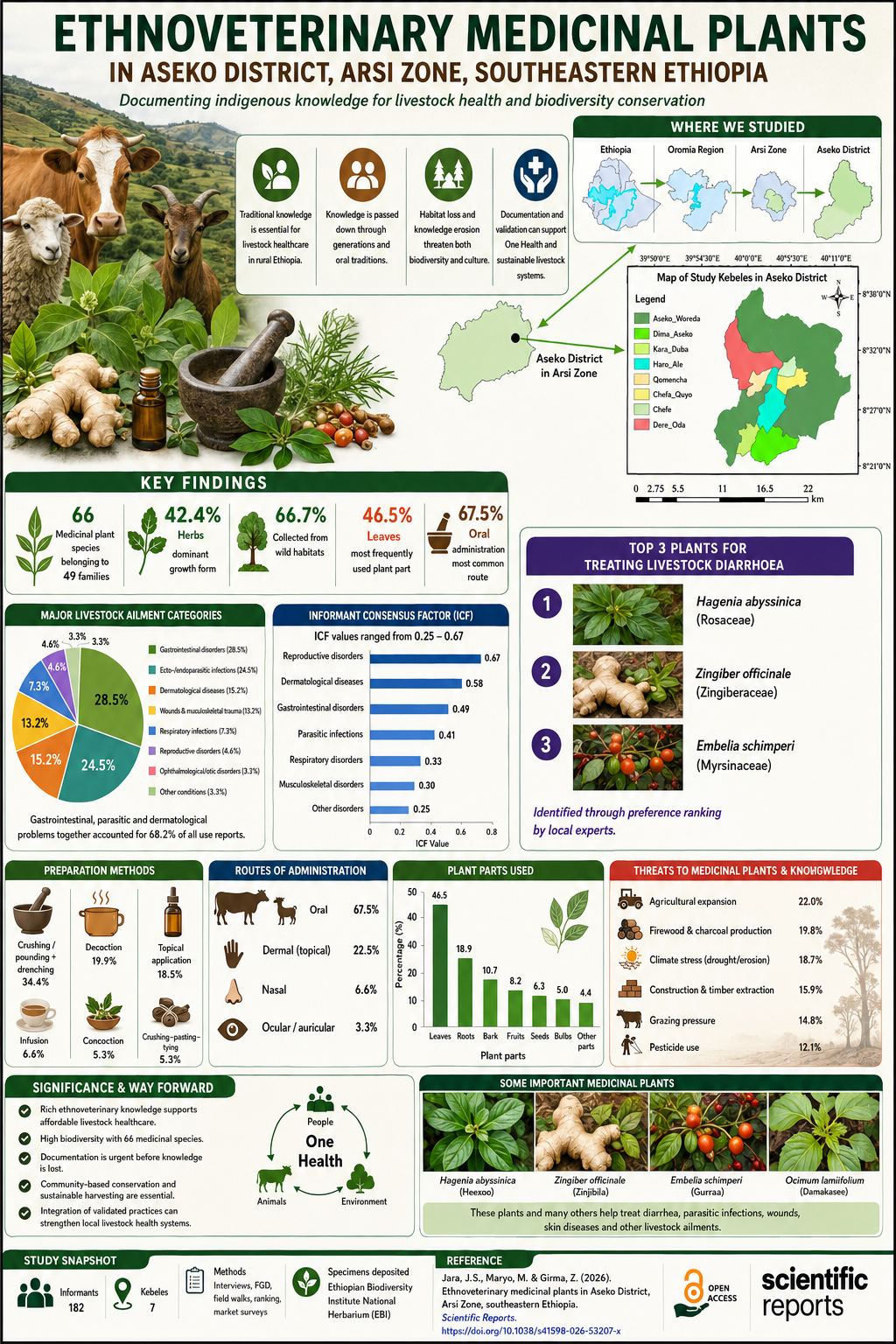






Livestock are central to rural livelihoods across Ethiopia. They provide food, income, draught power, and social security for millions of households. Yet many farming communities have limited access to modern veterinary services. In these settings, traditional ethnoveterinary medicine—the use of medicinal plants and indigenous knowledge to treat animal diseases—continues to play a vital role.
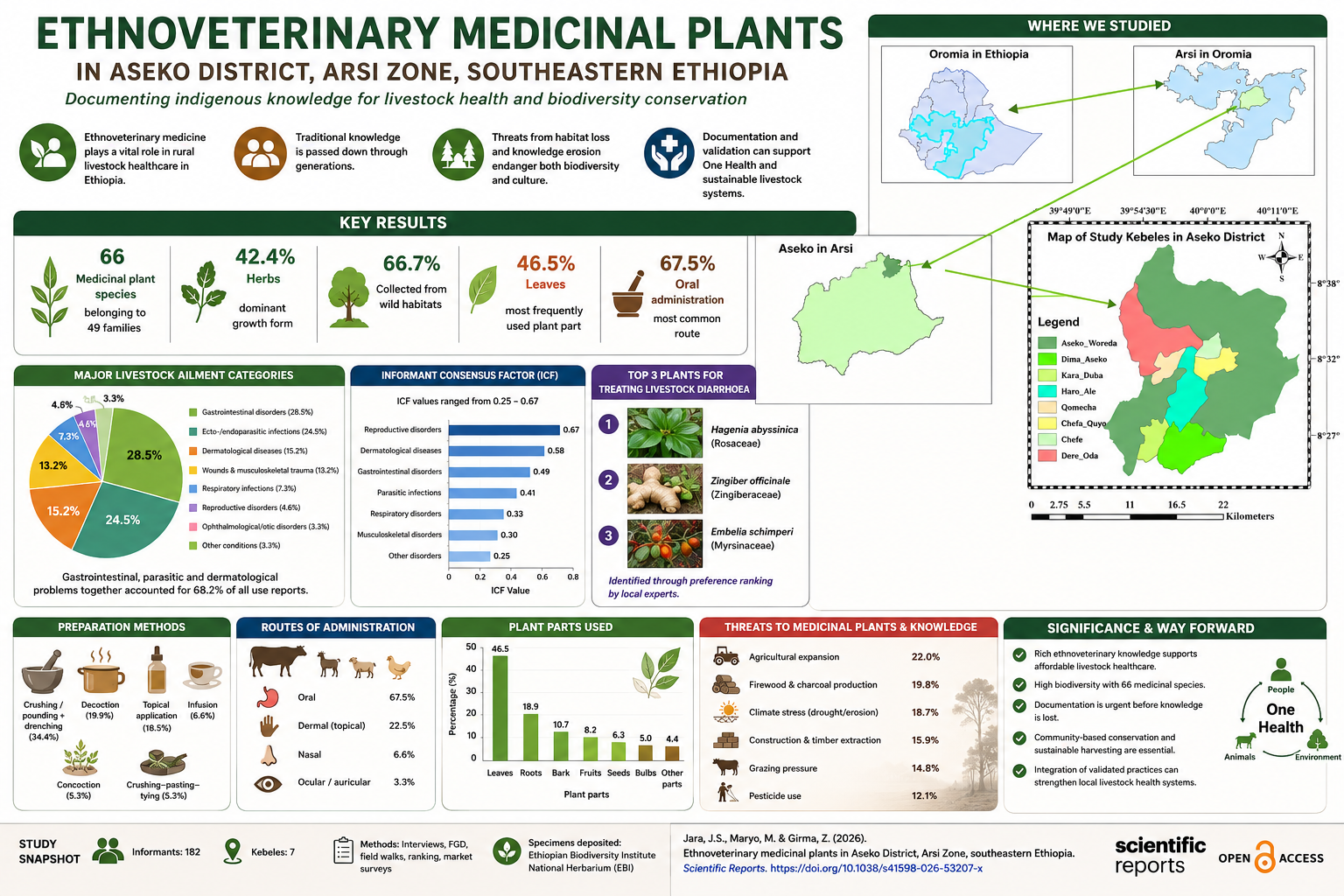
Our recently accepted study in Scientific Reports explored ethnoveterinary medicinal plants used in Aseko District, Arsi Zone, southeastern Ethiopia. The research aimed to document medicinal plant diversity, traditional treatment practices, knowledge transmission systems, and the conservation challenges facing these valuable biological resources.
Why Aseko District?
Aseko District contains diverse landscapes ranging from lowland to highland ecosystems. The area supports rich plant biodiversity and extensive livestock production. Despite this importance, little scientific information existed regarding local ethnoveterinary practices.
To address this gap, we worked with 182 informants, including experienced traditional healers and livestock keepers from seven kebeles representing different agroecological zones. Through interviews, focus group discussions, guided field walks, and market surveys, we documented medicinal plants used to treat livestock diseases and recorded the associated indigenous knowledge.
What Did We Find?
The study documented 66 ethnoveterinary medicinal plant species belonging to 49 plant families. This remarkable diversity highlights the depth of traditional knowledge maintained by local communities.
Herbs were the most common growth form, accounting for over 42% of all recorded species, followed by shrubs and trees. Most medicinal plants were collected from wild habitats, emphasizing the importance of natural ecosystems as sources of veterinary medicines.
Leaves were the most frequently used plant part, followed by roots and bark. Remedies were typically prepared from fresh materials and administered orally, although topical, nasal, and ocular applications were also reported.
Diseases Most Commonly Treated
Traditional healers reported using medicinal plants to manage a wide range of livestock ailments. The largest category involved gastrointestinal disorders, including diarrhea, bloating, and digestive problems. Parasitic infections and skin diseases were also commonly treated.
One particularly interesting finding was the strong agreement among informants regarding certain treatments. Species such as Embelia schimperi, Zingiber officinale (ginger), and Hagenia abyssinica were repeatedly cited as effective remedies for livestock diarrhea.
Through preference-ranking exercises, Hagenia abyssinica emerged as the most preferred plant for treating diarrheal conditions, suggesting a high level of community confidence in its effectiveness.
Preserving Indigenous Knowledge
Beyond documenting plants, the study revealed important insights into how ethnoveterinary knowledge is maintained.
Most knowledge is transmitted orally through family lineages, often from elders to younger generations. Older respondents generally possessed much greater knowledge of medicinal plants than younger participants.
This pattern raises concerns about the long-term survival of traditional knowledge systems. As formal education expands and lifestyles change, younger generations may become less engaged with indigenous healthcare practices.
Without deliberate documentation and knowledge-sharing efforts, valuable information accumulated over generations could be lost.
Conservation Concerns
While the diversity of medicinal plants is encouraging, the study also identified several threats.
Agricultural expansion was ranked as the most serious threat to medicinal plant resources. Other major pressures included fuelwood collection, charcoal production, climate-related stresses such as drought and soil erosion, grazing pressure, and harvesting for construction materials.
Many medicinal species are harvested directly from wild habitats. The use of roots and bark can be particularly destructive because it may kill plants or reduce their ability to regenerate.
Several important species, including Hagenia abyssinica, Croton macrostachyus, Podocarpus falcatus, and Juniperus procera, face additional pressure because they serve multiple purposes. These plants are used not only as medicines but also for fuelwood, construction, tools, fencing, and shade.
The combination of medicinal and non-medicinal uses increases harvesting pressure and highlights the need for conservation action.
Why Does This Matter?
Ethnoveterinary medicine represents far more than a collection of plant remedies. It is a living knowledge system that connects biodiversity, culture, animal health, and community resilience.
Many modern pharmaceuticals have origins in traditional medicinal knowledge. Documenting ethnoveterinary practices can help identify promising species for future pharmacological research while simultaneously preserving cultural heritage.
At the same time, safeguarding medicinal plant resources contributes to biodiversity conservation and supports sustainable rural livelihoods.
Looking Ahead
Our findings demonstrate both the resilience and vulnerability of ethnoveterinary knowledge in Ethiopia. Traditional medicinal plants continue to provide essential livestock healthcare, yet both the plants and the knowledge surrounding them face growing pressures.
Future efforts should focus on:
- Community-based conservation of medicinal plant species.
- Sustainable harvesting practices.
- Cultivation of high-demand medicinal plants.
- Documentation of indigenous knowledge.
- Scientific evaluation of promising medicinal species.
- Stronger collaboration between traditional practitioners and veterinary professionals.
By integrating traditional knowledge with modern scientific approaches, we can help ensure that these valuable resources continue to benefit both people and livestock for generations to come.
Follow the Topic
-
Scientific Reports
An open access journal publishing original research from across all areas of the natural sciences, psychology, medicine and engineering.

Related Collections
With Collections, you can get published faster and increase your visibility.
Cancer Prevention and Control
Publishing Model: Hybrid
Deadline: Feb 19, 2027
Healthy Aging
Publishing Model: Open Access
Deadline: Dec 31, 2026