Evidence of refugia buried in geohistorical records can guide conservation efforts
Published in Earth & Environment, Sustainability, and Statistics





The Past as the Key to the Future
Why do some populations survive while others go extinct during environmental crises?
The answer seems obvious: the crisis is unevenly distributed around the globe. Some locations experience the crisis less intensely than others, and populations in locations with more favourable (or a least less disastrous) conditions are more likely to survive. Such locations that shelter populations through crises are often dubbed “refugia.”
Refugia can be a useful resource for conservation biologists and policymakers: since refugia represent natural sources of extinction survivorship, identifying and protecting refugia for species at risk can prevent the species’ extinction and potentially aid its recovery.
However, if we consider the possible long-term fates of a putative refugium, we see that some refugia are more useful for conservation than others. Some putative refugia may protect a population through a crisis and serve as a source point for recolonization into its former range after the crisis passes. Other putative refugia may initially protect a population from a crisis but ultimately become a trap, such that deteriorating conditions within the locale cause the population to be extirpated anyway. Still other putative refugia may shelter a population through a crisis but serve as neither a source point for re-expansion nor a trap in which the population goes extinct; instead, the population remains stable within the confines of the refugium.
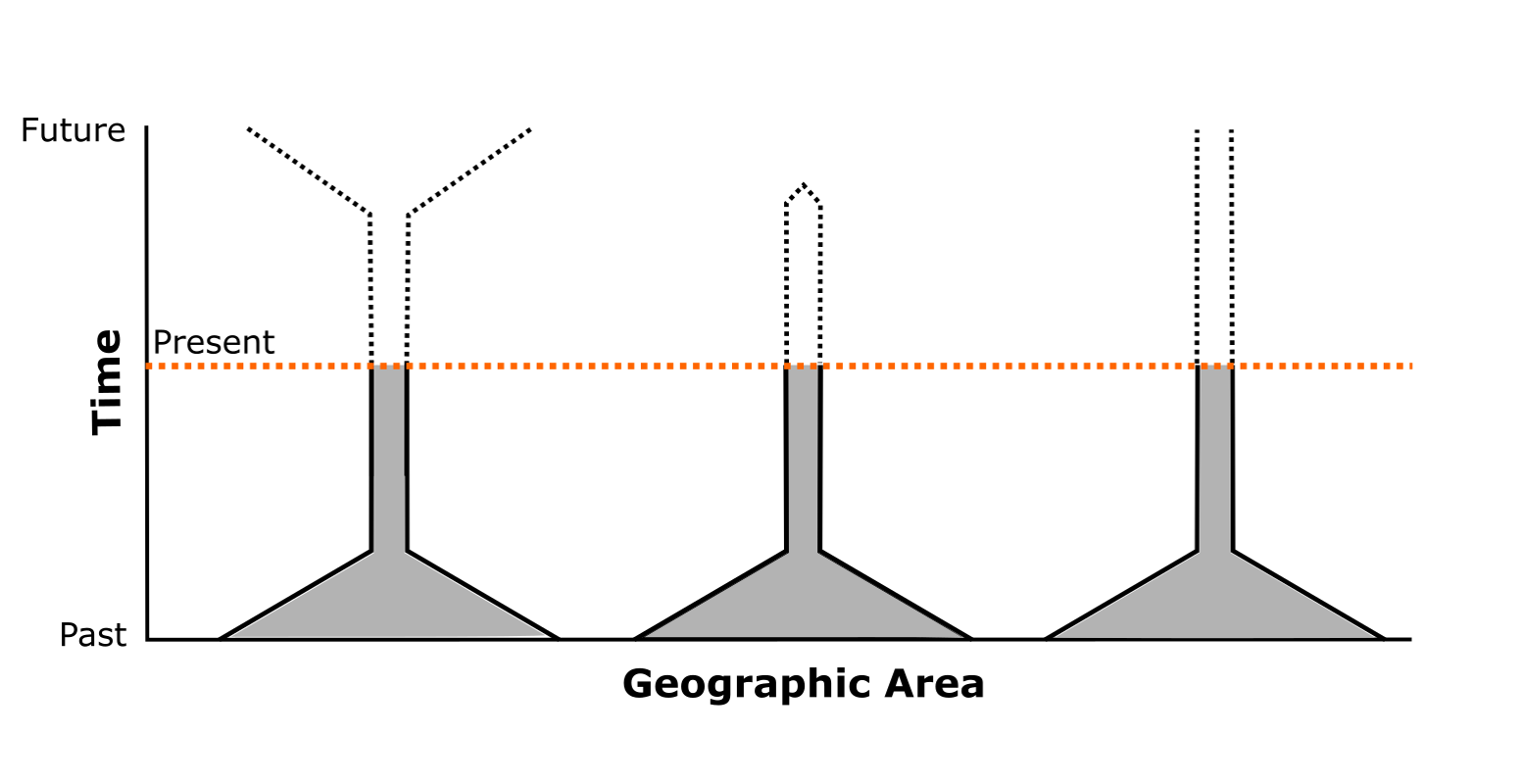
Possible long-term fates of a putative refugium.
In other words, not all refugia are created equally.
This poses a problem for conservation biologists and policymakers. Protecting refugia should be a priority for conservation, but inadvertently protecting a so-called “refugial trap” would waste conservation resources and may lead to the population’s (or species’) extinction in the long run.
So, how can we tell whether a putative refugium will become a “true” refugium or a refugial trap in the future?
The obvious solution is to compare true refugia to refugial traps in the historical record to determine what environmental conditions led to their respective geneses. However, refugia and refugial traps can occur on the scale of thousands – or even millions – of years, and the historical ecological record dates back a century at most.
Sometimes modern ecological data are not sufficient, and we need to peer beyond the historical into the prehistoric.
The State of the Field
When it comes to identifying prehistoric refugia, two methods reign supreme: phylogeography and species distribution models (SDMs). Phylogeography uses molecular techniques to interpret the demographic history of a population. This method is useful for identifying the existence and approximate timing of a refugium, but phylogeography cannot reveal the location of an identified refugium. Phylogeographic inference is also limited to refugia with descendant populations (i.e., they cannot be used to identify the existence of refugial traps).
Meanwhile, SDMs use statistical and mechanistic approaches to identify what environmental conditions co-occur with a taxon of interest; these SDMs can then be coupled with climate models to fore- and hindcast species ranges. While SDMs are a powerful and cost-effective tool for identifying refugia in the past and the future, they are limited by underlying assumptions such as niche stability through time and the integrity of the climate model.
Geohistorical data (e.g., palaeontological and geological data) provide the only definitive evidence that an organism lived in a given place at a given time. Once a prehistoric refugium has been identified with fossil data, independent palaeoclimate analysis of the surrounding sediment can determine what environmental conditions led to the formation of a successful refugium. These geohistorical data can then be coupled with inferences from phylogeography and/or SDMs to provide a more holistic understanding of how the taxon survived previous extirpation events.
Despite the potential of geohistorical data for identifying refugia, its widespread adoption has been limited by qualitative approaches and low sample sizes. Developing a quantitative method that can be readily applied to various high-fidelity datasets can make the geohistorical record a more accessible tool for conservation biologists.
The Study
In our study, my colleagues and I present a new quantitative method for identifying true refugia (i.e. those that facilitate post-crisis recovery) using geohistorical data. This method consists of three steps. First, we inspect time-series graphs of regional presence (i.e., the number of sites with a taxon in a given time bin) to see whether there are any declines and rebounds that could indicate a regional extirpation event. We then examine animated heatmaps to determine whether any localities shelter the taxon of interest through the regional extirpation event and serves as a source point for post-crisis re-expansion. If both qualitative tests pass, we perform Monte Carlo statistics to verify the significance of the temporal and spatial patterns.
To test the validity of this method, we present a case study looking for refugia in three plant taxa using pollen data from 25 lake cores in northern Alaska, USA following the end of the Last Glacial Maximum. Northern Alaska was unglaciated during this 20 kyr interval despite its high latitude, and this region saw rapidly shifting climatic conditions, leading to ideal conditions for the formation of refugia.
Each taxon demonstrated distinct ecological responses over this interval. Using our method, we identified a refugium that allowed spruce to persist through an interval of regional extirpation between 16.0–11.0 ka associated with warm and dry climate; this refugium also served as a centre for the re-expansion of spruce after conditions returned to a cool and humid baseline. These results build upon those of previous studies, which identified Alaskan spruce refugia following the LGM using phylogeographic and qualitative geohistorical data, by proposing a specific location for the refugium that can be tested with subsequent research.
Implications and Future Research
The implications for this method go beyond the case study presented in our paper. This method is taxon-independent and can be applied to any geohistorical dataset with sufficient spatial and temporal resolution. Furthermore, this method can potentially be applied to historical datasets where the scale of the refugium is appropriate.
I am currently developing an R package that will streamline the process for using this method to identify true refugia using geohistorical data. Once this package has been published, I hope the scientific community will be able to apply this method to identify refugia for other taxa, timeframes, and systems.
Combining insights from this method with those of phylogeography and SDMs will make the geohistorical record a more accessible and useful tool for conservation biologists and policymakers planning protected areas.

Follow the Topic
-
Communications Earth & Environment
An open access journal from Nature Portfolio that publishes high-quality research, reviews and commentary in the Earth, environmental and planetary sciences.

What are SDG Topics?
An introduction to Sustainable Development Goals (SDGs) Topics and their role in highlighting sustainable development research.
Continue reading announcementRelated Collections
With Collections, you can get published faster and increase your visibility.
Ecological resistance and resilience under global change
Publishing Model: Open Access
Deadline: Apr 07, 2027
Hazards in Mountain Regions
Publishing Model: Open Access
Deadline: Nov 02, 2026

