Extensive Bilateral Deep Vein Thrombosis After Uncomplicated Appendectomy in a Healthy Young Adult
Published in Biomedical Research


Explore the Research
Extensive bilateral lower limb deep vein thrombosis following uncomplicated open appendectomy in a young healthy male: a case report
Why this case matters
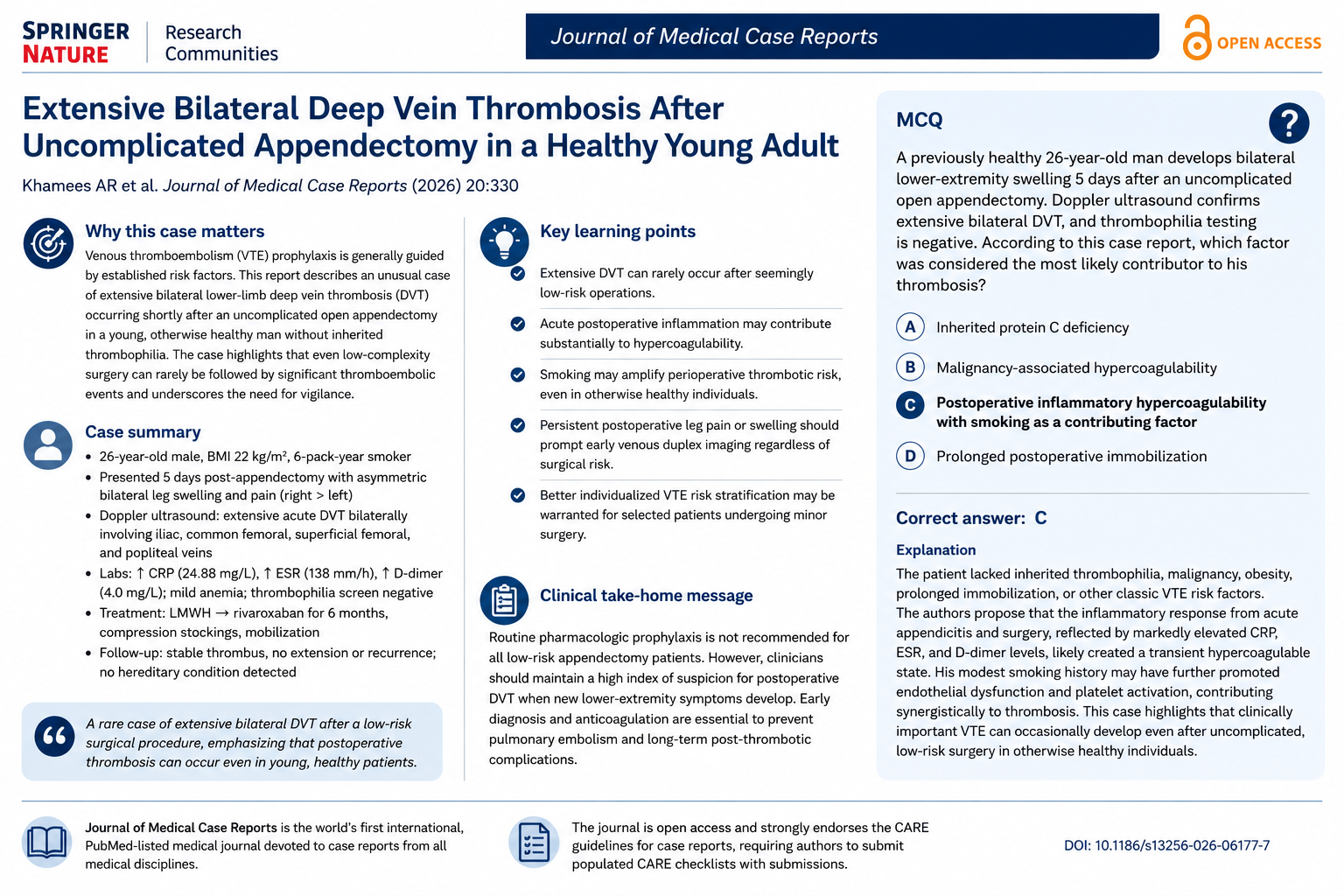
Venous thromboembolism (VTE) prophylaxis is generally guided by established patient and procedural risk factors. This report describes a rare case of extensive bilateral lower-extremity deep vein thrombosis (DVT) following an otherwise uncomplicated open appendectomy in a young patient without inherited thrombophilia or major traditional risk factors. The case emphasizes that postoperative inflammation and modest lifestyle risks, such as smoking, may occasionally be sufficient to precipitate clinically significant thrombosis even after low-risk surgery.
Case summary
A 26-year-old Iraqi man presented 5 days after uncomplicated appendectomy with painful bilateral leg swelling, worse on the right. Doppler ultrasonography demonstrated extensive acute bilateral DVT involving the iliac, common femoral, superficial femoral, and popliteal venous systems. Laboratory testing revealed elevated CRP, ESR, and D-dimer, while thrombophilia screening was negative. He was successfully treated with low-molecular-weight heparin followed by 6 months of rivaroxaban, compression therapy, and close follow-up, without thrombus progression or recurrence.
Key learning points
- Extensive DVT may rarely occur after seemingly low-risk operations.
- Acute postoperative inflammation may contribute substantially to hypercoagulability.
- Smoking may amplify perioperative thrombotic risk, even in otherwise healthy individuals.
- Persistent postoperative leg pain or swelling should prompt early venous duplex imaging regardless of perceived surgical risk.
- Better individualized VTE risk stratification may be warranted for selected patients undergoing minor surgery.
Clinical take-home message
Although routine pharmacologic prophylaxis is not recommended for all low-risk appendectomy patients, clinicians should maintain a high index of suspicion for postoperative DVT when new lower-extremity symptoms develop. Early diagnosis and anticoagulation remain essential to prevent pulmonary embolism and long-term post-thrombotic complications.
Multiple Choice Question
A previously healthy 26-year-old man develops bilateral lower-extremity swelling 5 days after an uncomplicated open appendectomy. Doppler ultrasound confirms extensive bilateral DVT, and thrombophilia testing is negative. According to this case report, which factor was considered the most likely contributor to his thrombosis?
A. Inherited protein C deficiency
B. Malignancy-associated hypercoagulability
C. Postoperative inflammatory hypercoagulability with smoking as a contributing factor
D. Prolonged postoperative immobilization
Correct answer: C. Postoperative inflammatory hypercoagulability with smoking as a contributing factor
Explanation
The patient lacked inherited thrombophilia, malignancy, obesity, prolonged immobilization, or other classic VTE risk factors. The authors propose that the inflammatory response from acute appendicitis and surgery, reflected by markedly elevated CRP, ESR, and D-dimer levels, likely created a transient hypercoagulable state. His modest smoking history may have further promoted endothelial dysfunction and platelet activation, contributing synergistically to thrombosis. This case highlights that clinically important VTE can occasionally develop even after uncomplicated, low-risk surgery in otherwise healthy individuals.
Journal of Medical Case Reports is the world's first international, PubMed-listed medical journal devoted to publishing case reports from all medical disciplines and will consider any original case report that expands the field of general medical knowledge, and original research relating to case reports. The journal is open access and strongly endorses the CARE guidelines for case reports, requiring authors to submit populated CARE checklists with submissions to improve transparency in reporting.

Richard Alan Rison is the interim Editor-in-Chief of Journal of Medical Case reports. He is also an associate neurology editor (editorial board) for BMC Neurology, and the former lead editor for case reports of BMC Research Notes (currently on the editorial board). His scholarly work focuses on medical case reporting, reporting standards, and editorial methodology. Dr. Rison participated in the development and dissemination of the CARE guidelines for clinical case reporting and has authored numerous publications addressing both neurological disorders and the role of case reports in advancing medical knowledge. Dr. Rison practices general neurology and served as the founding medical director of the PIH Health Hospital-Whittier Stroke Program and the PIH Health Hospital-Whittier Non-Invasive Vascular Laboratory, is a clinical assistant professor of neurology at the University of Southern California Keck School of Medicine and Los Angeles County Medical Center, and is a Fellow of the American Academy of Neurology, the American Neurological Association, and the American Association of Neuromuscular and Electrodiagnostic Medicine. Dr Rison is board-certified by the American Board of Psychiatry and Neurology in neurology and vascular neurology, and neurocritical care and neuroimaging by the United Council of Neurologic Subspecialties. He is also board-certified by the American Board of Electrodiagnostic Medicine in electrodiagnostic medicine. Dr. Rison is a former president of the Los Angeles Neurological Society.
Follow the Topic
-
Journal of Medical Case Reports
This journal will consider any original case report that expands the field of general medical knowledge, and original research relating to case reports.