FeOOH Cocatalysts with Gradient Oxygen Vacancy Distribution Enabling Efficient and Stable BiVO4 Photoanodes

Published in Chemistry and Materials

FeOOH Cocatalysts with Gradient Oxygen Vacancy Distribution Enabling Efficient and Stable BiVO4 Photoanodes

Like

Share this post

Choose a social network to share with, or copy the URL to share elsewhere

This is a representation of how your post may appear on social media. The actual post will vary between social networks

Explore the Research

SpringerLink
SpringerLink SpringerLink

FeOOH Cocatalysts with Gradient Oxygen Vacancy Distribution Enabling Efficient and Stable BiVO4 Photoanodes - Nano-Micro Letters

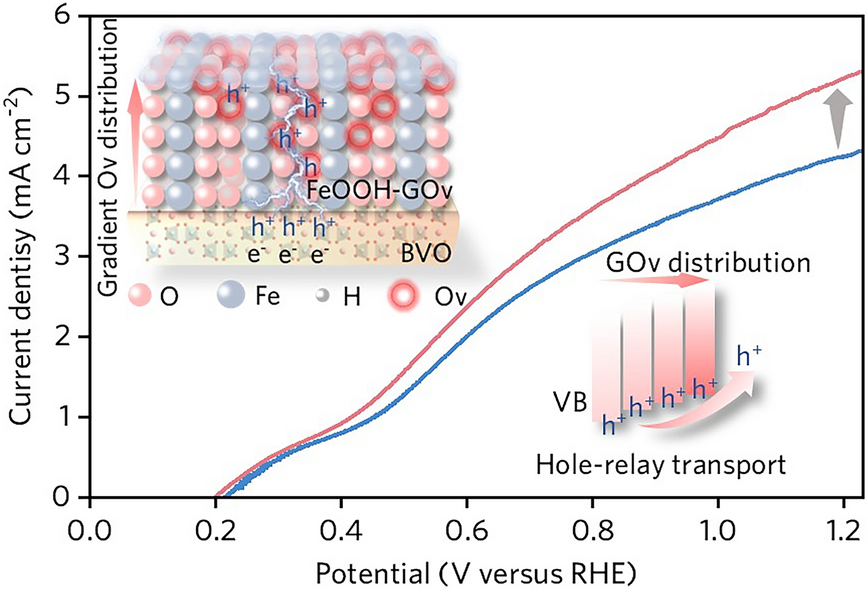
Highly active and stable FeOOH cocatalysts are essential for achieving optimal performance of BiVO4 (BVO) photoanodes. Despite offering remarkable structural stability, widely used thick FeOOH cocatalysts often suffer from insufficient hole transport capability, which hinders the overall activity. The present study demonstrates that a simple photoetching strategy is able to introduce gradient distributed oxygen vacancies (GOV) in the thick FeOOH layer and significantly enhances the photogenerated holes transport dynamics. The incorporation of GOV within FeOOH not only realizes the “relay transport” of photogenerated hole through the progressive upward shift of the valence band in the spatial distribution, but also provides abundant oxidation active sites by efficient hole trapping. These improvements effectively improve the oxygen evolution reaction (OER) activities and mitigate photocorrosion by the instantaneous hole extraction. Consequently, the FeOOH-GOV layer enables the BVO/FeOOH-GOV photoanode to achieve an impressive photocurrent density of 5.37 mA cm−2 and a robust operational stability up to 160 h at 1.23 VRHE, setting new benchmarks for current density and stability in FeOOH-based BVO photoanodes. This work provides an effective avenue to optimize OER cocatalysts for constructing highly efficient and stable photoelectrochemical water splitting devices.

Highly active and stable FeOOH cocatalysts are essential for achieving optimal performance of BiVO4 (BVO) photoanodes. Despite offering remarkable structural stability, widely used thick FeOOH cocatalysts often suffer from insufficient hole transport capability, which hinders the overall activity. The present study demonstrates that a simple photoetching strategy is able to introduce gradient distributed oxygen vacancies (GOV) in the thick FeOOH layer and significantly enhances the photogenerated holes transport dynamics. The incorporation of GOV within FeOOH not only realizes the “relay transport” of photogenerated hole through the progressive upward shift of the valence band in the spatial distribution, but also provides abundant oxidation active sites by efficient hole trapping. These improvements effectively improve the oxygen evolution reaction (OER) activities and mitigate photocorrosion by the instantaneous hole extraction. Consequently, the FeOOH-GOV layer enables the BVO/FeOOH-GOV photoanode to achieve an impressive photocurrent density of 5.37 mA cm−2 and a robust operational stability up to 160 h at 1.23 VRHE, setting new benchmarks for current density and stability in FeOOH-based BVO photoanodes. This work provides an effective avenue to optimize OER cocatalysts for constructing highly efficient and stable photoelectrochemical water splitting devices.

Please sign in or register for FREE

If you are a registered user on Research Communities by Springer Nature, please sign in

Follow the Topic

Photocatalysis
Physical Sciences > Materials Science > Materials for Energy and Catalysis > Photocatalysis
Materials for Energy and Catalysis
Physical Sciences > Materials Science > Materials for Energy and Catalysis
Nanoscale Design, Synthesis and Processing
Physical Sciences > Materials Science > Nanotechnology > Nanoscale Design, Synthesis and Processing
Electrochemistry
Physical Sciences > Chemistry > Physical Chemistry > Electrochemistry
  • Nano-Micro Letters Nano-Micro Letters

    Nano-Micro Letters is a peer-reviewed, international, interdisciplinary and open-access journal that focus on science, experiments, engineering, technologies and applications of nano- or microscale structure and system in physics, chemistry, biology, material science, and pharmacy.