Ferroelectric behavior of E‑beam evaporated Hf0.5Zr0.5O2 thin film and integration with GaN HEMTs toward programmable current switching
Published in Bioengineering & Biotechnology and Materials



Key Experimental Findings
Ferroelectric Properties of E-beam Evaporated HZO Thin Films
- P–Ecurves of MFM structures show remnant polarization (Pr) increasing with annealing temperature up to 800 °C; optimized at 600 °C with Pr reaching 60 µC/cm² at 30 °C/s heating rate.
- Powder XRD patterns confirm orthorhombic (o-phase) peak emergence at 30.5° above 600 °C and stronger with higher heating rates.
- Piezoelectric force microscopy exhibits 180° phase reversal, confirming ferroelectric switching.
Fabrication and Electrical Performance of FE-HEMTs
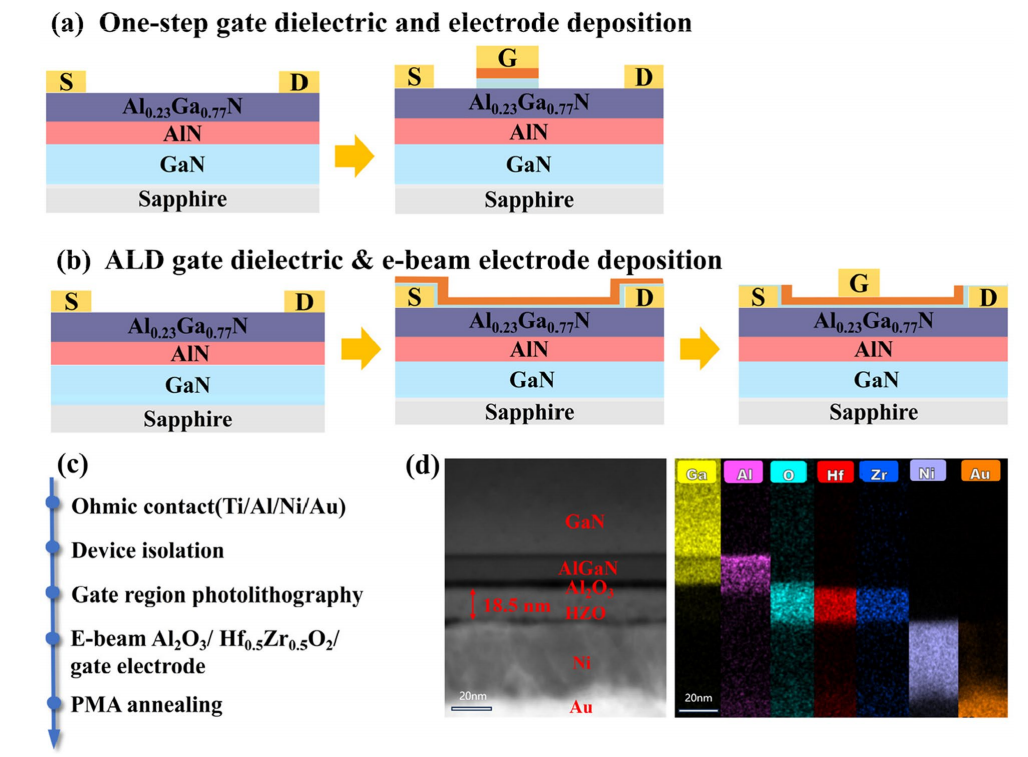
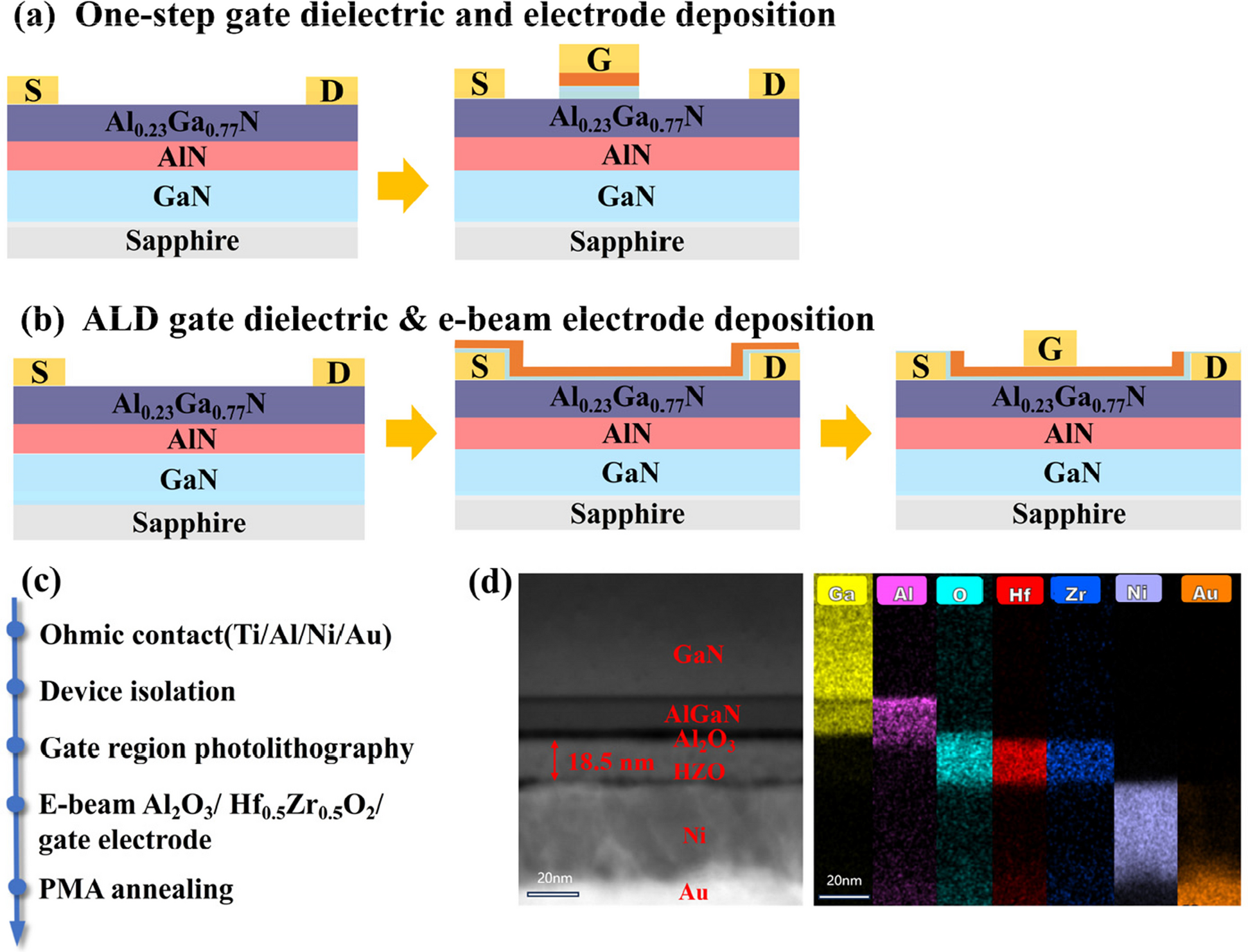
- One-step E-beam deposition of 2 nm Al2O3/20 nm HZO/Ni/Au (30/100 nm) gate stack on MOCVD-grown GaN HEMT (LG= 10 µm, WG= 110 µm) without breaking vacuum.
- Transfer characteristics yield Ion/Ioff = 108 and SS = 64.4 mV/dec.
Programmable Current Switching
- Pre-polarization voltages induce VTH shift from –2.14 V (negative poling) to –0.93 V (positive poling), total swing of 1.21 V.
- Saturation current IDS modulates from <100 mA/mm to 275 mA/mm; repeatable cycling between 50 mA/mm and 250 mA/mm over three cycles.
Mechanistic Insights
- Ferroelectric polarization charges couple with the 2DEG at the AlGaN/GaN interface, causing carrier accumulation (negative poling) or depletion (positive poling).
- Sheet carrier density nschanges from 5.73 × 1012 cm-2 (+5 V poling) to 9.68 × 1012 cm-2 (–10 V poling) via C–V measurements.
- Carrier mobility extracted from RSD–VGS linear fitting decreases from 1 947 cm²/(V·s) (positive poling) to 1 561 cm²/(V·s) (negative poling) due to electron-electron and polar optical phonon scattering.
Technological Implications
The findings directly enable:
- Integration of D-mode and E-mode HEMTs within a single architecture via VTH modulation.
- Programmable current-switching behavior for GaN-based logic circuits with non-volatile ferroelectric phase storage.
- Low-cost, CMOS-compatible fabrication alternative to ALD using E-beam evaporation.
Challenges and Future Directions
The work highlights the impact of ferroelectric polarization on electron transport at the AlGaN/GaN interface. Future integration should focus on further optimization of annealing conditions and gate stack thickness to enhance coupling efficiency.
Follow the Topic
Nanoengineering
Technology and Engineering > Biological and Physical Engineering > Nanoengineering
Materials Characterization Technique
Physical Sciences > Materials Science > Materials Characterization Technique
-
Moore and More
This is the first top-tier journal dedicated to Beyond Moore technology in the field of integrated circuit.