Unleashing Metasurfaces from Rigid Substrates: The OPTIMISM Approach for Universal Transfer and Inverse Design
Optical metasurfaces are usually bound to rigid, flat, and bulky substrates. The Omni-Purpose Transfer and Integration of Metasurfaces in Suspended Membranes (OPTIMISM) platform enables transfer onto diverse substrates and devices.
Published in Bioengineering & Biotechnology and Physics


Like
Be the first to like this

Key Experimental Findings
- Universal Fabrication: The OPTIMISM process is completely free from limitations regarding metasurface geometries, such as meta-atoms and nanoholes, or materials, including plasmonic, dielectric, and polymer structures.
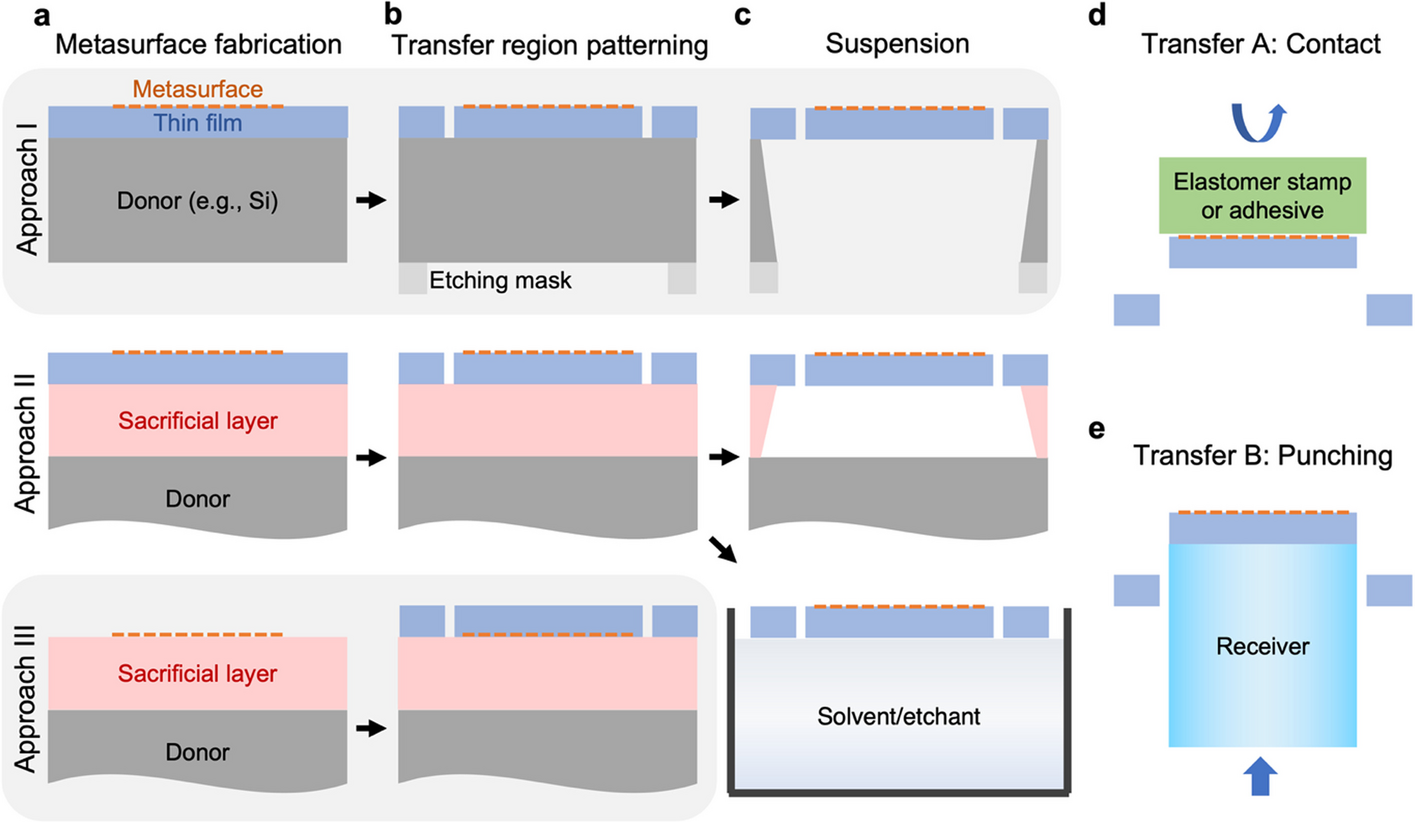
- Micro-Punching Transfer: A direct micro-punching process was developed to transfer suspended metasurfaces directly onto optical fiber tips without relying on intermediate carriers or adhesives.
- High Pattern Fidelity: Scanning electron microscopy confirmed that the structural integrity of the metasurfaces is highly preserved, with individual meta-atom positions matching perfectly before and after the transfer process.
Mechanistic Insights
- Membrane Suspension with Thin Connections: Metasurfaces are supported or embedded in membranes, which are released by etching sacrificial layers and then suspended with prepatterned thin tether connections. During the mechanical contact or punching process, pressure is strictly concentrated on the thin tether connections, allowing the tethers to break easily without damaging the core metasurface.
- Dielectric Environment Sensitivity: Systematic computational and experimental investigations revealed that high-aspect-ratio waveguide-type meta-atoms are robust, whereas ultrathin resonant meta-atoms are extremely sensitive to their surrounding refractive index.
- Leveraging Non-Local Interactions: Embedding metasurfaces in coating materials reduces the refractive index contrast and increases non-local interactions, which degrades standard forward design performance but can be effectively compensated for using inverse design strategies.
Technological Implications
- Meta-Optic Probes: Integrating metasurfaces directly onto optical fiber tips allows for the creation of compact meta-optic probes, which have broad applications in biomedical sensing and endoscopic imaging.
- High-Throughput Scalability: The micro-punching process is highly scalable; by combining metasurface arrays with optical fiber arrays, multiple integrations can be performed in parallel to achieve high-throughput manufacturing.
- Optimized Optical Efficiencies: By utilizing inverse design strategies, metasurfaces embedded in supporting/protective layers can achieve optical efficiencies that match or even exceed those of standard forward-designed metasurfaces exposed to air.
Challenges and Future Directions
- Scalable Manufacturingand Quantitative Evaluation: Future research must quantitatively assess critical manufacturing metrics, including mechanical stability, transfer yield, alignment accuracy, and batch-to-batch reproducibility.
- Biological Translation: For practical applications, the integrated meta-fibers need to be packaged with protective sheaths and strictly characterized in biological media.
- Algorithmic Enhancements: The inverse design capabilities can be further strengthened by developing and integrating novel machine learning and topology optimization algorithms.
Conclusion
The metasurfaces in suspended membranes (MISM) platform, driven by the OPTIMISM technology, offers a universal toolkit for highly flexible, scalable metasurface integration. By combining this advanced transfer approach with intelligent inverse design, researchers are well-positioned to drive the next generation of highly integrated optical devices and meta-probes.
Follow the Topic
Photonics and Optical Engineering
Technology and Engineering > Biological and Physical Engineering > Photonics and Optical Engineering
Biomedical Engineering and Bioengineering
Technology and Engineering > Biological and Physical Engineering > Biomedical Engineering and Bioengineering
Optics and Photonics
Physical Sciences > Physics and Astronomy > Optics and Photonics
-
Moore and More
This is the first top-tier journal dedicated to Beyond Moore technology in the field of integrated circuit.