From Shadow to Spotlight: Dequenching the Quenched Fluorescence with Cryosoret Nanoassembly and Photonic Crystal Technologies
Published in Materials






The Problem with Quenching: Distance Matters
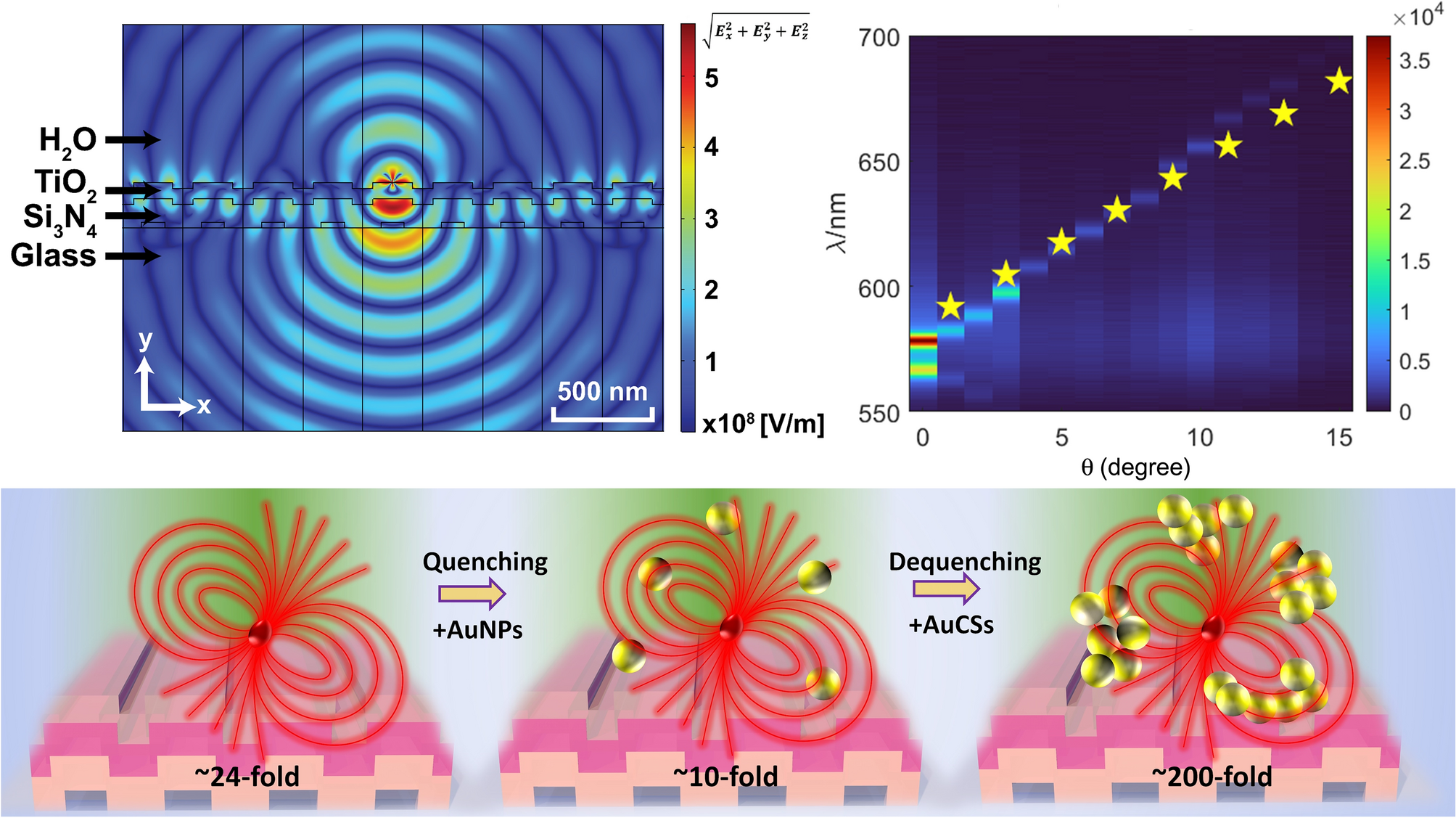
In the world of plasmonics and photonics, a delicate balance must be struck between light emitters and nanoparticles. The closer the emitter is to a gold nanoparticle, the stronger the quenching effect becomes. It’s like trying to hear a whisper in a noisy crowd: if you’re too close to the source, the noise overwhelms the sound; if you’re too far, you can’t hear it at all. The challenge lies in finding that sweet spot—a distance where fluorescence is enhanced without being buried under the shadow of quenching.
The Cryosoret Solution: "Unity We Stand, Divided We Fall"
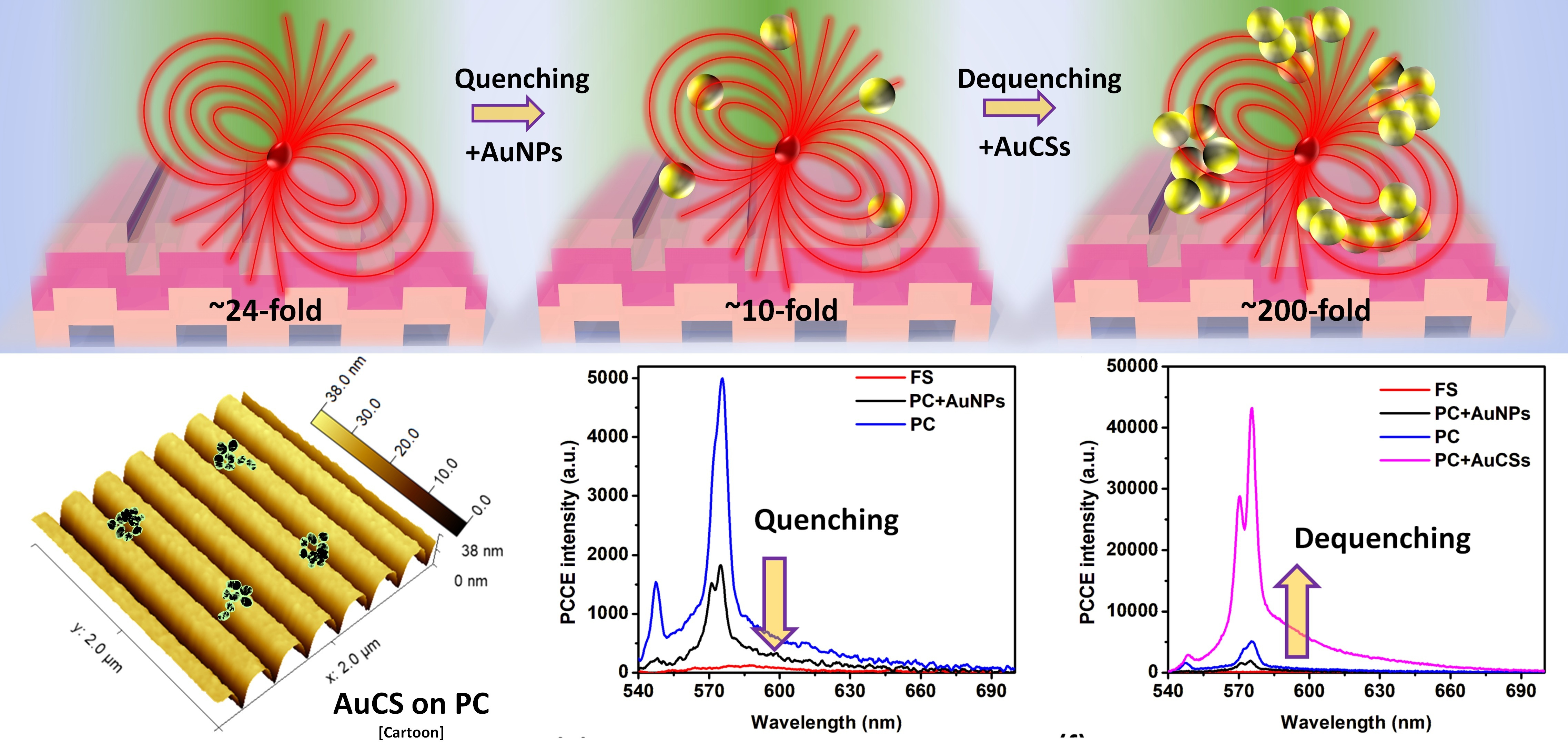
However, overcoming this challenge isn’t as simple as just pushing the emitter further away. This is where the idea of “unity” becomes important. Just as individuals come together to create something greater than the sum of their parts, nanoparticles, when assembled together, form a structure that amplifies the fluorescence signal rather than competing with it. This concept led to the creation of cryosorets—nanoassemblies made by subjecting gold nanoparticles to ultra-cold temperatures, using liquid nitrogen to arrange them into perfectly structured assemblies.
This is a bit like a group of people trying to speak with one voice. When you bring people together—like particles—they can combine their strengths. But if you separate them too much, they lose that collective power. In the case of cryosorets, the gold nanoparticles, when cooled under controlled conditions, form tight-knit assemblies that don’t just hold their ground but actively boost the fluorescence signal. These assemblies create nano-gaps, or "hotspots," where the electromagnetic fields are intensely concentrated—think of these as little suns that help the fluorescent molecules shine brighter than ever before.
As the temperature drops, the nanoparticles migrate and settle into these nanoassemblies, where the localized electromagnetic fields at the nano-gaps help the emitter molecules shine, overcoming the quenching (shadowing) effect that normally occurs when particles are too close. The result is not only the elimination of quenching but also an augmentation of the fluorescence signal, up to 200 times stronger than before.
The Power of Photonic Crystals: More Than Just Fancy Gratings
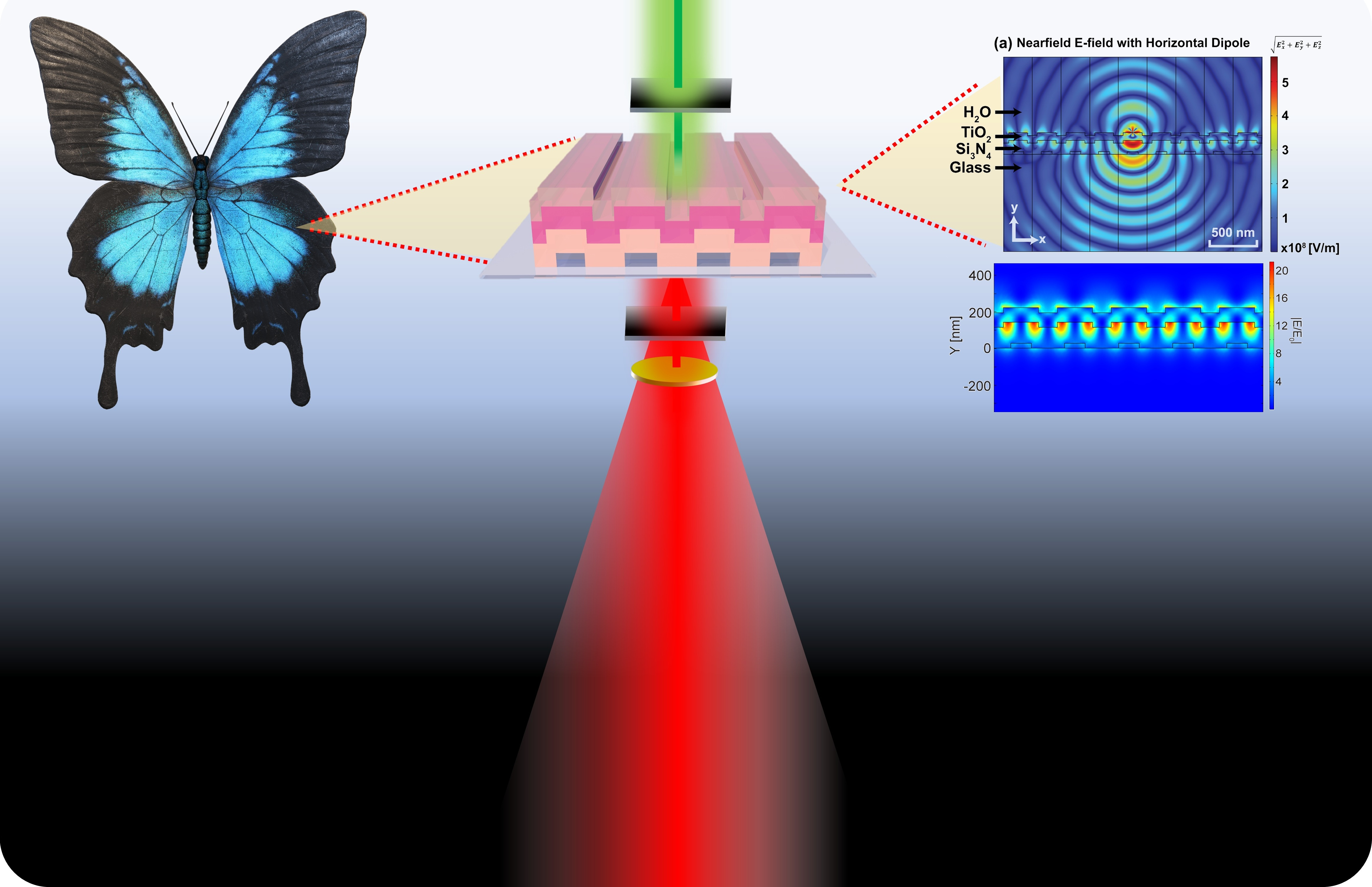
But we didn’t stop there. While cryosorets were the key to dequenching the signal, we still needed a way to guide and direct this enhanced light. This is where photonic crystals come play a key role. These are not just “fancy gratings” - they are the secret to making light behave in controlled ways. Imagine trying to send a message across a vast, noisy room: without the right technology, the message might get lost. But with photonic crystals, the light is guided precisely along the path we want it to travel, ensuring that the fluorescence signal is both strong and efficiently captured.
In our work at the University of Illinois, at Prof. Cunningham’s Nanosensors lab, Dr. Bhaskar combined the power of cryosorets with photonic crystal substrates to create a system that could direct and amplify fluorescence, in collaboration with simulation and experimental experts: Leyang Liu, Weinan Liu and Joseph Tibbs. The photonic crystal substrates are manufactured in a way that allows them to regulate various properties of light, such as diffraction, refraction, polarization, and interference to name a few. These properties work in synchronized fashion to ensure that the fluorescence emitted by the molecules is not only enhanced but also perfectly directed.
The photonic crystals help steer the fluorescence, ensuring it doesn't scatter in all directions. This ability to guide light is essential for improving the efficiency of fluorescence-based detection technologies, where every photon counts.
Humans Talking to Molecules: A Real-World Analogy
Now, imagine a scenario where we, as humans, are trying to communicate with molecules or even bacteria. Although humans can talk to each other, and we can even communicate with animals to some extent, the same is not true for molecules or microorganisms. It’s as though we’re trying to talk to creatures that are too small to hear our voices. Molecules, bacteria, and even the smallest particles in our environment operate on scales far beyond the reach of our traditional senses. That’s where the power of photons, nano-engineering, and technologies like cryosorets and photonic crystals come into play.
With the help of photons—light particles—we can interact with these tiny entities and detect their presence, much like trying to amplify our voice so that even the smallest organisms can hear us. In our research, we use nanomaterials and photonic crystals to make it possible for us to “speak” with molecules, enabling us to detect biological markers for diseases, environmental contaminants, and even trace chemicals in the human body. Yes, materials at nanoscale help us to break the ‘diffraction limit’ barrier and talk to molecules.
Real-World Impact: From Cancer Diagnostics to Environmental Sensing
This research has far-reaching implications, especially in biosensing applications. For instance, we’re already exploring how this technology can be used to detect cancer biomarkers at early stages, when the disease is still at its most treatable. It could also be used to detect hazardous chemicals in drinking water, or even to monitor vital analytes like dopamine, which plays a crucial role in numerous physiological processes. This could lead to more efficient, accurate, and affordable diagnostic tools that can be used at the point of care—anywhere, anytime.
Conclusion
In this research published in MRS Bulletin, by leveraging the power of cryosorets and photonic crystals, we’ve found a way to not only overcome one of the biggest challenges in fluorescence enhancement but also to open up new possibilities for medical diagnostics, environmental monitoring, and beyond. Through these advances, we’re bringing the unseen closer, allowing us to communicate with molecules in ways we never thought possible. Dr. Bhaskar thanks the immense support provided by Carl R. Woese Institute for Genomic Biology, Nick Holonyak Micro and Nanotechnology Laboratory, Materials Research Laboratory, Department of Electrical and Computer Engineering, University of Illinois Urbana-Champaign.
Follow the Topic
-
MRS Bulletin
This journal publishes the latest research advances, topical reviews, opinion and perspectives, and tutorial-style overviews on subjects in interdisciplinary materials research.