From Waste to Resource: Rethinking Urban Futures through Innovative Solid Waste Management
Published in Social Sciences, Earth & Environment, and Sustainability

Cities today are at a crossroads. Rapid urbanisation, changing consumption patterns, and rising populations have led to an unprecedented surge in solid waste generation. What was once considered a local municipal issue has now evolved into a global sustainability challenge—one that directly impacts public health, environmental quality, and urban resilience.
Our recent work, “Emerging Techniques of Solid Waste Management for Sustainable and Safe Living Environment”, published as part of the Sustainable Development Goals Series, explores how innovative waste management practices can reshape the future of cities.
What Inspired This Research?
The motivation behind this study stems from a simple yet pressing question:
Can waste be transformed from an environmental burden into a valuable resource?
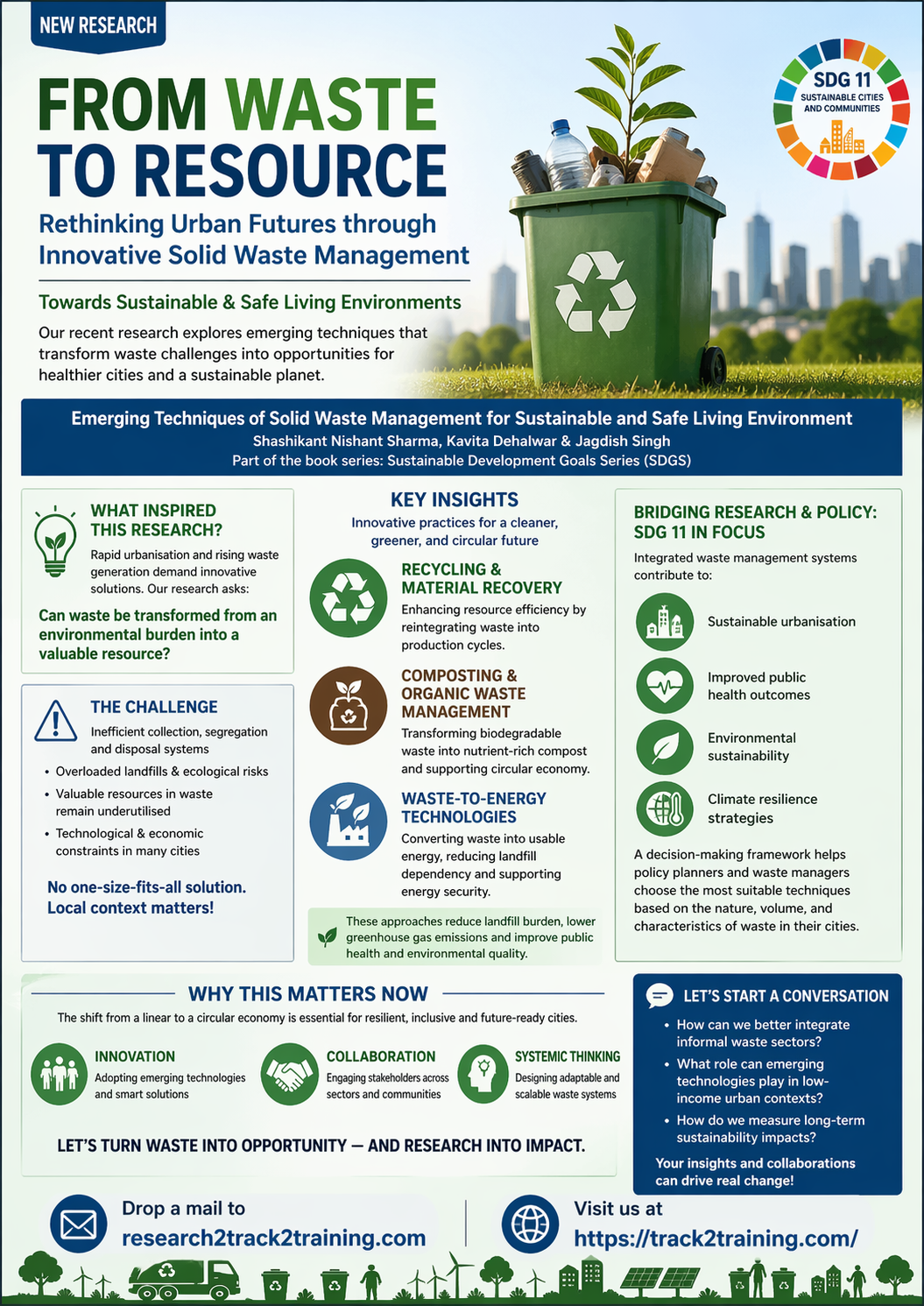
In many developing regions, including rapidly growing urban centres in India, traditional waste management systems struggle with inefficiencies in collection, segregation, and disposal. Landfills continue to expand, often encroaching upon valuable land and posing serious ecological risks. At the same time, valuable materials embedded in waste streams remain underutilised.
This contradiction inspired us to explore emerging techniques that go beyond conventional systems and align with the broader vision of sustainable urban development.
Key Insights from Our Study
Our research systematically examines the full cycle of solid waste management—collection, transportation, treatment, and disposal—while focusing on innovative and sustainable interventions:
-
Recycling and Material Recovery
Enhancing resource efficiency by reintegrating waste into production cycles. -
Composting and Organic Waste Management
Transforming biodegradable waste into nutrient-rich compost, supporting circular economy practices. -
Waste-to-Energy Technologies
Converting waste into usable energy, reducing landfill dependency and contributing to energy security.
These approaches not only reduce the volume of waste sent to landfills but also significantly lower greenhouse gas emissions and improve urban environmental health.
Bridging Research and Policy: SDG 11 in Focus
A central contribution of this work is its alignment with Sustainable Development Goal 11 (Sustainable Cities and Communities). The research highlights how integrated waste management systems can:
- Promote sustainable urbanisation
- Improve public health outcomes
- Enhance environmental sustainability
- Support climate resilience strategies
Importantly, the study provides a decision-making framework for policymakers and urban planners, helping them select context-specific waste management solutions based on the nature, volume, and characteristics of waste in their cities.
Challenges We Encountered
Like many interdisciplinary studies, this research required navigating several challenges:
- Data variability across cities
- Technological feasibility in resource-constrained settings
- Balancing environmental benefits with economic viability
These challenges reinforced a key lesson: there is no “one-size-fits-all” solution in solid waste management. Local context matters—and successful systems must be adaptable, inclusive, and scalable.
Why This Matters Now
As cities continue to expand, the urgency to adopt sustainable waste management practices has never been greater. The transition from a linear to a circular economy is no longer optional—it is essential.
This research aims to contribute to that transition by offering both theoretical insights and practical guidance for stakeholders across academia, governance, and industry.
Let’s Start a Conversation
Research should not remain confined to journal pages—it should spark dialogue, inspire innovation, and inform action.
I invite fellow researchers, practitioners, and policymakers to engage with this work:
- How can we better integrate informal waste sectors into formal systems?
- What role can emerging technologies play in low-income urban contexts?
- How do we measure the long-term sustainability impacts of these interventions?
Looking Ahead
The future of waste management lies in innovation, collaboration, and systemic thinking. By reimagining waste as a resource, we can move closer to building cities that are not only cleaner, but also more resilient and equitable.
If you are working in related areas or interested in collaboration particularly at the intersection of urban planning, sustainability, and emerging technologies I would be glad to connect and explore ideas further. Drop a mail to research2track2training.com Visit us at https://track2training.com/
References
Sharma, S.N., Dehalwar, K., Singh, J. (2024). Emerging Techniques of Solid Waste Management for Sustainable and Safe Living Environment. In: Nasr, M., Negm, A. (eds) Solid Waste Management. Sustainable Development Goals Series. Springer, Cham. https://doi.org/10.1007/978-3-031-60684-7_3
Kumar, G., Vyas, S., Sharma, S. N., & Dehalwar, K. (2024). Challenges of environmental health in waste management for peri-urban areas. In M. Nasr & A. Negm (Eds.), Solid waste management (pp. 149–168). Springer Nature Switzerland. https://doi.org/10.1007/978-3-031-60684-7_9
Don Eliseo Lucero-Prisno III,Dauda Ayuba Sr.,Anna Yunana Akinga,Kolawole Emmanuel Olayinka,Fadele Kehinde Precious,Jerico Bautista Ogaya,Shashikant Nishant Sharma,Eda J. Opina,Abraham Fessehaye Sium,Carina Joane V. Barroso,Lin Xu,Ryan C. Guinaran,Jannet Bondad,M.B.N. Kouwenhoven (2025). Impact of climate disaster, migration and health risk on food security in Africa. In Advances in food security and sustainability. Elsevier. https://doi.org/10.1016/bs.af2s.2025.08.003
Ogbanga, M. M., Sharma, S. N., Pandey, A. K., & Singh, P. (2025). Artificial intelligence in social work to ensure environmental sustainability. In M. Nasr, A. Negm, & L. Peng (Eds.), Artificial intelligence applications for a sustainable environment (pp. 1–??). Springer. https://doi.org/10.1007/978-3-031-91199-6_16
Sharma, S. N., Dehalwar, K., & Singh, J. (2024). Emerging techniques in solid waste management for a sustainable and safe living environment. In M. Nasr & A. Negm (Eds.), Solid waste management (pp. 29–51). Springer Nature Switzerland. https://doi.org/10.1007/978-3-031-60684-7_3
Sharma, S. N., Dehalwar, K., Jain, S., & Pandey, A. K. (2025). An assessment of the applications and prospects of AI tools in solid waste management. In M. Nasr, A. Negm, & L. Peng (Eds.), Artificial intelligence applications for a sustainable environment. Springer. https://doi.org/10.1007/978-3-031-91199-6_4
Sharma, S. N., Lodhi, A. S., Dehalwar, K., & Jaiswal, A. (2024). Life cycle assessment of recycled and secondary materials in the construction of roads. IOP Conference Series: Earth and Environmental Science, 1326(1), 012102. https://doi.org/10.1088/1755-1315/1326/1/012102
Sharma, S. N., Prajapati, R., Jaiswal, A., & Dehalwar, K. (2024). A comparative study of the applications and prospects of self-healing concrete / biocrete and self-sensing concrete. IOP Conference Series: Earth and Environmental Science, 1326(1), 012090. https://doi.org/10.1088/1755-1315/1326/1/012090
Sharma, S. N., Singh, S., Kumar, G., Pandey, A. K., & Dehalwar, K. (2025). Role of green buildings in creating sustainable neighbourhoods. IOP Conference Series: Earth and Environmental Science, 1519(1), 012018. https://doi.org/10.1088/1755-1315/1519/1/012018
Sharma, S. N., Dehalwar, K., Singh, J., & Kumar, G. (2025). Prefabrication building construction: A thematic analysis approach. In S. B. Singh, M. Gopalarathnam, & N. Roy (Eds.), Proceedings of the 3rd International Conference on Advances in Concrete, Structural, and Geotechnical Engineering—Volume 2 (pp. 405–428). Springer Nature Singapore. https://doi.org/10.1007/978-981-96-0751-8_28
Shashikant Nishant Sharma is a distinguished scholar and practitioner in the field of development studies, widely recognised for his contributions to planning, management, and sustainable development. Having a B Plan from SPA Delhi, MURP from IIT Roorkee, PGDDM from IGNOU Delhi and a PhD from MANIT Bhopal, India, has wide educational exposure. He is the author of 20 books that critically engage with issues of urban planning, policy, sustainable development and governance. Currently, he serves as the Head of Research at Track2Training, an NGO he co-founded to advance training, capacity building, and skill development initiatives. He has also contributed to academia as an Assistant Professor at NIT Calicut and as a Guest Faculty at UPES Dehradun, where he taught and mentored future professionals. His work bridges the gap between academic research and practice, making him a prominent voice in contemporary development discourse.
Follow the Topic
What are SDG Topics?
An introduction to Sustainable Development Goals (SDGs) Topics and their role in highlighting sustainable development research.
Continue reading announcement