Gain-controlled broadband tuneability in self-mode-locked Thulium-doped fibre laser
Published in Physics


For somewhat fifteen years now, carbon nanotubes, graphene, transition metal dichalcogenides and similar few-layer material saturable absorbers have promised us to overcome the deficits of costly semiconductor saturable absorber mirrors on one side and lab-bound nonlinear polarisation evolution on the other side. The mentioned saturable absorbers are an inevitable part to mode-lock laser oscillators. Unfortunately, they are also one of the bottlenecks restraining design flexibility, energy endurance and performance scaling. On their most critical parameter, low damage threshold and degeneration, these few-layer materials appear to barely progress in recent times, which is underpinned by the fact that they have not gained acceptance into industrial products; except for one start-up [1]. Contrarily, conventional saturable absorbers are either laborious free-space-coupled to the fibre, involve sophisticated cavity structures, or are environmentally sensitive.
However, owing to unique applications in biological and chemical analysis, medicine or semiconductor and polymer machining, the market for ultrafast lasers in the spectral range of 2 µm and beyond in the mid-infrared has grown rapidly. What is desirable for non-technical users in the field is portable turnkey integration. This calls for a so-called all-fibre design with virtually maintenance-free, robust operation in a small footprint. At the same time, the supply of fibre-integrated components for these spectra is sadly very meagre to vanishing.
When we were confronted with this riddle while searching for opportunities to reduce fragility, space and costs, we came across the idea of self-mode-locking. This term relates to a case where the ultrashort pulse generation emerges without a clear saturable absorber in the oscillator. Following some inquiry into self-mode-locking, we found it can have some disparate foundations, among them intermode beating, modulation instabilities or nonlinear coupling between e.g. two cores [2,3,4]. The multitude of ways to bypass a classical saturable absorber is astonishing, even though many methods receive so little attention and some have been reported only once.
The phenomenon of nonlinear saturable absorption in rare-earth-metal-doped silica fibres aroused particular interest in us, as it makes up a genuine fibre format saturable absorber that comes with the impressive damage threshold of silica. On the downside, earlier contributions observed it to have only a weak effect. They required a high amount of self-phase-modulation for mode-locking, leading to longish picosecond pulses and a slow repetition rate. In a dialogue with a colleague, it emerged that a problem for the production of highly doped rare-earth-metal-doped fibres is that they bundle in clusters instead of distributing homogeneously in the silica matrix. As a consequence, in place of the much-desired effect of cross-relaxation, other inhomogeneous upconversion processes, including a process called energy-transfer upconversion, occur more frequently. It came about several articles argue that the saturable absorption in doped fibres may well be originated from this energy-transfer upconversion, yet the subject is still intensively discussed [5,6,7]. Obviously, the idea arose to deliberate incorporate clusters into the Thulium:fibre to reinforce self-mode-locking—unexpectedly, no earlier reports on this subject have been discovered. It gave the impression of an attractive chance to revive such fibres that had been discarded as inadequate for laser applications owing to an excessive amount of clusters.
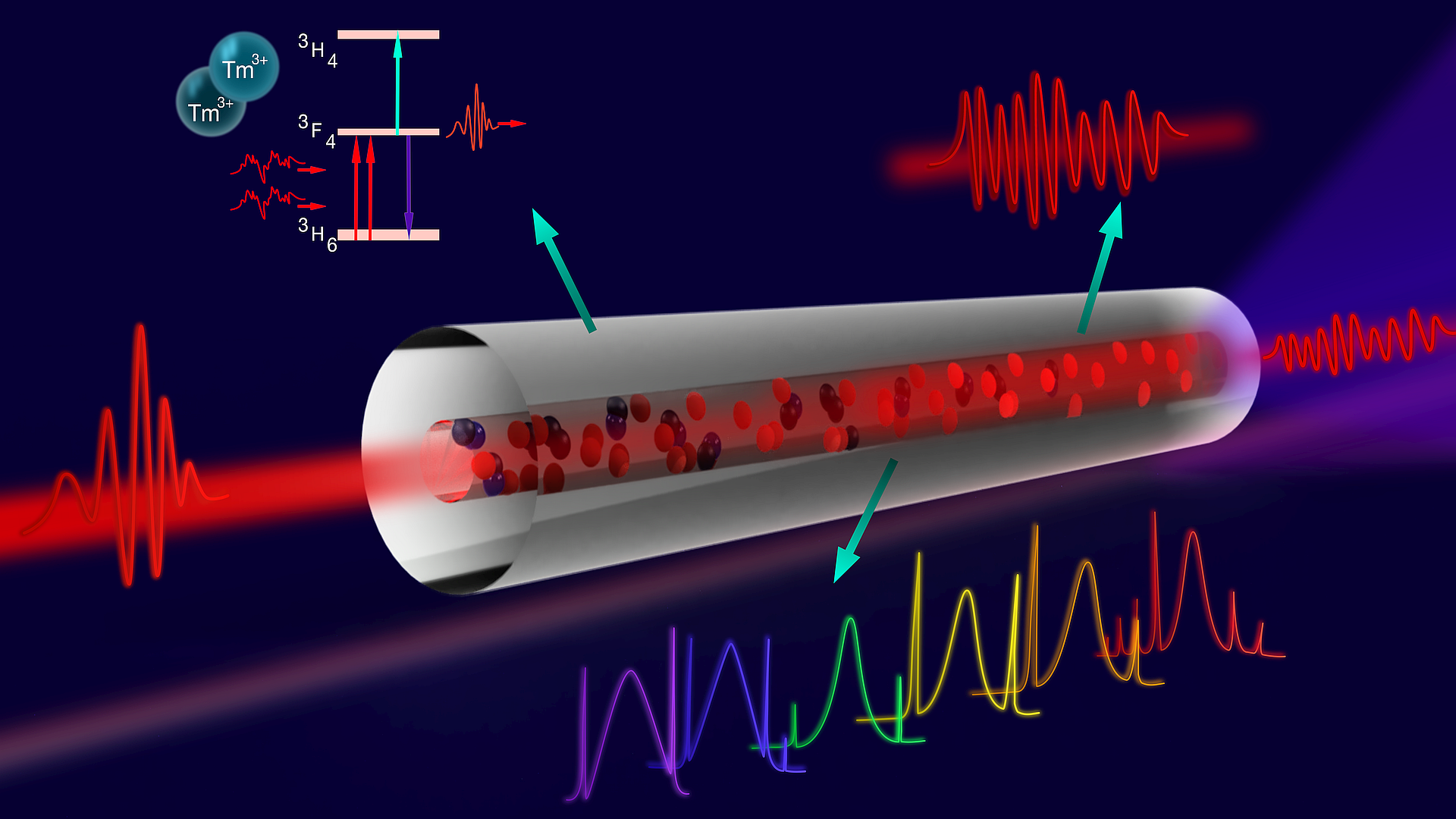
Accordingly, in our resultant article "Gain-controlled broadband tuneability in self-mode-locked Thulium-doped fibre laser” we propose a different way to potentially remediate the long-lasting insufficiencies mentioned above. In detail, we waive such prone material saturable absorbers completely in favour of dear old doped silica fibre. The absence of this weak point will make the laser possibly more resilient and more economical anyhow. In order to test our hypothesis, we established cooperation between Leibniz-IPHT, French company “iXblue Photonics”, providing highly doped fibres, and the Institute of Photonics and Electronics of the Czech Academy of Sciences in Prague, whose fibre characterisation equipment aided us.
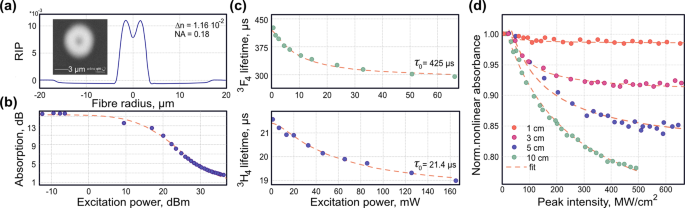
Given this background, the saturable absorption effect has been investigated in two different glass matrices. We conducted fluorescence lifetime, non-saturable and nonlinear absorption measurements and corroborated them with simulations, drawing insightful conclusions about the saturation level, gain, and glass matrix. Our results reveal how the doping concentration of rare-earth ions and their distribution in a glass matrix influence the resulting saturable absorption properties. When 20% of the Thulium ions are clustered, the modulation depth can reach a remarkable 23%, as can be seen in Figure 1 a.
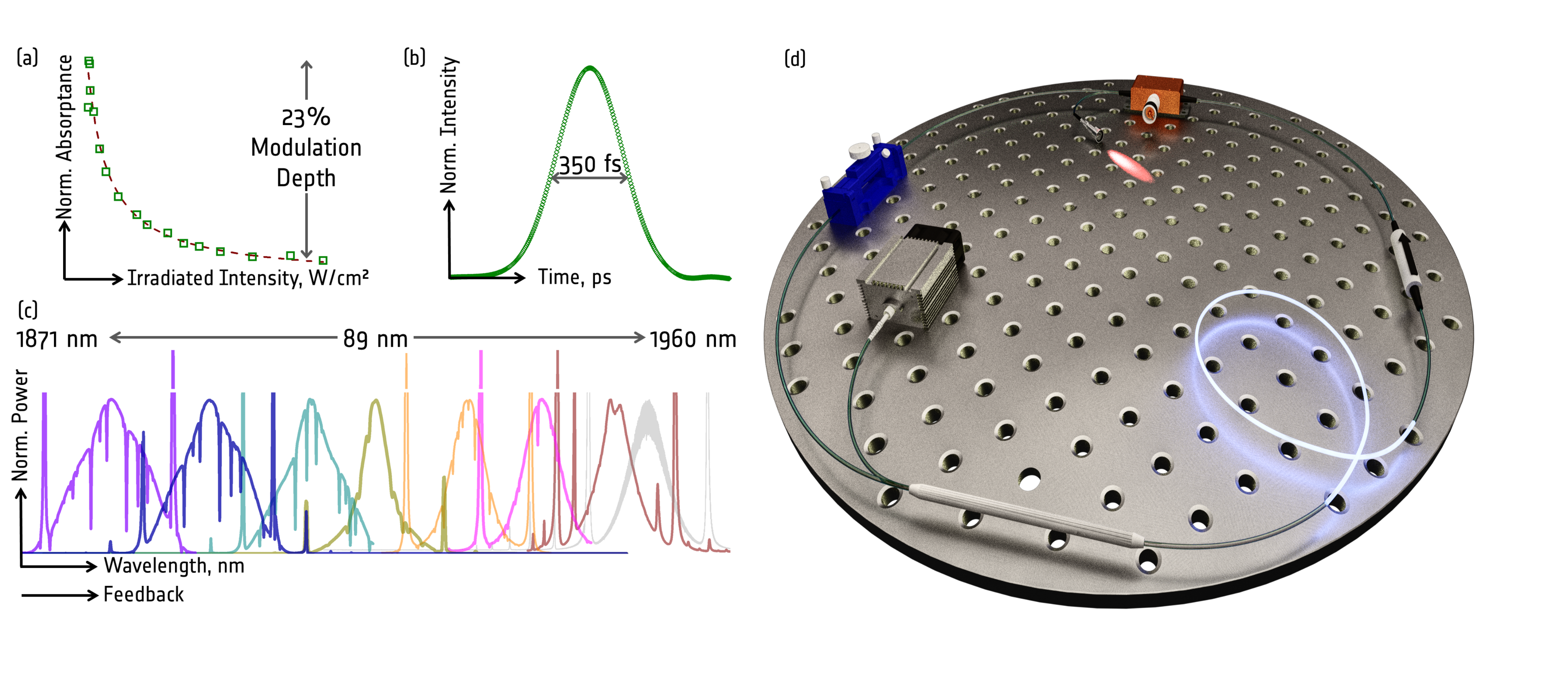
Ultimately, we could accomplish an oscillator (Figure 2 d) undercutting the previously observed pulse duration by almost a magnitude. By proper balancing between the length of excited and unexcited active fibres and cavity dispersion, a yet unique pulse duration and repetition rate are presented. Thus, self-mode-locking now represents a convenient solution featuring cost-efficiency and simplicity, while delivering decent values reading 350 fs pulse duration, 45 MHz repetition rate and 80 mW average powers (Figure 1 b-c).
I would like to share forthright our concern about nonlinear polarisation evolution, which was the most frequent question of reviewers and during conference presentations. Intuitively, one may suspect nonlinear polarisation evolution may contribute in some manner to mode-locking in our oscillator. But looking at standard nonlinear polarisation evolution mode-locked Thulium:fibre lasers based on standard silica fibres, a well-known disadvantage at 2 µm is that several dozen metres of fibres are needed to accumulate enough nonlinear shift to initiate mode-locking. We are confident that, in our oscillator, there are no structures gaining such a polarisation-dependent loss. Beyond that, the used isolator of course is polarisation-insensitive, as all deployed elements and fibres also are. To confirm this, we have inspected the nonlinear saturable absorption properties of the different lengths of the active fibre and no mode-locking was possible with shortening the Thulium:fibre by only 3 cm. Hence, we can firmly say that the active fibre is solely responsible for mode-locking and that nonlinear polarisation evolution does not affect our oscillator.
Another tenacious shortfall of all-fibre lasers has always been their narrow spectral tuneability since conventional all-fibre tuning approaches rely on the prone to damage fibre’s strain or not environmental steady birefringence effects. This obstacle has brought forward some elaborated strategies such as active chip-waveguide Mach-Zehnder modulators or exhausting fibre Bragg grating arrays.
To further streamline our design, we, for the first time, have combined the straightforward self-mode-locking technique with a tuneability approach that gets along without a spectral filter. This makes our demonstrated oscillator lean and nifty in two aspects: neither a spectral filter nor a saturable absorber has to be implemented as an extra component. Simply by means of an alteration of the excitation level of the active medium, it was possible to realise nearly 90 nm tuneability from 1870 to 1960 nm - this outperforms the present stat-of-the-art for the used technique by 180%.
On the bottom line, the demonstrated broadly tuneable ultrafast laser proves that complex conventional mechanisms of mode-locking and wavelength shifting may in some businesses be omitted in favour of the presented simpler approaches. These approaches may render not only low-cost, miniaturised, all-fibre integrated Thulium:fibre lasers but may also stimulate the field of mid-infrared oscillators when applied with other (quasi-)three-level active media. It will be furthermore intriguing to assess these approaches with other pulse evolution regimes, such as normal dispersion dissipative soliton and to develop an all-polarisation-maintaining oscillator.
[1] KPhotonics LLC, https://kphotonics.com
[2] Zhang, J. et al. Intermode beating mode-locking: toward compact 2 μm shortpulse all-fiber lasers. Opt. Fiber Technol. 58, 102253 (2020).
[3] Nakazawa, M. et al. The modulational instability laser. I. Experiment. IEEE journal of quantum electronics 25.9, 2036-2044 (1989).
[4] Winful, H. et al. Passive mode locking through nonlinear coupling in a dual-core fiber laser. Optics letters 17.23, 1688-1690 (1992).
[5] Jackson, S. D. Direct evidence for laser reabsorption as initial cause for self-pulsing in three-level fibre lasers. Electronics Letters 38.25, 1 (2002).
[6] Sanchez, F. et al. Effects of ion pairs on the dynamics of erbium-doped fiber lasers. Physical Review A 48.3, 2220 (1993).
[7] El-Sherif, A. F. et al. Dynamics and self-pulsing effects in Tm3+-doped silica fibre lasers. Optics communications 208.4-6, 381-389 (2002).

Follow the Topic
-
Communications Physics
An open access journal from Nature Portfolio publishing high-quality research, reviews and commentary in all areas of the physical sciences.

Related Collections
With Collections, you can get published faster and increase your visibility.
Nonlinear dynamics of living systems
Publishing Model: Open Access
Deadline: Nov 09, 2026
Active, Entangled or Confined: Polymer Physics Across Synthetic and Living Matter
Publishing Model: Open Access
Deadline: Dec 31, 2026