Gender differences in the association between discrimination, mental health, and peer support among ethnic/racial minority adolescents
Published in Social Sciences and Behavioural Sciences & Psychology


Behind the Paper: Gender differences in the association between discrimination, mental health, and peer support among ethnic/racial minority adolescents
The Positives of Peers & the Detriments of Discrimination: Combining Prior Bodies of Work
It is fitting that my story on peer research begins with an experience with my own peers. It is no surprise that when you are navigating graduate school, leaning on peers (others who share in your experience and can relate to your struggles) is a major source of support. So when one of my peers reached out to me to present research at a symposium on peers and discrimination, I knew I had to accept.
My research interest in peers and adolescent development originated with my Master's Thesis, where I explored the role of peer ethnic/racial composition on ethnic/racial identity. What I found was that both same-race friendships and diversity of friendships were both promotive of ethnic/racial identity development in different ways. More same-race friends were associated with greater ethnic/racial identity in the same year, whereas diverse friendships during the transition to high school were associated with faster increases in ethnic/racial identity throughout high school. Although this was a great first step in my research interests, I wanted to go deeper then just what peers looked like and moved toward the question of how protective peers can be.
In addition to the growing reliance on peer support, the teenage years can also be marked by increasingly complex social dynamics. Discrimination, experiences of differential or unfair treatment based on a social characteristic or identity, can unfortunately persist among teenagers and is an especially detrimental health risk for ethnic/racial minority adolescents. I had conducted prior research on discrimination, focusing particularly on how discrimination among ethnic/racial minority adolescents can "get under the skin" and compromise physical health behaviors such as sleep. However, I had done less work that explored the potential factors that could protect against the negative health consequences of discrimination. Thus, this paper began as a combination of two of my areas of prior knowledge in the adolescent literature: the important role of peers and the detrimental effect of discrimination.
Gender Differences: The Missing Link
As I reviewed the literature, I found that the protective effect of peer support against discrimination was mixed-- there did not seem to be a consensus on how effective peers were in buffering the negative impact of discrimination on mental health outcomes. Another stark gap emerged to me, which was that very few researchers had explored whether or not this effect may differ by gender.
As a man myself, it was clear to me that this was a major gap, since traditional gender norms continue to have an influence not only on the way men and women experience discrimination, but also on the way they offer and receive support in their friendships. I had just finished reading The Will to Change by bell hooks, where she discusses the role of patriarchy shaping men's understanding of relationships. Traditional, patriarchal gender norms emphasize men as being more independent and less emotional compared to women, and the pressure to conform to these norms can feel especially pronounced during the teenage years (see "gender intensification hypothesis"). Thus, I set out to explore how more peer support would influence the association between discrimination and mental health, and whether or not this varied between adolescent boys and girls.
Initial Successes... and Initial Challenges
As expected, there were negative associations between reports of discrimination and reports of mental health one year later. Ethnic/racial minority adolescents who reported experiencing more discrimination in their first fall semester also reported greater levels of depression, anxiety, rumination, as well as lower levels of self-esteem in the the following fall semester. This supported my hypothesis and was consistent with the literature.
But then an interesting null finding emerged when I tested peer support as a protective factor. In my sample, peer support had no effect on the association between discrimination and mental health. In other words, discrimination was detrimental for mental health, and whether or not you had more peer support did not seem to change this. Though this was not entirely inconsistent (remember that the findings on the protective effect of peer support were mixed), it led me to question whether there was an issue with my data or measurement. Maybe the way we measured peer support was imperfect? Maybe our limited sample from NYC was not representative of the general adolescent population? Nonetheless, I moved on to the final aim of my study-- exploring gender differences-- which proved to be an illuminating process.
Peer Support for Self-Esteem: Good for Girls...but Bad for Boys?
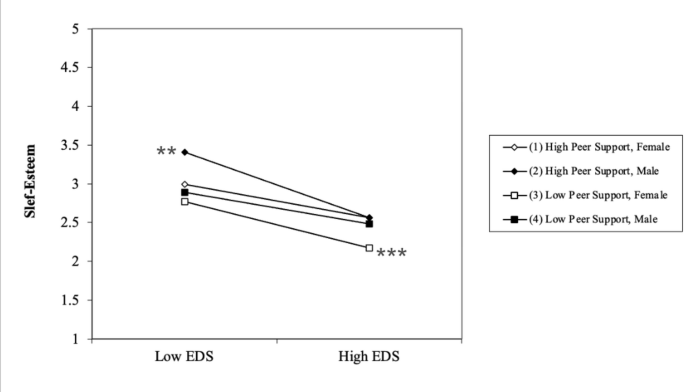
Exploring this association by gender turned out to be a major contribution. A surprising finding emerged when exploring the association between discrimination and self-esteem. For girls, more peer support was protective for self-esteem when faced with discrimination. However, for boys, more peer support was a risk factor for self-esteem when faced with discrimination.
This contradictory and opposing pattern was likely why peer support had no effect when looking at the full sample. Because they functioned in opposite directions, the results for boys and girls essentially cancelled each other out. Moreover, the findings were consistent with theories on gender norms. Though follow-up research is needed, it is likely that adolescent girls emphasize peer support as a source of emotional closeness and personal disclosure, which may explain why peer support was especially protective for girls who experience discrimination. In contrast, boys may emphasize peer support as a validation of social status or character that is closely tied to self-esteem, which may explain why boys who are accustomed to peer support may be especially susceptible to the detriments of experiencing discrimination, which is inherently a threat to one’s identity and status.
The Takeaway
I was fortunate enough to present these findings with other academic peers. After the symposium, one member of the audience spoke with me and expressed that they did not appreciate my finding that peer support "wasn't effective" in combatting the harms of discrimination. We went on to have a good conversation, and I elaborated that the null finding was explained by the fact that the sample hadn't teased apart the differences in gendered experiences. I didn't blame the audience member-- I and many others fall into the trap of disappointment when seeing a null finding that doesn't go our way. But this null finding ultimately led to a more interesting story to tell, one that continues to highlight the importance of disaggregating our findings. If your results don't seem to align with your expectations, it may be worth seeing if the differences emerge when you factor in gender. Research continues to unravel interesting gender differences in complex, developmental processes, though there is still more work to be done.
If researchers want to uncover hidden realities and better represent the lived experiences of communities, then they too must have the will to change.

Follow the Topic
-
Discover Mental Health
This is an international, open access journal that publishes research across the transdisciplinary field of mental health research.

Related Collections
With Collections, you can get published faster and increase your visibility.
Gender and Psychosocial Factors in Mental Health: Rethinking Determinants, Experiences, and Outcomes
This collection examines the complex interplay between gender and psychosocial factors in shaping mental health across diverse populations. Giving equal attention to both domains, it brings together empirical and theoretical contributions from psychology, psychiatry, public health, and the social sciences to analyze how gender norms, identities, roles, and inequalities intersect with psychosocial dimensions such as social support, stigma, stress, violence, work and family conditions, and broader structural determinants. Adopting intersectional perspectives and context-sensitive methodologies, the contributions seek not only to document how gendered arrangements and psychosocial contexts jointly contribute to mental health disparities, but also to identify protective processes and promising avenues for prevention and intervention. In doing so, this collection aims to advance a more integrated and nuanced understanding of how gender and psychosocial factors influence mental health experiences and to inform policies and practices that promote equity and well-being.
Submissions are welcome on mental health in relation to gender and/or psychosocial factors across diverse populations and settings. We particularly encourage contributions that adopt a gender perspective, an intersectional approach, or other critical frameworks that illuminate how social positions, identities, and contexts shape mental health outcomes, access to care, and experiences of distress and well-being. Empirical, theoretical, and methodological articles that advance understanding of these issues or offer innovative insights with clear implications for research, practice, or policy will be considered especially relevant for this Collection.
These are some suggested, though by no means exhaustive, thematic lines and study designs for contributions. Submissions may, for example, address: (1) gender norms, roles, and systemic imbalances in relation to common psychological problems and health; (2) how gender interacts with other social locations such as sexual orientation, ethnicity/race, disability, migration, and chronic illness; (3) psychosocial processes including stigma, social support, caregiving, work–family balance, discrimination, and stress/trauma; and (4) implications for prevention, clinical practice, and policy (e.g., gender-transformative interventions, workplace or educational policies, etc.). We particularly welcome longitudinal and cross-sectional empirical studies, qualitative and mixed-methods research, intervention or implementation studies, and theoretical or model papers that address a wide range of determinants (e.g., gendered labor, caregiving, stigma, minority stress, chronic illness, body image, sexuality, etc.). However, other innovative and relevant proposals that fall within the broader scope of gender and mental health are also highly encouraged.
Keywords:
Gender; Mental Health; Psychosocial Factors; Well-being
Publishing Model: Open Access
Deadline: Dec 31, 2026
Mental Health Inequities and Disparities: Behavioral Pathways, Intervention Targets, and Global Policy Implications
This collection seeks to advance understanding of mental health inequities by explicitly focusing on behavioral pathways that link structural, social, and economic inequities to mental health outcomes. Rather than addressing social determinants in broad terms, the Collection emphasizes how inequities rooted in socioeconomic status, race and ethnicity, gender, geography, and disability shape health-related behaviors (e.g., substance use, diet, physical activity, sleep, and help-seeking), and how these behaviors constitute modifiable targets for intervention, service design, and policy action.
Health inequities are systematic, avoidable, and unjust differences in health that both contribute to and result from mental health problems. These inequities often operate through behavioral and psychosocial mechanisms that exacerbate mental and physical health disparities across the life course. The Collection welcomes large-scale epidemiological and cohort studies, registry-based analyses, qualitative and mixed-methods research with marginalized populations, implementation and dissemination studies, natural experiments and policy evaluations, as well as digital, community-based, and behavioral interventions grounded in behavioral science and health psychology.
By integrating perspectives from public health, epidemiology, behavioral science, health psychology, and intervention research, this interdisciplinary Collection aims to generate evidence that is directly relevant for translating research into policies and practices that promote mental health equity in diverse global contexts.
Keywords:
Mental health disparities; Health inequities; Social determinants of mental health; Health behavior; Structural inequity; Psychosocial stress; Health equity interventions; Global mental health; Socioeconomic status; SDG 3 (Good Health and Well-being); Behavioral science; Health psychology; Behavioral interventions; Policy translation
Publishing Model: Open Access
Deadline: Oct 21, 2026