Heteroatom‑Coordinated Fe–N4 Catalysts for Enhanced Oxygen Reduction in Alkaline Seawater Zinc‑Air Batteries
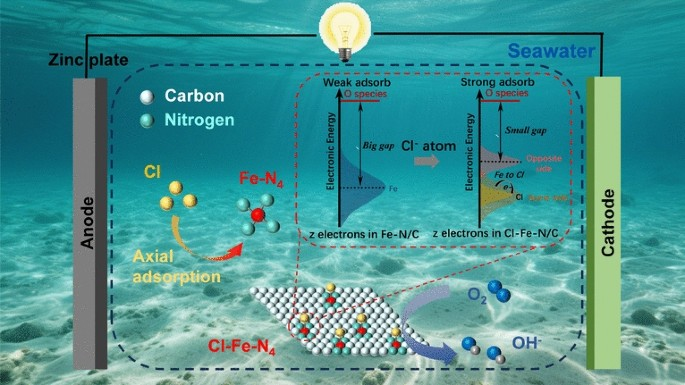
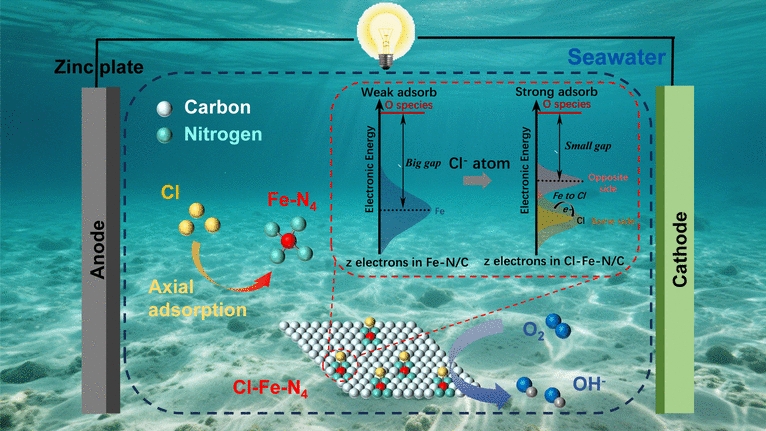

As maritime electrification and blue-energy harvesting accelerate, conventional Pt/C cathodes collapse in natural seawater because chloride ions poison active sites and shift the oxygen-reduction pathway from the desired 4 e- route to the parasitic 2 e- peroxide route. Now, researchers from Central South University and Xi’an Jiaotong-Liverpool University, led by Professor Jun Wu and Professor Danlei Li, have unveiled a universal oxidative-polymerization route that axially clamps Fe–N4 single-atom sites with heteroatoms (Cl or S) to create square-pyramidal “Cl–Fe–N4” catalysts that repel Cl- while doubling reaction kinetics. The work is published in Nano-Micro Letters.
Why Heteroatom Axial Coordination Matters
• Chloride Shield: Axial Cl pulls electron density toward itself, generating a negatively charged Fe center that electro-statically rejects Cl⁻ adsorption, keeping 96.7 % current retention after 12 h in pH-13 synthetic seawater.
• Intrinsic Boost: The Cl–Fe bond shortens the Fe–N bond length to 1.91 Å, down-shifts the d-band center to –2.94 eV and lowers the *OH-to-H2O rate-limiting step from 0.86 eV to 0.63 eV, delivering a record 5.8 mA cm-2 limiting current density that outperforms 40 wt % Pt/C (3.0 mA cm-2).
• Seawater Compatibility: The five-coordinated geometry maintains a strict 4 e- pathway (n = 4.02) even in 0.5 M KCl, whereas undoped Fe–N4 collapses to 2.24.
Innovative Design and Features
• One-Pot Synthesis: 1,5-diaminonaphthalene oxidative polymerization at 80 °C followed by 950 °C Ar pyrolysis and acid leaching yields 708 m2 g-1 microporous carbon with atomically dispersed Fe and 4.73 % N content.
• Spectroscopic Proof: HAADF-STEM, XANES and EXAFS confirm the absence of Fe clusters; only a single Fe–Cl shell at 2.17 Å is detected, matching square-pyramidal Cl–Fe–N4.
• Device Validation: When coated on nickel-foam air-cathodes (1 mg cm-2), the Cl–Fe–N4 seawater zinc-air battery delivers 187.7 mW cm-2 peak power at 245.1 mA cm-2 and sustains 200 h of deep discharge–charge cycles at 10 mA cm-2 with only 7 mV half-wave-potential decay.
Applications and Future Outlook
• Maritime Power Packs: Coupled with printable Zn anodes, the catalyst enables pouch cells that operate directly in ocean water, promising buoy-based sensors and unmanned underwater vehicles.
• Off-Grid Desalination: High current density at low overpotential allows SZAB-driven membrane pumps that consume 30 % less energy than conventional reverse-osmosis systems.
• Scalable Manufacturing: The precursor ink is water/ethanol-based and the maximum processing temperature is <1000 °C, making roll-to-roll production compatible with existing carbon-fiber lines.
• Next-Gen Tuning: The team is exploring F and Br axial ligands and dual-metal (Fe/Co) centers to further widen the operating salinity window to 10 wt % NaCl.
This comprehensive study provides a materials-by-design playbook for turning the most abundant anion in the ocean—chloride—from a poison into a performance descriptor, paving the way for truly seawater-robust energy storage and conversion devices.

Editor of Nano-Micro Letters, which is an Open-Access, peer-reviewed journal reported papers that have at least one dimension ranging from a few sub-nanometers to a few hundreds of micrometers. The journal is published by Springer Nature and indexed by SCI, EI, SCOPUS, Pubmed, etc. The 2025 JCR Impact Factor is 38.5. The 2025 CiteScore is 58.9.
Follow the Topic
-
Nano-Micro Letters
Nano-Micro Letters is a peer-reviewed, international, interdisciplinary and open-access journal that focus on science, experiments, engineering, technologies and applications of nano- or microscale structure and system in physics, chemistry, biology, material science, and pharmacy.