Highlights from the 2025 Society of Vertebrate Paleontology Annual Meeting
Published in Earth & Environment, Ecology & Evolution, and Arts & Humanities
.jpg)
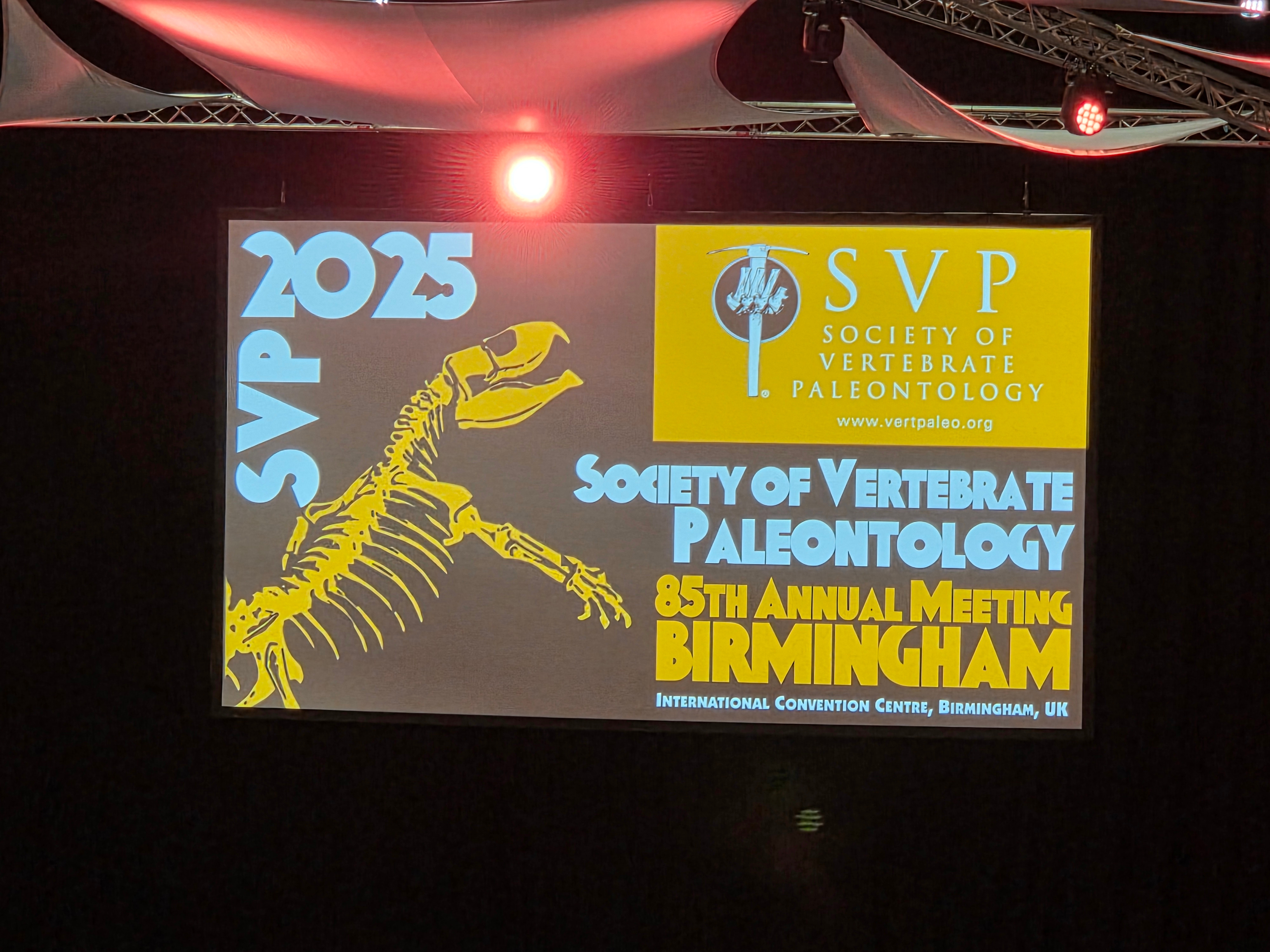
Jennifer Harman, Editor of BMC Zoology and BMC Ecology and Evolution, was pleased to attend the 85th Annual Meeting of the Society for Vertebrate Palaeontology (SVP), held this year in rainy Birmingham. Despite the weather, over 1,200 delegates from over 40 countries attended, many sporting themed outfits that set the tone for a lively event. The four-day programme included field trips to local paleontological sites, such as the Jurassic Coast, and featured 311 talks and 565 poster presentations. Topics ranged from ancient biomolecules to paleo-robotics, highlighting the diverse research approaches being used in vertebrate palaeontology today.
Here, Jennifer Harman shares her highlights.
The Isle of Skye: A Window into the Middle Jurassic
At this year's meeting, several speakers described exciting discoveries from vertebrate assemblages worldwide. Among them, new research on fossils and trackways from a sequence of Middle Jurassic sedimentary rocks found on the Isle of Skye, Scotland, stood out. Known as the Great Estuarine group, the rocks represent a series of coastal, lagoonal, and shallow marine environments deposited ~170–166 million years ago.
Professor Richard Butler (University of Birmingham), meeting co-host, presented new fossils from vertebrate beds of the Kilmaluag Formation, a part of the Great Estuarine group. The formation has yielded a remarkable variety of fossils from the Middle Jurassic, including dinosaurs, pterosaurs, early mammals, amphibians, turtles, and crocodylomorphs. Such finds are particularly valuable because Middle Jurassic vertebrates are poorly sampled in the fossil record. The Middle Jurassic was an important period in animal evolution, during which many major groups diversified. By the Late Jurassic, this expansion had produced a wealth of new species that would continue into the Cretaceous. Skye’s exceptionally preserved fossils provide rare insights into this evolutionary burst, highlighting the island’s growing importance for understanding vertebrate evolution and ecosystems during this period. It was fascinating to hear Richard describe new field discoveries using multimodal imaging techniques. When asked about his personal highlights from the meeting, Richard said: “It was wonderful to be able to welcome the world’s vertebrate palaeontologists to Birmingham, for only the second time that SVP has visited the UK in 85 years. It was an amazing opportunity to share our exciting new discoveries from the Isle of Skye with the community and to showcase some of the UK’s incredible fossil heritage. We’ve had great feedback that will inspire further discoveries and new collaborations.”
Another highlight came from Tone Blakesley (The Open University), who presented his research on theropod footprints from Skye. His study, recently published in Royal Society Open Science (DOI: 10.1098/rsos.251016), builds on decades of paleontological work on the island, describing and characterising 185 tracks from the Kilmaluag Formation and the Valtos Sandstone Formation. By categorising these into four main morphotypes, Tone established a new Hebridean theropod morphotype scheme. His findings reveal clear patterns in the distribution of specific morphotypes across contrasting environments—higher-energy coastal settings in the Valtos Sandstone versus more sheltered lagoonal conditions in the Kilmaluag Formation. While behavioural interpretations were necessarily cautious, a handful of multi-track-bearing slabs offered rare insights into the possible activities undertaken by dinosaurs of different sizes within these landscapes.
Tone paid tribute to his late colleague and mentor, Dugie Ross, who first identified dinosaur footprints on Skye in the mid-1960s and went on to found the Staffin Dinosaur Museum in 1976 at just 19 years old. Tone reflected, "Dugie was instrumental in inspiring a generation of palaeontologists who visited Skye, including myself. Being able to share Dugie’s legacy and enthusiasm for communicating the island’s prehistoric heritage was a major highlight, especially considering all he has done for me over the years.” He added, “The atmosphere at SVP was highly uplifting; everyone was positive about each other's work and expressed genuine interest. Sharing my research with various academics and learning about their projects has led me to initiate a few collaborations."
.png)
This growing recognition of Skye’s paleontological importance aligns with recent work published in the 'Evolution of Vertebrate Flight' Collection in BMC Ecology and Evolution, which describes Dearc sgiathanach. This Middle Jurassic pterosaur hunted along Jurassic shorelines and lagoons 170 million years ago. Pterosaurs were the first vertebrates to evolve active flight. However, the limited number of well-preserved pterosaur fossils hampers our understanding of their functional anatomy and behaviour, particularly in the Middle Jurassic. By the Cretaceous (145.5–66 million years ago), some pterosaurs had developed enormous wingspans exceeding 10 meters (33 feet). Using photography and high-resolution X-ray microtomography, the study revealed scarring on the deltopectoral crest, indicating that Dearc sgiathanach had large pectoral muscles for flying and hunting. Compared to other recently discovered pterosaurs from Skye, Dearc represents an important ‘stepping stone’ in pterosaur evolution, illustrating a gradual transition towards larger, more land-capable, and morphologically diverse forms.
Reassessing the Paleoecology of the La Venta mammal assemblage
Juan Carrillo (Museum national d'Histoire naturelle) presented new work on the La Venta fossil site in Colombia. Its Middle–Late Miocene fauna captures a time when South America was still isolated, offering paleoenvironmental insights before the Great American Biotic Interchange (GABI) when South and North America became connected by a land bridge.
Juan discussed that most paleoenvironmental interpretations of La Venta have been based on material from a single, heavily sampled layer - the Monkey Beds (~12 Ma). New stratigraphic analyses, however, show that fossil-bearing layers span 16–10.5 Ma, revealing a more extensive fossil record and a richer picture of Miocene environments and biodiversity.
I recognised Juan’s name from a recent BMC Zoology paper, which described new litoptern fossils from La Venta. These finds provide new anatomical details for this extinct group of South American hoofed mammals and included a comparative analysis of North and South American herbivore faunas before and after GABI. The study showed that pre-interchange South American communities were more ecologically diverse, with small arboreal browsers and species with ever-growing teeth, than their North American counterparts.
Juan highlighted the importance of hosting SVP meetings outside the USA, stating that "palaeontology is truly international, so it provides an opportunity to meet palaeontologists who may not often get the chance to travel to the USA." This year's meeting marked only the third time in its 85-year history that it has been held in Europe, so I was personally delighted to be able to attend this year being based in the UK. He added, "Although I understand there are likely logistical challenges, I hope that someday the SVP meeting can be held in the Global South."
New Insights into Ichthyosaur Biology and Evolution
.jpg)
The call for broader international representation for future SVP meetings was underscored by some fantastic speakers from scientists based in the Global South. For example, Judith Pardo-Pérez, a palaeontologist at the University of Magallanes in Chile, delivered an engaging talk about her discovery of a rare, pregnant ichthyosaur, a Mesozoic marine reptile that gave birth to live young. Dr. Pardo-Pérez and her team unearthed “Fiona,” a nearly 4-meter-long specimen, from melting ice at the Tyndall Glacier's edge in Patagonia, located within Torres del Paine National Park. Dating back around 131 million years to the Early Cretaceous period, Fiona is the first complete ichthyosaur skeleton ever excavated in Chile. Notably, she retained fossilized remains of two foetuses, making her the only known example of a pregnant ichthyosaur from this time period. Her stomach even held her last meal, small fish bones preserved in her stomach. CT scans of Fiona revealed anatomical structures still encased within the rock, as well as signs of healed injuries on her bones. This discovery offers insights into ichthyosaur reproduction, diet, ecology, and even their health. Finally published after meticulous excavation under extreme weather conditions, Fiona’s findings illuminate the biology of marine reptiles in a region and time period that have been largely underexplored in the fossil record.
Reflecting on her experience at SVP, Dr. Pardo-Pérez shared: "The Society of Vertebrate Paleontology has played a defining role in my scientific career. At the 2011 SVP meeting, I met Dr. Erin Maxwell — now my long-term collaborator and one of the scientists who joined our expedition to excavate the pregnant ichthyosaur ‘Fiona’ in Patagonia. Although living at the end of the world makes it difficult for me to attend SVP every year, reconnecting with colleagues and friends in Birmingham was truly meaningful. It was inspiring to hear the talks, explore the posters, and see the diverse range of technologies being applied across paleontology. Receiving thorough feedback from colleagues on my student's poster was especially valuable. I hope that, in the future, SVP might also explore hosting a meeting in the Southern Hemisphere, where many wonderful research communities are making exciting discoveries."
I also had the pleasure of seeing Dr Feiko Meidema (University of Oslo) speak, a researcher who has published extensively on ichthyosaurs, including in BMC Ecology and Evolution. His paper, "Heads or tails first? Evolution of fetal orientation in ichthyosaurs, with a scrutiny of the prevailing hypothesis," investigates how ichthyosaur embryos were positioned in the womb. The prevailing theory had long been that fetuses were born tail-first as an adaptation to underwater birth, reducing the risk of asphyxiation. In his study, Meidema and colleagues examined three fossils: two showed tail-first fetal orientation, while one was head-first. By comparing ichthyosaurs to other viviparous reptiles, both living and extinct, as well as aquatic mammals, they concluded that asphyxiation risk was unlikely to drive fetal orientation. Instead, body shape, pelvic girdle width, and neck flexibility likely determined how embryos were positioned during birth.
At the meeting, Meidema shared insights from his ongoing research into how the pelvic girdle of ichthyosaurs adapted to multiple functions, including swimming and giving birth. He highlighted how subtle modifications in the pelvic bones allowed these reptiles to maintain hydrodynamic efficiency while accommodating live offspring. When asked about his personal highlights, he commented that “seeing the micro-CT scans of Fiona firsthand was incredible”.
Empowering Early Career Researchers to Lead Ethical Open Science
Another highlight was a talk by Meghan Balk, co-investigator of the Ethical Open Science for Past Global Change Research Coordination Network (RCN) funded by the National Science Foundation, who discussed the important role early career researchers (ECRs) play in advancing ethical and open science. Launched in 2023, the RCN aims to “build technical and social capacity among community-curated data repositories in the Quaternary sciences by supporting technical implementation of ethical open science principles and developing communities of practice focused on CARE (collective benefit, authority to control, responsibility, ethics) and FAIR (findable, accessible, interoperable, reusable) data principles.”
Paleodata spans multiple disciplines and data types, requiring researchers to work across numerous repositories, such as Neotoma Paleoecology Database, Paleobiology Database, FuTRES, NEON, the Florida Museum, NOAA, Open Context, and CARD. These repositories often have different standards and metadata, creating significant challenges for ECRs trying to navigate and combine data effectively.
Meghan explained that the RCN was started when “a group of community-curated data resource (CCDR) managers noticed several related challenges in the open databases used to assess global change, which rely on big data from various disciplines. First, different databases were not easily interoperable with one another, leading to friction when compiling big datasets. Second, there was a need to reconcile making these resources comply with CARE data principles by reassessing for whom and how these resources are ‘open.’ This is a challenge as different disciplines have different standards, data were collected for various purposes, and, because of interoperability barriers, data permissions are not always transmitted across CCDRs.”
One of the network's goals is to support the next generation of ECRs in thinking and practicing ethical open science. It has focused on ECRs in its leadership, invited ECRs to annual workshops, held monthly webinars, and supported ECR -led initiatives. You can learn more about the ECR group here: https://eos-rcn.github.io/web/community#readMore_ECR
As a part of the RCN ECR group, Meghan explored the challenges ECRs encounter in implementing FAIR and CARE principles. Balk identified three main challenges:
- Time: building relationships and learning new practices takes time.
- Resources: many ECRs lack funding for collaboration.
- Power: ECRs often do not have the authority to set standards or make decisions.
Meghan advocated for structural changes, targeted resources, and cross‑disciplinary training to align ideals with practice in ethical open science.
With such an exceptional and diverse programme, it is impossible to include every highlight in this blog. What was clear, however, is that attendees left Birmingham inspired, full of new questions to explore, fresh ideas for future research, and strengthened connections across the global palaeontological community.

Follow the Topic
-
BMC Ecology and Evolution
An open access, peer-reviewed journal interested in all aspects of ecological and evolutionary biology.
-
BMC Zoology
This is an open access, peer-reviewed journal that considers articles on zoology, including comparative physiology, mechanistic and functional studies, morphology, life history, animal behavior, signaling and communication, cognition, parasitism, systematics, biogeography and conservation.


Related Collections
With Collections, you can get published faster and increase your visibility.
Nighttime ecology and evolutionary adaptations to low-light environments
BMC Ecology and Evolution welcomes submissions of research exploring the remarkable adaptations and ecological dynamics that enable life to flourish in the dark and low light environments. Contributions will explore evolutionary adaptations such as sensory specialization (e.g., night vision, echolocation, bioluminescence, heat-sensitive pits, and specialized hairs) that allow organisms to navigate, forage, and communicate in low-light conditions from caves to the deep sea. The collection will also investigate behavioral and physiological mechanisms, including circadian rhythm adjustments and predator-prey interactions, that are essential for survival in nocturnal niches.
Submissions on the impact of anthropogenic influences, such as light pollution, on nocturnal ecosystems and biodiversity are encouraged. The Collection also welcomes research on nighttime bioacoustics and soundscapes, examining how sound is used to adapt to and shape nocturnal environments. Contributions discussing the role of citizen science in advancing our understanding of nighttime ecology are also encouraged.
Publishing Model: Open Access
Deadline: Nov 20, 2026
Evolution of disease: From pathogens to proliferating cells
Evolution of disease: From pathogens to proliferating cells is a special Collection that explores how evolutionary processes shape health and disease—from infectious microbes to cancerous cells. We invite research within the discipline of evolutionary medicine that examine how forces such as natural selection, genetic drift, host-pathogen coevolution, and environmental change contribute to disease susceptibility, resistance, and progression. We welcome submissions that deepen our understanding of disease as a dynamic outcome of evolutionary interactions.
Topics of research may include but are not limited to research which uses evolutionary principles to understand:
1. Pathogen evolution, resistance, and host interactions
•
The evolution of antibiotic, antiviral, antifungal, and antiparasitic resistance
•
Mechanisms of immune evasion, persistence, and transmission
•
Experimental evolution and molecular insights into pathogen adaptation
•
Host-pathogen coevolution and the impacts of medical or environmental interventions
•
Comparative host-pathogen dynamics across species
2. Evolutionary mismatch and modern disease
•
Evolutionary insights into metabolic disorders, autoimmune conditions and cancer
•
When a previously advantageous trait becomes maladaptive due to change in the environment
3. Evolution of cancer
•
Evolutionary and ecological models of cancer progression and resistance
•
Comparative oncology: insights from cancer-resistant and long-lived species
•
Somatic evolution, immune escape, and tumor heterogeneity
4. Genetic variation, adaptation, and disease susceptibility
•
Adaptive and maladaptive genetic variants in human and animal populations
•
Pleiotropy and trade-offs in immune function, metabolism, and reproduction
•
Population genetics, admixture, and the evolutionary roots of health inequality
5. Microbiome evolution and host symbiosis
•
Coevolution and community ecology of host-associated microbiota
•
Functional evolution in microbial genomes and implications for host health
•
Microbiome shifts due to modern environments, drugs, or host genetic factors
6. Viral evolution and endogenous elements
•
Evolutionary arms races between hosts and viruses
•
Evolution and function of endogenous viral elements in animal genomes
•
Phylogenomic approaches to uncover ancient viral influences on host evolution
7. Experimental and computational approaches
•
Experimental evolution in microbial or model systems
•
Genomics, phylogenomics, and systems biology in disease evolution
•
Machine learning and AI in evolutionary medicine research
Publishing Model: Open Access
Deadline: Dec 04, 2026