How Bathymetric Data Proved an Ice Shelf Hypothesis Around Since the 1970s
Published in Earth & Environment


The Baffin Bay Deglacial Experiment (BADEX)
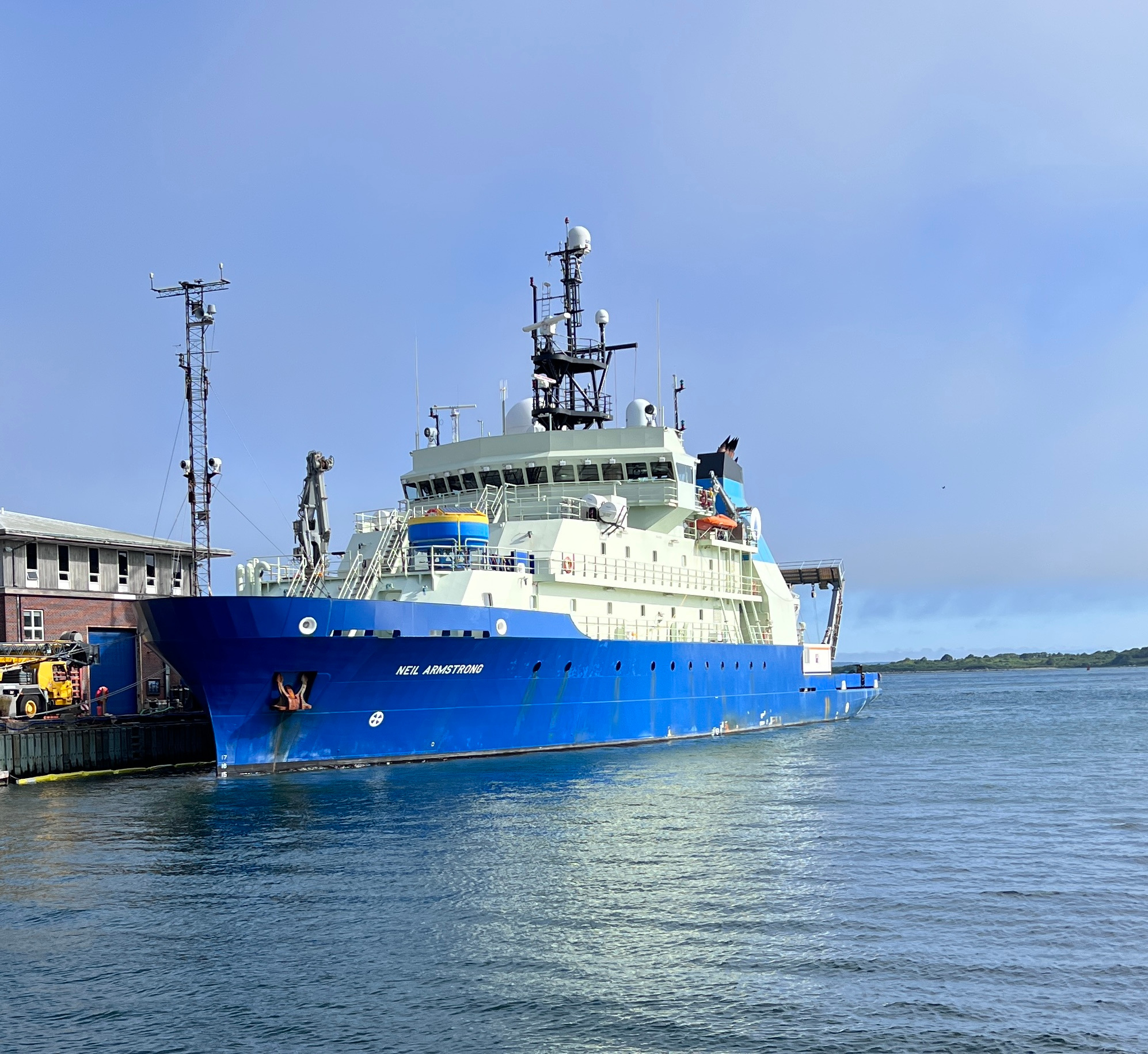
This study is one of the first major results from the BADEX research program, a multi-institutional US National Science Foundation-funded project. BADEX seeks to determine the mechanisms, timing, and rates of initial retreat of the western margin of the Greenland Ice Sheet from its last glacial maximum (LGM) extent, when it was grounded below sea level at the continental shelf edge. Motivated by very limited existing data, we hypothesized that the geomorphology and sediment deposits on the western Greenland continental slope in Baffin Bay would be the key to studying the dynamics of this marine-terminating ice sheet. Thus, our team set out from Woods Hole, Massachusetts, USA on the Research Vessel Neil Armstrong (Image 1) in July 2023 and disembarked in Nuuk, Greenland in August, spending 34-days conducting geophysical surveys and sediment sampling along this margin.
We brought filmmaker Georg Koszulinski and UNCW Film Studies graduate student Janneke Wade-de Jong on the research cruise to document the project and field work. They made two award-winning films, a short (Video 1) and a narrative feature, A Map of the World in Time.
Video 1. Documentary short about the project and cruise, with background information about coring and surveying methods.
What was the ice configuration in Baffin Bay at the LGM?
To study the initial retreat of the Greenland Ice Sheet, we first needed to determine the ice configuration in Baffin Bay at the LGM—an important region where several North American ice sheets coalesced. The maximum extent, configuration of potential ice shelves, and paleoenvironment would have exerted influence on the processes governing ice sheet stability and retreat. Historical observations from Antarctica highlight that ice shelves, the floating extensions at its margins, are particularly important for stabilizing marine-based ice sheets. However, there are limited data that constrain the existence, size, and glaciological significance of LGM ice shelves in the Northern Hemisphere.
Early work hypothesized that an extensive ice shelf would have existed in the Arctic Ocean during glacial maxima (Mercer, 1970; Broecker, 1975). Hughes et al. (1977) extended this hypothesized ice shelf to Baffin Bay, where they proposed complete ice cover, with the ice shelf extending into the Labrador Sea. Some modeling studies later suggested that an ice shelf could have initiated in southern Baffin Bay and grown towards the north (Álvarez-Solas et al., 2011; Marcott et al., 2011). However, data from a sediment core from southern Baffin Bay refuted extensive LGM ice cover in that region (Jennings et al., 2018), highlighting the need for new observations to resolve this ongoing mystery of the ice configuration.
The first published geomorphic data that supported the existence of an ice shelf in Baffin Bay was from Couette et al. (2022), which came out as we were planning for our 2023 cruise. They identified a few ridges along the outer shelf and upper slope of Baffin Island and inferred that they were formed by an ice shelf flowing along the margin. However, the spatial coverage of the ridges was small enough that formation from local fringing ice shelves could not be fully ruled out, even though a larger ice shelf was a plausible and intriguing hypothesis.
A seafloor surprise
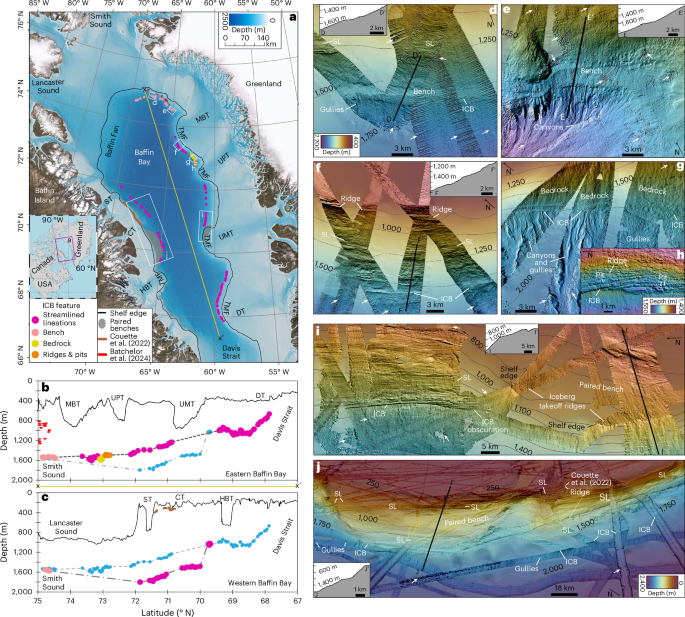
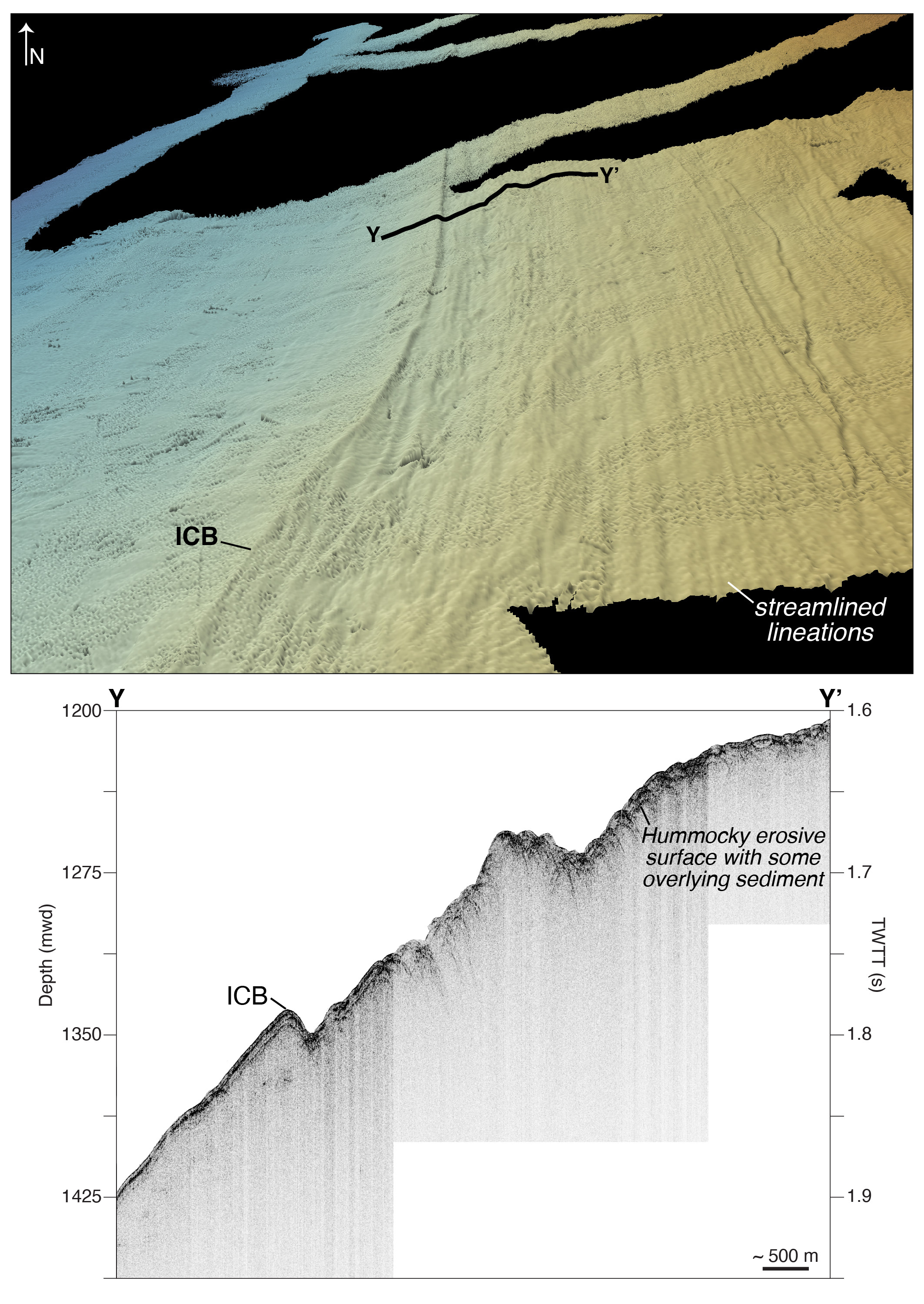
In most of the west Greenland continental slope regions we surveyed during our 2023 R/V Armstrong research cruise, we observed a sharp transitional feature in the subbottom data where there were continuous laminations downslope, indicating thick sediment deposits, and hummocky features upslope, reflecting differential erosion (Image 2). When we examined the bathymetry data from this transition, a major geomorphic feature jumped out (Image 2). This sharp geomorphic boundary separates where ice was grounded on the seafloor from where ice was not in contact with the seafloor, and we termed it the Ice Contact Boundary (ICB). This feature is traceable along slope and is now demonstrated to indicate the deepest that a paleo ice shelf was in contact with the seafloor. This was a surprising discovery, as we mapped these ICB features at water depths up to around 1800 meters in Northern Baffin Bay, deeper than any previously recognized glacial bed form documented in the Northern Hemisphere.
Putting it all together
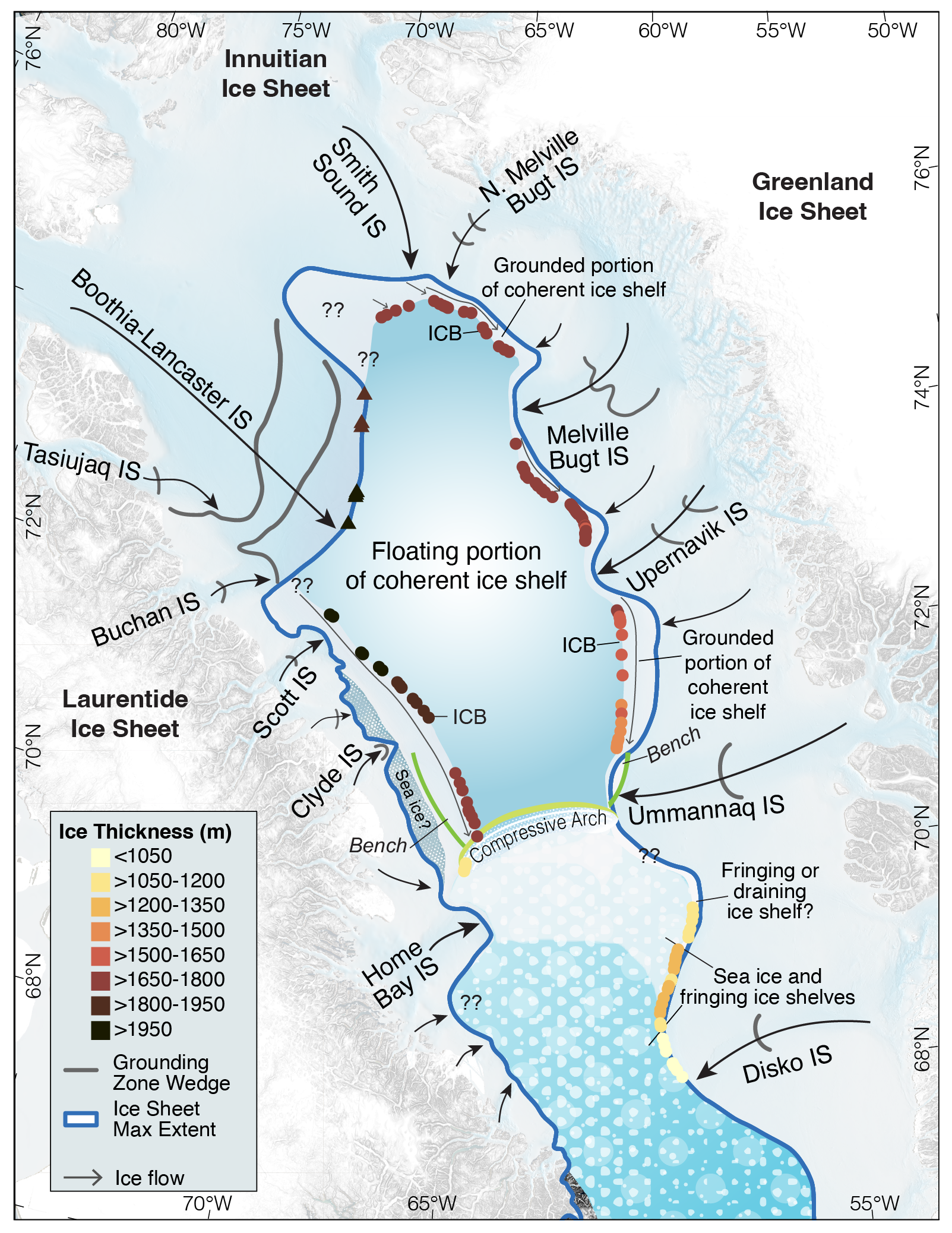
We mapped the ICB in the bathymetric data we collected from the Greenland slope and then looked for these ICB features in publicly available multibeam bathymetry data collected over the last 25 years in Baffin Bay. Based on that mapping we were able to define the base of the Baffin Bay Ice Shelf at its maximum size during the last glacial cycle and propose mechanisms that supported the ice configuration.
To estimate ice shelf thickness, we collaborated with glacial isostatic adjustment modelers to account for differences in seafloor depth since the end of the glacial max. This allowed us to estimate that the coherent Baffin Bay Ice Shelf was ~1,400–2,100 m thick at its grounding zone along the Canadian and Greenlandic continental slopes (Image 3). These large thicknesses around the rim of the Baffin Bay Ice Shelf exceed those of modern Antarctic ice shelves, which only have such thicknesses near some feeder glaciers. The Baffin Bay Ice Shelf was also larger in areal extent than most modern Antarctic ice shelves except the Ronne and Ross ice shelves.
Implications and future work
Our data-based ice configuration for Baffin Bay shows that confluent Northern Hemisphere ice sheets can be mechanically coupled, linking their stability. Ice models that do not consider such an ice shelf could be underestimating ice sheet thickness and stability, while also not accounting for the latent instability of an ice shelf buttress. Our geomorphic mapping and ICB points have been released as GIS files for easy incorporation into models. Paleoceanographers and paleoclimatologists interested in the North Atlantic region and the impacts and feedbacks associated with freshwater releases should consider the consequences of the Baffin Bay Ice Shelf moving forward.
The Baffin Bay Ice Shelf represents a paleo analog for modern Antarctic ice shelves that buttress the thick, marine-terminating margins of Antarctic ice sheets. The BADEX project is continuing its work on the spatial and temporal demise of the western Greenland Ice Sheet. The forthcoming results will provide data on how marine-terminating ice sheets respond to the loss of an ice shelf buttress, a major source of uncertainty in projections of future sea level rise.
References
Header image credit: Rob Hatfield
Álvarez-Solas, J. et al. Heinrich event 1: an example of dynamical ice-sheet reaction to oceanic changes. Past 7, 1297–1306 (2011).
Broecker, W.S.. Floating glacial ice caps in the Arctic Ocean. Science 188, 1116-1118 (1975).
Couette, P. O. et al. Evidence for an extensive ice shelf in northern Baffin Bay during the Last Glacial Maximum. Earth Environ. 3, 225 (2022).
Hughes, T. J., Denton, G. H. & Grosswald, M. G. Was there a late-Würm Arctic ice sheet. Nature 266, 596–602 (1977).
Jennings, A. E. et al. Baffin Bay paleoenvironments in the LGM and HS1: resolving the ice shelf question. Geol. 402, 5–16 (2018).
Marcott, S. A. et al. Ice-shelf collapse from subsurface warming as a trigger for Heinrich events. Natl Acad. Sci. USA 108, 13415–13419 (2011).
Mercer, J. H. A former ice sheet in the Arctic Ocean? Palaeogeogr. Palaeoclimatol. Palaeoecol. 8, 19–27 (1970).
Follow the Topic
-
Nature Geoscience
A monthly multi-disciplinary journal aimed at bringing together top-quality research across the entire spectrum of the Earth Sciences along with relevant work in related areas.

Related Collections
With Collections, you can get published faster and increase your visibility.
Soil microbiomes and carbon sequestration under global change
Publishing Model: Hybrid
Deadline: Mar 18, 2027