JMCR: Highlight
Published in Biomedical Research
Explore the Research
JavaScript is disabled
Introduction
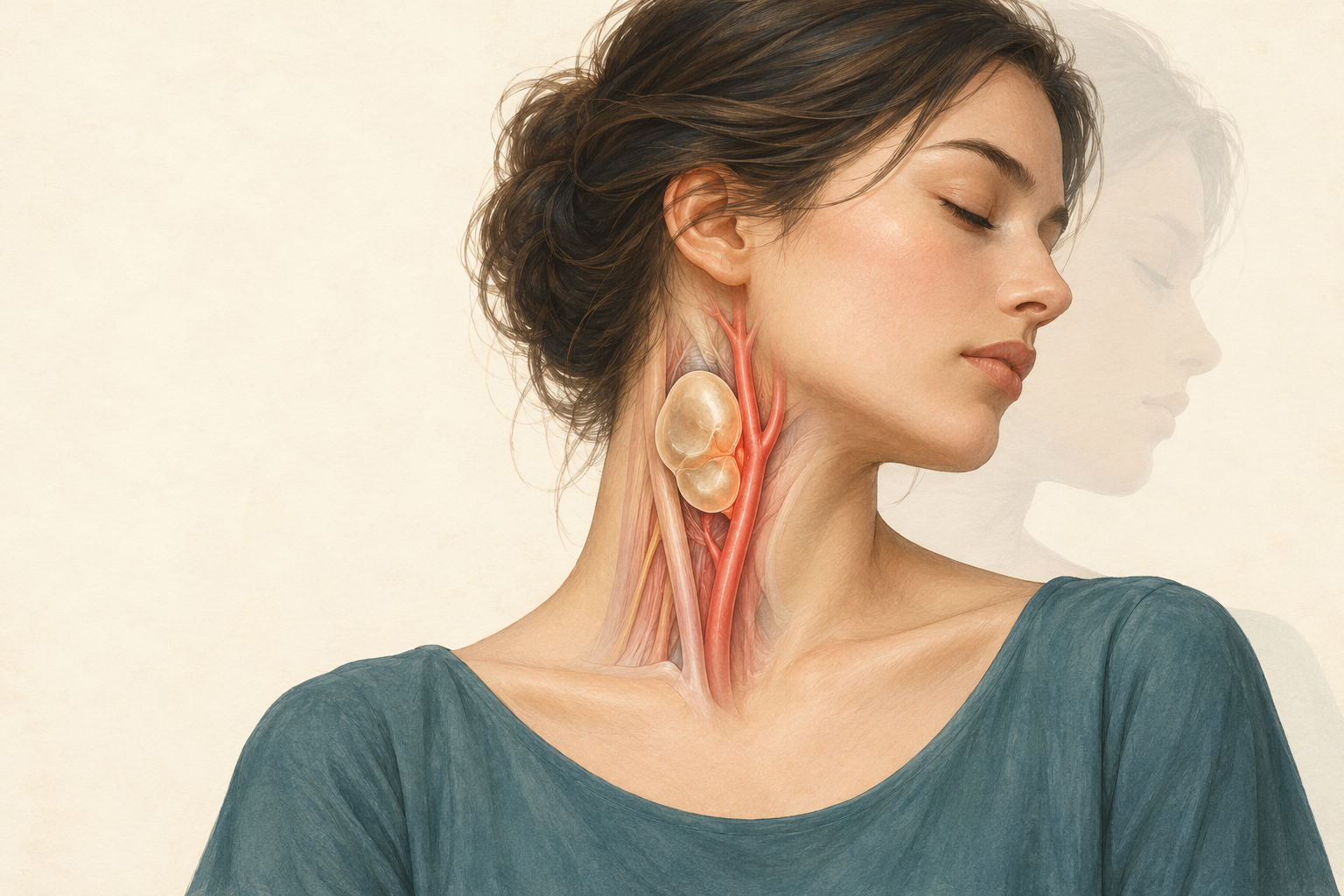
An 18-year-old woman with recurrent fainting triggered by turning her head was found to have a multilocular branchial cleft cyst compressing the carotid bifurcation—an unusual structural cause of carotid sinus syncope.
Syncope with a mechanical trigger
The patient presented with a progressively enlarging right lateral neck mass and recurrent episodes of dizziness and syncope.
The episodes were specifically associated with turning her head. That reproducible mechanical relationship was an important clue.
The mass had initially been painless but became larger and more symptomatic over approximately two weeks. A course of antibiotics for presumed cervical lymphadenitis did not resolve either the swelling or the fainting episodes.
Examination demonstrated a cystic, mildly tender lateral neck mass without overlying erythema or warmth. The lesion did not move with swallowing or tongue protrusion.
Routine laboratory studies were unremarkable.
Imaging reveals an unusual structure
Ultrasonography demonstrated a smooth-walled, anechoic cystic lesion with posterior acoustic enhancement and no internal vascularity.
Contrast-enhanced CT showed a 4.4 × 2.8 × 3.1-cm ovoid cyst in the right retromandibular region, positioned between the sternocleidomastoid muscle and the cervical great vessels.
A smaller 1.3-cm cystic component appeared inferoposteriorly. On imaging, it resembled a separate lesion.
The anatomical location supported a second branchial cleft cyst, but the apparently dual structure was atypical.
The operative explanation
At surgery, the two apparent lesions proved to be components of a single septated multilocular cyst.
The cyst was located deep to the sternocleidomastoid muscle, consistent with a Bailey type II second branchial cleft cyst. It directly compressed the carotid bifurcation.
The lesion was excised completely. Histopathological examination demonstrated a cyst lined by squamous and respiratory epithelium with underlying lymphoid stroma, confirming a second branchial cleft cyst.
After surgery, the syncopal episodes stopped.
How could a benign cyst cause syncope?
The carotid sinus contains baroreceptors that participate in short-term regulation of blood pressure and heart rate.
External pressure or mechanical distortion may produce an exaggerated reflex response, with increased vagal activity and reduced sympathetic tone. Depending on the response, this may result in bradycardia, vasodilation, hypotension, or a combination of these effects.
In this patient, the reproducible association with head turning, direct operative evidence of carotid-bifurcation compression, and resolution after excision support a mechanical carotid-sinus mechanism.
The report did not describe formal carotid-sinus massage, continuous monitoring during a spontaneous episode, or physiological classification into cardioinhibitory, vasodepressor, or mixed subtypes. The precise hemodynamic mechanism therefore remains inferred rather than directly recorded.
Looking beyond common causes of syncope
Most syncope in young adults is not caused by a neck mass. Initial assessment should still address common cardiac, reflex, orthostatic, neurological, and metabolic causes.
The diagnostic frame changes when syncope is consistently linked to neck movement and accompanied by a mass near the carotid sheath.
In that setting, imaging must define not only the nature of the lesion but also its relationship to the carotid bifurcation, internal jugular vein, cranial nerves, and surrounding tissues.
Clinical Take-Home Message
Recurrent syncope triggered reproducibly by turning the head may indicate mechanical stimulation of the carotid sinus.
When a lateral neck mass is present, cross-sectional imaging should define its relationship to the carotid bifurcation and other neurovascular structures. A benign congenital lesion can produce clinically important hemodynamic symptoms through mass effect even when routine laboratory evaluation is normal.
Resolution after excision supported the proposed mechanism in this case, although the precise reflex subtype was not formally documented.
Journal of Medical Case Reports is the world’s first international, PubMed-listed medical journal devoted to publishing case reports from all medical disciplines and will consider any original case report that expands the field of general medical knowledge, and original research relating to case reports. The journal is open access and strongly endorses the CARE guidelines for case reports, requiring authors to submit populated CARE checklists with submissions to improve transparency in reporting.
Richard Alan Rison is the Editor-in-Chief of Journal of Medical Case reports. He is also an associate neurology editor (editorial board) for BMC Neurology, and the former lead editor for case reports of BMC Research Notes (currently on the editorial board). His scholarly work focuses on medical case reporting, reporting standards, and editorial methodology. Dr. Rison participated in the development and dissemination of the CARE guidelines for clinical case reporting and has authored numerous publications addressing both neurological disorders and the role of case reports in advancing medical knowledge. Dr. Rison practices general neurology and served as the founding medical director of the PIH Health Hospital-Whittier Stroke Program and the PIH Health Hospital-Whittier Non-Invasive Vascular Laboratory, is a clinical assistant professor of neurology at the University of Southern California Keck School of Medicine and Los Angeles County Medical Center, and is a Fellow of the American Academy of Neurology, the American Neurological Association, and the American Association of Neuromuscular and Electrodiagnostic Medicine. Dr Rison is board-certified by the American Board of Psychiatry and Neurology in neurology and vascular neurology, and neurocritical care and neuroimaging by the United Council of Neurologic Subspecialties. He is also board-certified by the American Board of Electrodiagnostic Medicine in electrodiagnostic medicine. Dr. Rison is a former president of the Los Angeles Neurological Society.
Follow the Topic
-
Journal of Medical Case Reports
This journal will consider any original case report that expands the field of general medical knowledge, and original research relating to case reports.