How city design may shape the ageing hippocampus?
Published in Earth & Environment, Neuroscience, and Anatomy & Physiology
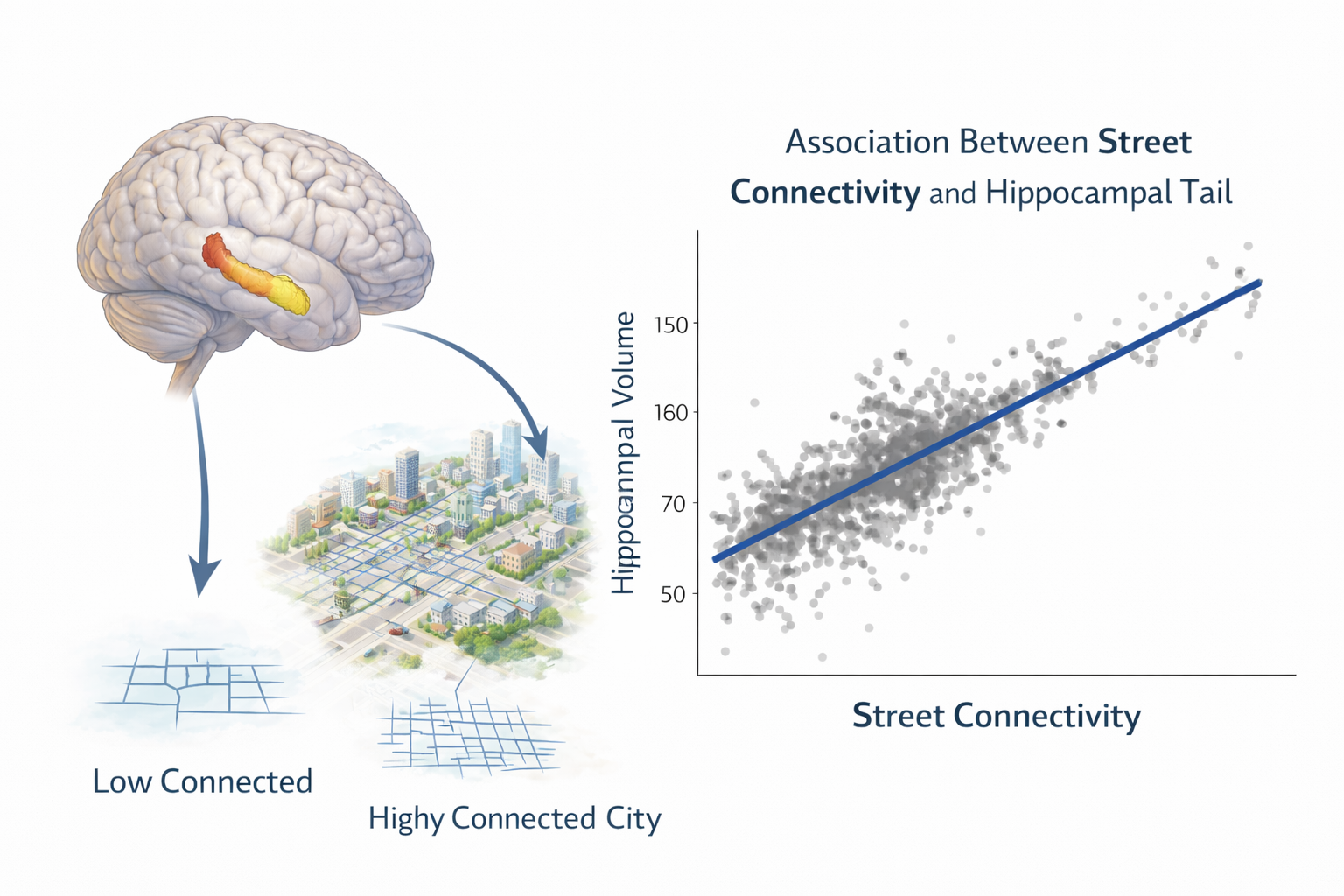





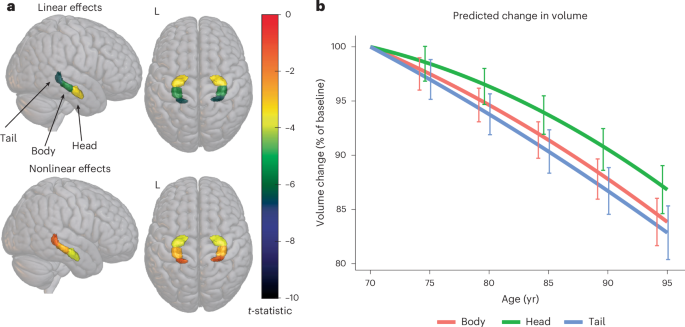

The human brain goes through fundamental biological changes during aging. The brain gradually loses its ability to maintain and regenerate neurons, and neural networks that once worked effortlessly become more vulnerable. Genetics plays a role, but so does the environment. Therefore, the spaces we move through every day and how well they are connected can quietly influence how our brains age.
Our recent research explored whether the connectivity of neighbourhoods might be linked to brain health in later life.
The brain’s navigation centre
We focused on the hippocampus, a small structure deep within the brain. This structure plays an important role in memory and spatial navigation. Within it lies the hippocampal tail, a region particularly involved in the ability to navigate, remember routes, and orient ourselves in space. Changes in this region are especially relevant to ageing. Early shrinkage of the hippocampal tail, along with difficulties in spatial navigation, can be among the earliest signs of Alzheimer’s disease.
We wanted to understand whether everyday urban experiences might influence how this part of the brain changes as people age.
Studying the brains of older city residents
To investigate this question, we analysed brain MRI scans from more than 500 older adults aged 70–90 living in Sydney, Australia. We combined detailed neuroimaging with information about neighbourhood street connectivity, a measure of how dense and interconnected local streets and intersections are.
Neighbourhoods differ dramatically in how they demand navigation. Some areas have simple, predictable street layouts. Others require frequent route decisions, multiple intersection crossings, and continuous spatial awareness. These differences provided a natural experiment in how urban environments might influence the brain.
Navigating complexity and hippocampal ageing
We found that older adults living in highly connected neighbourhoods tended to have larger hippocampal tails. This suggests that environments requiring frequent navigation and route planning may help maintain the brain’s spatial memory systems. The patterns across age were particularly striking. Between ages 70 and 85, individuals with larger hippocampal tails showed a steeper decline in this region. However, after age 85, this decline slowed or plateaued. This pattern is consistent with the idea that cognitively stimulating environments may build resilience earlier in ageing, potentially helping to preserve brain structure later in life.
Everyday navigation as brain exercise
Urban navigation is often overlooked as a form of cognitive activity. Yet even simple daily tasks in dense neighbourhoods require complex mental processes:
- planning routes and choosing paths
- remembering street names and landmarks
- monitoring traffic and making safe crossing decisions
- continuously updating spatial maps of the environment
These activities engage multiple brain systems simultaneously. Over time, repeated engagement may act as a form of everyday cognitive training.
Rethinking cities as brain-health environments
The findings contribute to a growing body of research linking urban design to healthy ageing. Walkable neighbourhoods and connected street networks are already known to support physical activity and social engagement. Our results suggest they may also support brain health.
This has implications for urban planning. Environments that encourage movement, navigation, and interaction may do more than improve lifestyle, they may help maintain the brain’s memory and navigation systems across the lifespan.
A new perspective on ageing in cities
The relationship between cities and health is often framed in terms of pollution, noise, or access to green space. Our work highlights another dimension: the cognitive demands of everyday urban life. Crossing streets, choosing routes, and navigating neighbourhoods may seem mundane. Yet these small daily challenges could play a meaningful role in shaping how the brain ages. As urbanisation continues worldwide, understanding how city design influences brain health may help us build environments that support healthier ageing for generations to come.

Follow the Topic
-
Nature Cities
This journal aims to deepen and integrate basic and applied understanding of the character and dynamics of cities, including their roles, impacts and influences — past, present and future.