How Mathematics Became My Bridge to Healing
Published in Research Data, Biomedical Research, and General & Internal Medicine
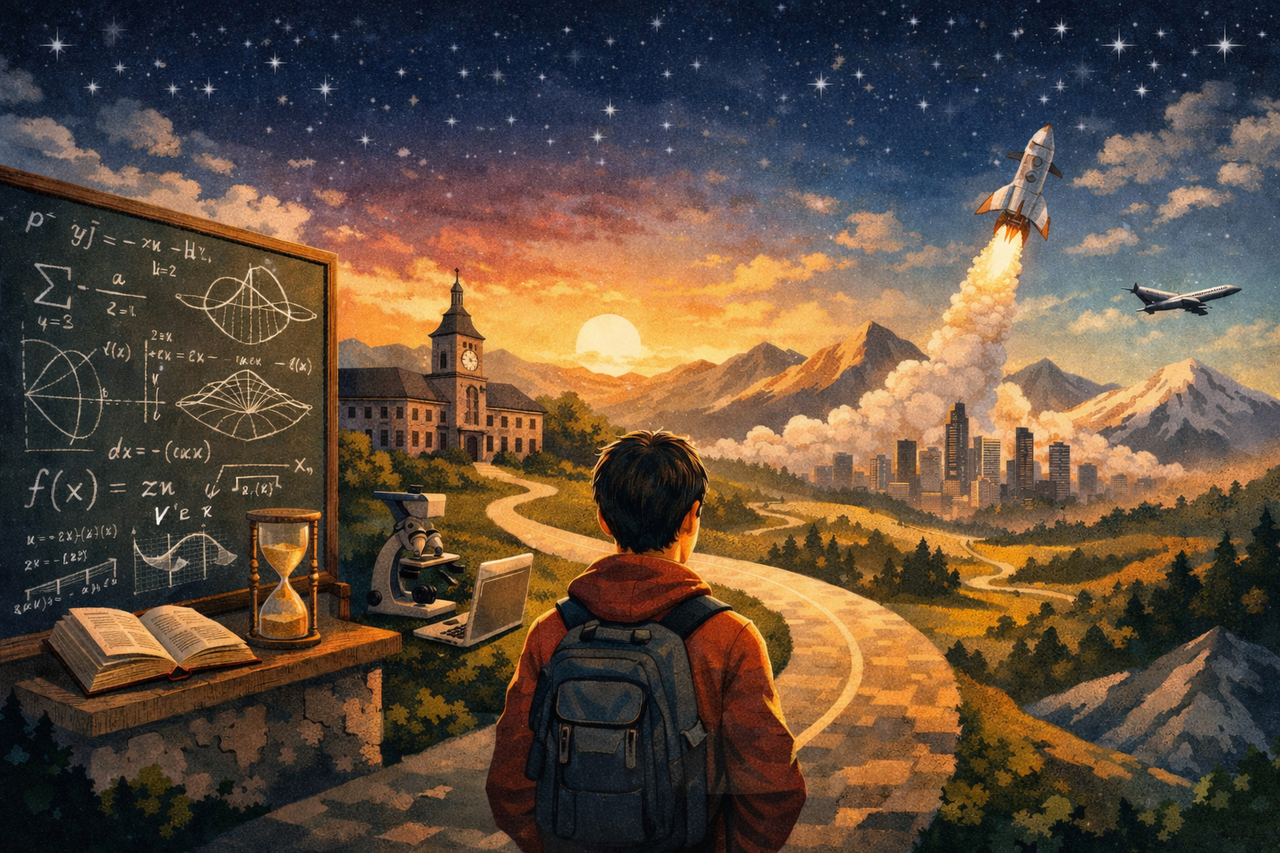



In the dim glow of our living room lamp, I sat hunched over my high school physics textbook, the words blurring as my mother's voice called from the kitchen. It was around the time she was diagnosed with breast cancer. "Deniz, come eat," she said, her tone steady but her eyes shadowed. I was just a teenager, already lost in the abstractions of math and science, dreaming of unraveling the world's patterns. But that night, the equations felt so distant, so powerless against the real chaos invading our home. For years, we faced relentless treatments, surgeries, and hospital visits that tested our family's strength. My father balanced work with caregiving, while I buried myself in my studies to escape the fear. Little did I know then that this personal battle would shape my future in unexpected ways.
From childhood, I aspired to be a scientist. Mathematics and physics, among the foundational sciences, have always been my interests and passion. Even in primary school, I realized that being a mathematician would allow me to study and research in almost any field I desired, acting as a universal language for questioning how the universe works. The challenges I encountered in life only drove me further toward science.
After completing my undergraduate degree in math, I started full-time jobs in defence & aerospace and IT sectors while pursuing an unfunded graduate degree in financial mathematics. The days melted into nights: building tools for satellite images in defense projects, analyzing big data for real estate predictions, or modeling unpredictable systems for aviation monitoring. I loved solving complex puzzles, but it was exhausting. I was hurrying between the office and classes on random processes and probabilities. My doctoral work on blending math techniques with predictive models for financial trends felt like weaving threads into something useful and insightful. However, I questioned whether my work was making a real difference in people's lives, rather than just serving abstract goals of efficiency and profit.
Before my parents’ losses, I envisioned continuing to advance in industry, perhaps leading data science teams or consulting on complex mathematical problems, while keeping the door open for an eventual academic position. My career seemed to have multiple possible trajectories.
Then came the heart-wrenching losses that upended everything. My father collapsed due to a blood clot in his brain during heart surgery. Just a few years later, during a worldwide lockdown (COVID-19) while finishing my doctorate, my mother lost her battle with cancer. The grief crashed over me, making me question my devotion to numbers when they couldn't protect my loved ones. Funerals and unresolved words made me realize that science isn’t just about uncovering secrets; it’s about using knowledge to transform sorrow into something that helps others. This wasn't just grief; it was a significant shift in purpose. The abstract models I had worked with suddenly felt empty when I couldn't apply them to save the people I cared about most.
The pivoting process became both emotional and strategic. I began actively seeking ways to redirect my mathematical training toward healthcare applications, reading medical journals and reaching out to researchers whose work bridged mathematics and medicine. In November 2021, I packed my bags for a postdoctoral position at Aalborg University in Denmark, drawn to projects blending AI with medical research shifted from pure theory to developing tools to analyze messy patient data. Getting there wasn't easy. After nearly a decade in the industry, most academic postings favored purely academic CVs. I faced numerous rejections and sent countless applications during my grieving process. What kept me motivated was knowing this transition was a personal mission to ensure my skills could prevent other families from experiencing what mine had. Eventually, I found a position seeking both research and industry experience, and my dual background led to my acceptance.
One moment from those days sticks with me still. I was buried in messy anonymized health records reflecting on the overlooked symptoms and unpredictability of chronic disease, which reminded me of my parents. I thought, "This might have made a difference," as I adjusted the algorithms. We developed methods to detect potential risks at an early stage in cancer patients, such as infections in individuals battling lymphoma, by utilizing pattern-recognition strategies from other disciplines. While it wasn't a miraculous solution, it serves as a decision support resource for physicians, applying comparable logical structures from finance to the goal of saving lives.
Collaborating with doctors and researchers, I saw how my math background connected various fields. My parents' encouragement of curiosity prepared me for this path. Losing them didn't derail me; instead, it redirected me, showing that applied mathematics is a universal language that meets pressing needs.
One key lesson lingers: science thrives on linking diverse fields, especially when lives depend on it. For anyone at a career crossroads or facing personal challenges, remember that your journey is not a linear path. Mine has gone from grief to purpose, teaching me that curiosity, driven by loss, can create connections that didn't previously exist. By questioning the world around us, we not only advance our knowledge but also honor those who have influenced our lives.

Accustomed to working in a team and on projects with complicated structures, with 13 years in the IT sector and aerospace & defense industry. Gained a deep understanding of mathematics and finance with a Ph.D. and an M.Sc. in Financial Mathematics, and a B.Sc. in Mathematics. Skilled in Artificial Intelligence, Data Science, Image Processing, Statistical Modelling, Predictive Analytics, and Project Management using Matlab, C++, R, and Python. My research subjects, for instance, wavelets, chaos theory, machine learning (particularly neural networks, LSTM, CNN), deep learning, natural language processing (NLP), nonlinear dynamical systems, and time series, are very fresh subjects related to science, engineering, and mathematics. Interested in multidisciplinary fields that require mathematical, statistical, and financial backgrounds.
Published a book named "Ruh & Zaman - Şizofren Hikayeler", which consists of short stories. Published novel named “Anlamsızlığa Tutunmak”. Published music album, EP, and singles named "Electronic Emotion Engine", "Songs for Nothing (Live)", "Soul and Time" and "Reflex", respectively. Currently dealing with novel writing and classical/electronic music production.
Language skills: fluent in English, Turkish / German at an intermediate level
GitHub: https://github.com/denizkenankilic
Books: Amazon, D&R, idefix, bkm, kitapyurdu, and other e-commerce sites
Music: Spotify, Apple Music, iTunes, YouTube Music, Deezer, Amazon Music, and all other digital stores
Hobbies: Classical guitar, tennis, painting, photography, traveling, cycling, writing stories and poems
Please sign in or register for FREE
If you are a registered user on Research Communities by Springer Nature, please sign in