How Nitrogen Limitation Shapes Climate and Carbon Cycle Futures
Published in Earth & Environment and Mathematics







The inclusion of the terrestrial nitrogen cycle in Earth system models (ESMs) represents a major advance in our understanding of the Earth system. Yet its role in fully coupled climate–carbon–nitrogen dynamics has remained largely unexplored. In our recent paper, we set out to address this important gap in future climate projections.
The Challenge of Fairly Assessing the Nitrogen Effect
The scientific challenge surrounding the terrestrial nitrogen cycle is twofold.
-
Offline limitations. Most studies evaluating the impact of nitrogen cycle inclusion have relied on "offline" model simulations with prescribed climate and atmospheric CO₂ concentrations. While useful, these experiments cannot assess how nitrogen influences climate through coupled carbon–climate feedbacks.
-
Inherent uncertainty. Even among these offline simulations, models exhibit a wide range of responses to nitrogen limitation, highlighting substantial uncertainties in the representation of nitrogen processes.
Although ESMs explicitly couple the carbon, nitrogen, and climate systems, comparisons between models with and without nitrogen cycles often conflate the effects of nitrogen with differences in model structure, parameterisation, and calibration. A fair assessment requires comparing simulations within the same model framework while selectively switching nitrogen–carbon interactions on and off. However, conducting such experiments across multiple fully coupled ESMs is computationally prohibitive and technically challenging.
Our Approach: Emulating the Earth System
To overcome these challenges, we used MAGICC-CNit, a unified physical emulator that has demonstrated the ability to reproduce the behaviour of most CMIP6 ESMs (Tang et al., 2025; Tang et al., 2026).
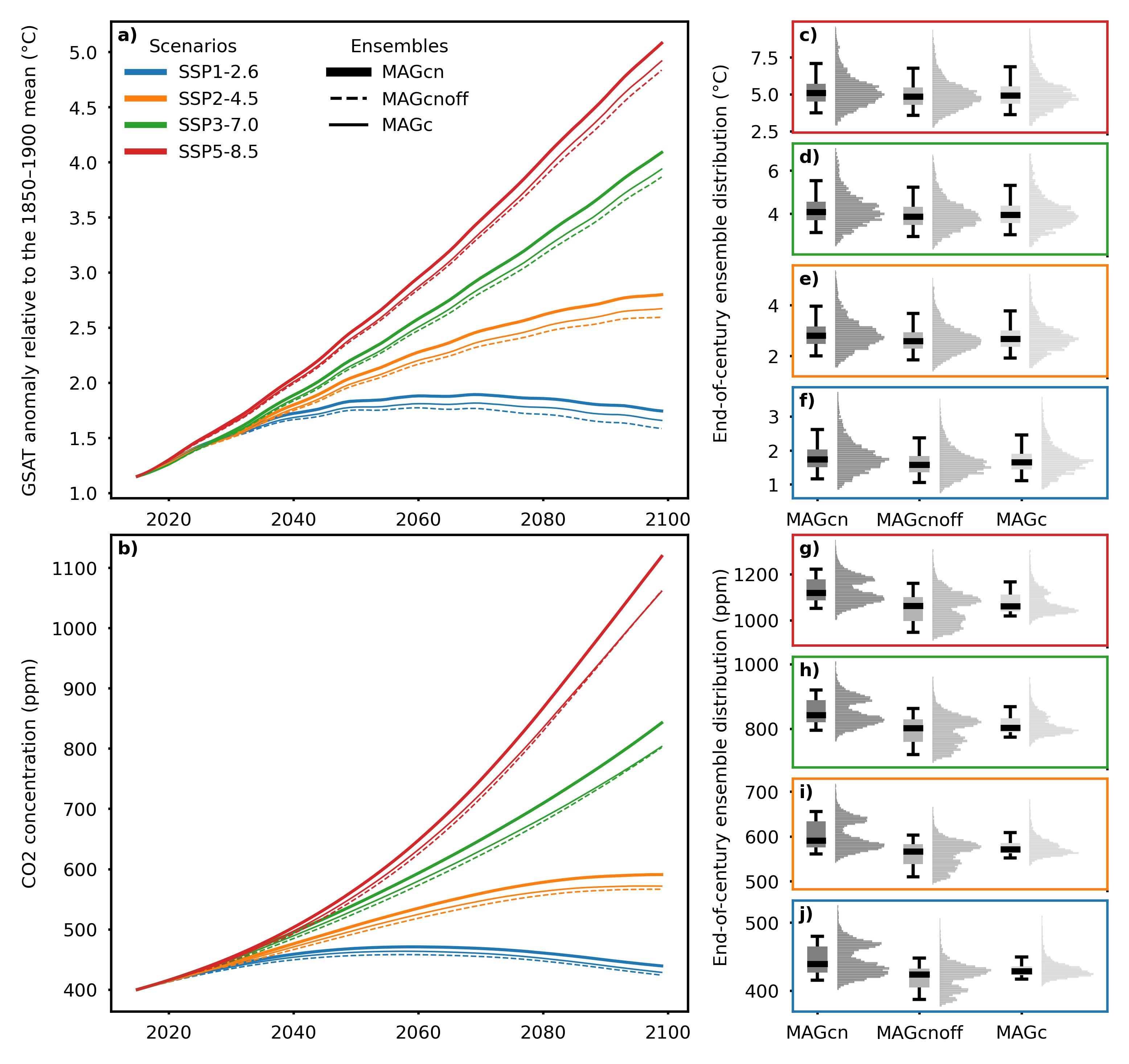
Using this framework, we performed emission-driven probabilistic ensemble projections of the climate and carbon cycle under ScenarioMIP pathways. The analysis relied on three distinct ensembles:
-
MAGc: Emulated carbon-only ESMs.
-
MAGcn: Emulated carbon–nitrogen coupled ESMs.
-
MAGcnoff: Emulated carbon–nitrogen coupled ESMs in which nitrogen does not influence carbon dynamics.
Comparing these three configurations allowed us to isolate the dynamic effect of nitrogen independently of broader structural differences among models.
Nitrogen Limitation and Carbon Cycle Feedbacks
When we isolated the impact of nitrogen limitation, the results were striking. Nitrogen limitation substantially weakens the Earth's natural capacity to absorb carbon by reducing the strength of two key feedback mechanisms.
Carbon–concentration feedback. This feedback quantifies how much additional carbon is taken up per unit increase in atmospheric CO₂ concentration. A larger positive value indicates a stronger carbon sink. Nitrogen limitation reduces this feedback by 37%, from 1.10 ± 0.36 to 0.70 ± 0.37 GtC ppm⁻¹.
Carbon–climate feedback. This feedback quantifies how much carbon is released per degree of warming. A less negative value indicates a weaker carbon loss to the atmosphere. Nitrogen limitation weakens this feedback by 16%, from −53.35 ± 37.53 to −44.6 ± 30.1 GtC °C⁻¹.
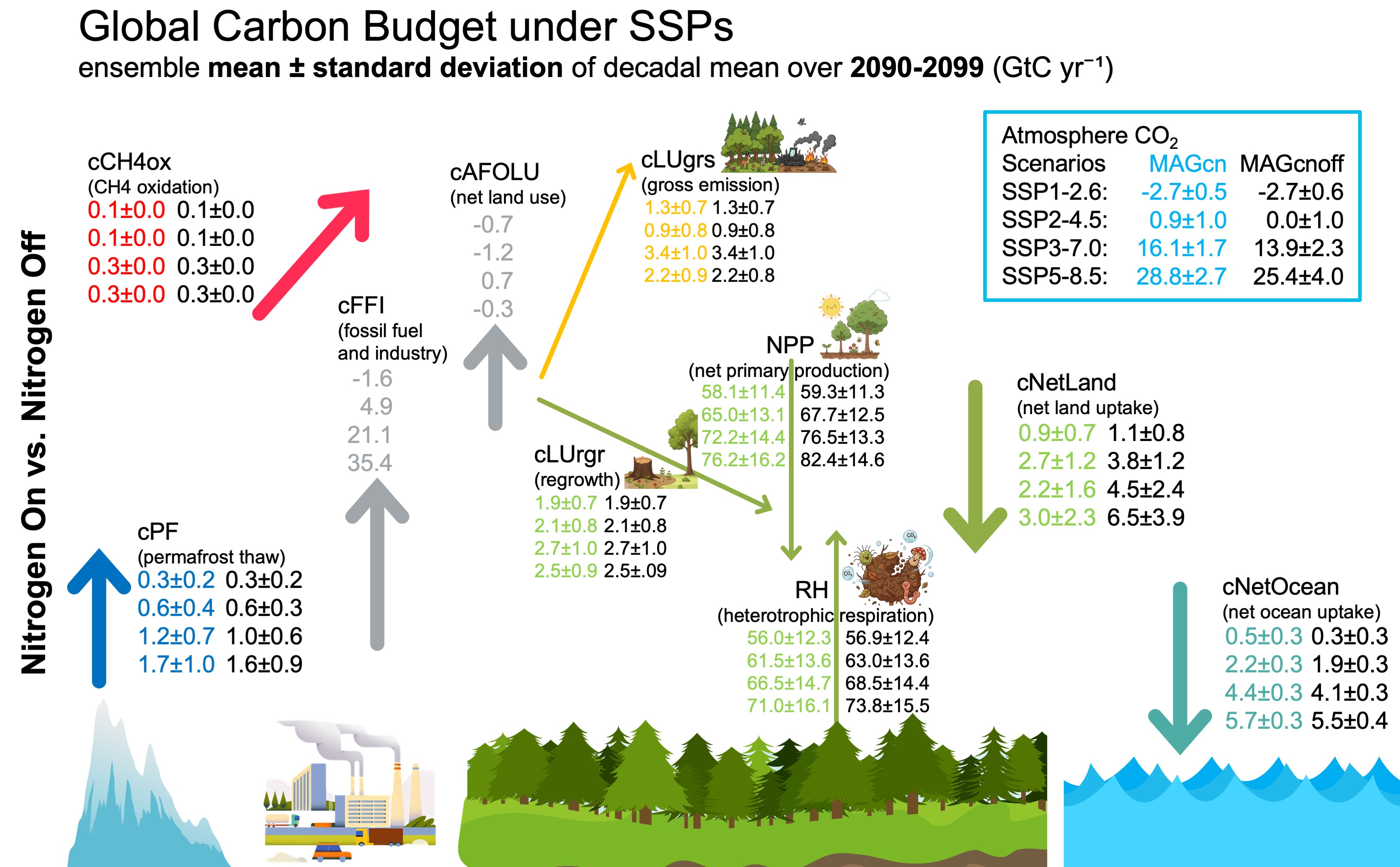
Importantly, the reduction in the carbon–climate feedback is insufficient to compensate for the much larger weakening of the carbon–concentration feedback. As a result, substantially less carbon is stored in terrestrial ecosystems, and the associated reduction in respiration cannot offset the loss of carbon uptake.
What Does This Mean for Future Climate Pathways?
The consequences are substantial:
-
Reduced land carbon sink: Nitrogen limitation decreases land carbon uptake by 18–54% across scenarios by 2100.
-
Higher atmospheric CO₂: Reduced carbon uptake leaves more CO₂ in the atmosphere, increasing concentrations by 15–57 ppm by the end of the century.
-
Amplified warming: The additional atmospheric CO₂ increases global warming by 0.16–0.25 °C across SSP scenarios.
Perhaps the most concerning result emerges under the high-emissions scenarios SSP3-7.0 and SSP5-8.5. Our probabilistic projections show that the 5th percentile of net land carbon uptake becomes negative, reaching −0.5 and −0.9 GtC yr⁻¹, respectively, by 2100. This suggests a risk that terrestrial ecosystems could transition from a net carbon sink to a net carbon source by the end of the century under continued high emissions.
Looking Ahead
While carbon-only ESMs implicitly capture some historical effects of nitrogen limitation through model calibration and tuning, our findings demonstrate that they do not fully represent the impact of nitrogen on future climate projections.
We can no longer assume that the terrestrial biosphere will continue scaling its carbon uptake in proportion to increasing anthropogenic emissions without biogeochemical constraints. Nitrogen availability fundamentally limits the capacity of ecosystems to remove carbon from the atmosphere.
Our study provides the first internally consistent quantification of nitrogen's role in coupled climate–carbon dynamics across the CMIP6 ensemble. These results highlight the importance of explicitly representing nitrogen cycling in both ESMs and climate emulators to produce robust, self-consistent projections of future climate change and carbon-cycle dynamics.
Follow the Topic
-
Communications Earth & Environment
An open access journal from Nature Portfolio that publishes high-quality research, reviews and commentary in the Earth, environmental and planetary sciences.

Related Collections
With Collections, you can get published faster and increase your visibility.
Ecological resistance and resilience under global change
Publishing Model: Open Access
Deadline: Apr 07, 2027
Hazards in Mountain Regions
Publishing Model: Open Access
Deadline: Nov 02, 2026

