How to distinguish a good socialist country from a bad one
Published in Social Sciences, Earth & Environment, and Physics



Protagonist of Sergey Dovlatov's "Compromise", a journalist in a mid-1970s Tallinn newspaper, constantly struggles with norms and conventions of Soviet ideological canon. Once, after he submits a short info piece, he has the following exchange with the editor:
- You made a serious ideological mistake.
- ?
- You are listing the countries...
- Is it not allowed?
It is. Allowed, and necessary. But the point is how you list them. In what order. You have Hungary, East Germany, Denmark, then Poland, USSR, West Germany. - Naturally. In [Cyrillic] alphabetic order.
- It is an extraclass approach, - groans the editor, - there is a proper order set in stone. Democratic [i.e., socialist] countries first! Then neutral states. And only in the end, the bloc [i.e., NATO] members.
- Ok, I said.
I rewrote the info, passed it on to the secretariat. Next day he runs in: - You are mocking me! Are you doing it on purpose?
- What now?
- You mixed up the popular democracy countries! You have East Germany after Hungary! Alphabet, again? Forget that opportunistic word! You are working in a party newspaper. Hungary goes in the third place. There was a putch there.
- And there was a war with Germany.
- Don't argue! Why are you arguing? This is a different Germany, different! Don't understand, who entrusted you with this? Political shortsightedness! Moral infantilism!...
Every news medium has to decide which stories and which places to cover in their reporting. In doing so it inevitably develops some conventions on which topics and parts of the world are more and which are less important. Such conventions, which we call representation biases, are rarely as explicit as in the Soviet Union, but they are inevitable and worth studying: on one hand side, it helps to notice forgotten places and topics, on the other, elucidation of hidden and sometimes unconscious biases gives a lot of information about underlying collective values of the news-producing medium and the society in which it functions.
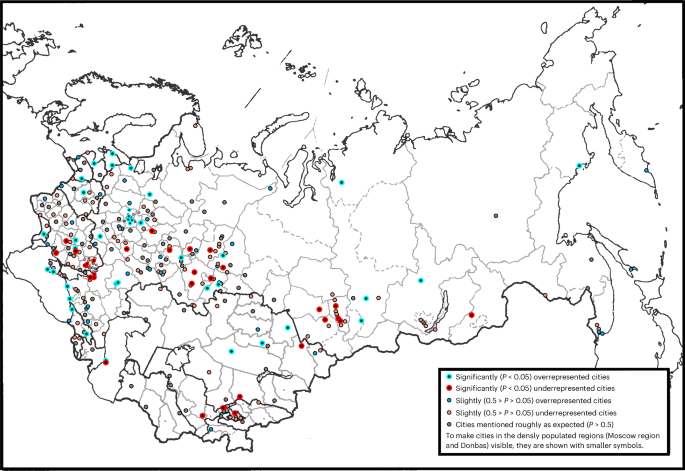
In the "City representation in Soviet propaganda and geographical biases in cultural data", which was just published in Nature Cities (https://www.nature.com/
Some of the patterns we notice, like, e.g., large difference in attention between domestic and foreign cities, excessive interest towards foreign capitals, and over-representation of the close neighbourhood of the population center where medium is produced (Moscow in our case) seem natural and are probably to be expected of most news media. Some others reflect well-documented peculiarities of the Soviet Union, such as, e.g., excessive interest in huge hydroelectric dams and in the "virginlands" of Northern Kazakhstan. Another example is a clear split of the world into three distinct mega-regions:
- the disproportional well-covered "socialist" world;
- "capitalist" world (or, de facto, "white and developed": Western Europe, USA, Canada and Australia) perceived as an ideological enemy but also as the significant Other with whom to compare oneselves; this latter role is disproportionally borne by two "friendly neutral" capitalist states - Austria and Finland;
- "developing" or "third", which, data shows, implicitly includes Japan and China and which, contrary to the official ideological narrative, attracts much less interest than the other two.
Interestingly, one can go beyond these known biases and point out other unexpected ones, such as a peculiar fascination with metallurgy and systematic neglect of Eastern Ukraine and of ethnic minorities within Russia proper. Internal structure of the "socialist" world differentiating "good" and "bad" allies in a way akin to Dovlatov's example is also clearly seen.
We believe that the method we developed here could and will be used to study geographic representation and mental maps in various other contexts.

Follow the Topic
-
Nature Cities
This journal aims to deepen and integrate basic and applied understanding of the character and dynamics of cities, including their roles, impacts and influences — past, present and future.