Hydrogel with cell-cell adhesion cues enhances neural regeneration
Published in Bioengineering & Biotechnology and Biomedical Research
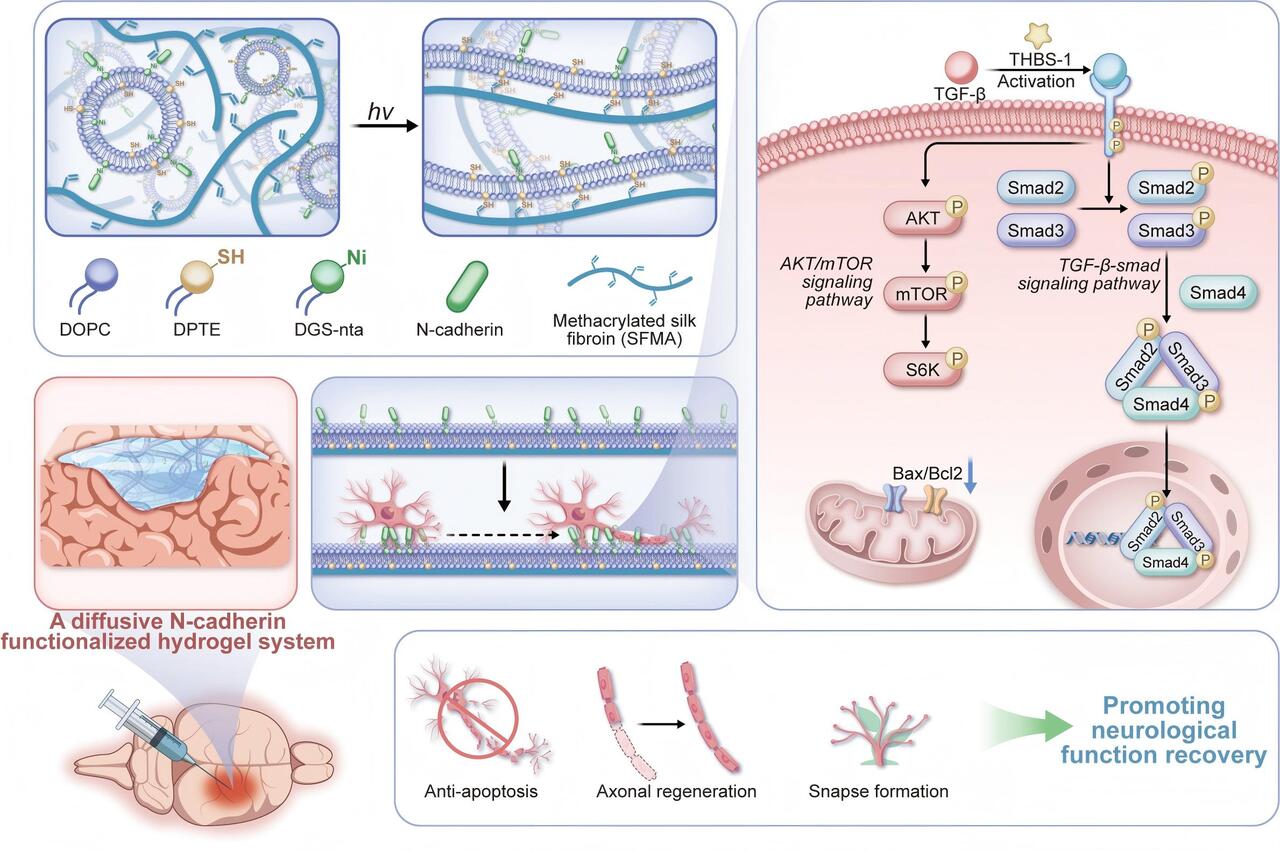


In addition to cell-extracellular matrix (ECM) interactions, cell-cell adhesion and communication mediated by cell adhesion molecule, play critical roles in maintaining cellular functions and the structural integrity of tissues in organisms. Particularly in the central nervous system, cell-cell adhesion dependent neuron-neuron and astrocyte-neuron interactions can facilitate synaptogenesis and the functionality of neural networks, which are significant for brain functions, including motor function, memory, and learning.
Remarkably, artificial lipid bilayers mimicking cell membranes have been developed to enable protein lateral mobility recently, which offer possibilities for investigating interactions of cell adhesion molecules in biological process. However, inability to adapt to three-dimensional tissues structure limits the application of such artificial systems in vivo. On the other hand, although cell adhesion molecules have also been directly fixed in the polymer chain of bioscaffold to enhance cell-ECM interactions in tissue regeneration, it leads to the loss of functionality of these cell adhesion molecules in providing effective cell-cell adhesion cue.
Overall, cell-cell adhesion cue has not been effectively replicated in biomaterials and cell-cell adhesion associated mechanisms that enhance neural regeneration remained largely unexplored.
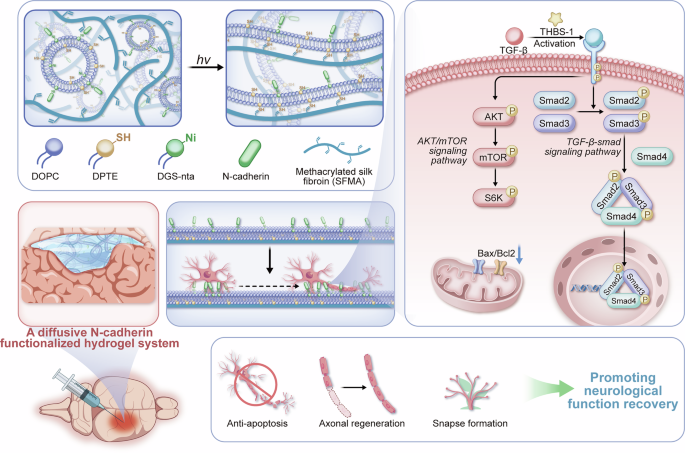
Based on our previous experience in the synthesis and applications of bionic scaffolds for neural regeneration (for example, Advanced Functional Materials, 2024, 34, 2314610; Advanced Functional Materials, 2023, 33, 2213342; Science Advances, 2021, 7, eabi5812; Nano Letters, 2021, 21, 3007), we have now developed a diffusive N-cadherin functionalized hydrogel system in our new manuscript, which provided cell-cell adhesion cue to modulate intercellular communications to significantly promote the formation of active neural network. The dynamic assembly of N-cadherin at cell membrane-hydrogel interface driven by adhered cells occurred at a timescale of minutes, facilitating the reshaping of membrane protrusions to initiate intercellular adherens junctions and modulate long-term cell-cell communications. Focusing on the mechanisms, it is associated with Thrombospondin-1 (THBS-1) mediated neural communication and activation of TGF-β/Smad pathway. Furthermore, the hydrogel system was applied to traumatic brain injury (TBI) models and not only effectively promoted neural regeneration and synapse formation, but also notably inhibited microglia over-activation to hinder glial scar formation, thereby facilitating neurological function recovery in rats following TBI. This finding provides a novel strategy for developing new materials for the treatment and regeneration after nervous system trauma.
More importantly, this manuscript represents only the beginning of a broader journey. Although this research primarily focuses on N-cadherin and neural regeneration, the principles of replicating diffusive cell adhesion molecules mediated cell-cell adhesion in hydrogels will spark new research interest in the development of engineered biomaterials aimed at modulating various cell fates in the regeneration of diverse tissues, as well as investigating the roles of other cell surface molecules across different organs during development. And, putting these biomaterials into the hands of clinicians would have great potential for improving patient outcome.

Follow the Topic
-
Nature Communications

An open access, multidisciplinary journal dedicated to publishing high-quality research in all areas of the biological, health, physical, chemical and Earth sciences.
Related Collections
With Collections, you can get published faster and increase your visibility.
Women's Health
Publishing Model: Hybrid
Deadline: Ongoing
Biosensing
Publishing Model: Hybrid
Deadline: Jun 30, 2026

Please sign in or register for FREE
If you are a registered user on Research Communities by Springer Nature, please sign in