Hydrophobic Eutectogels Reinforced by Zn2+-Coordinated Lignin Nanoparticles for Underwater Wearable Electronics
Published in Bioengineering & Biotechnology and Materials
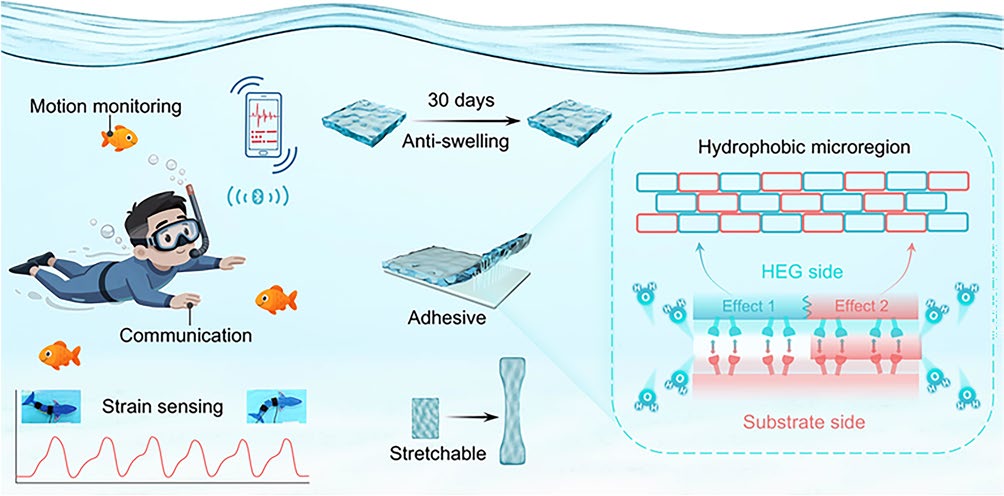
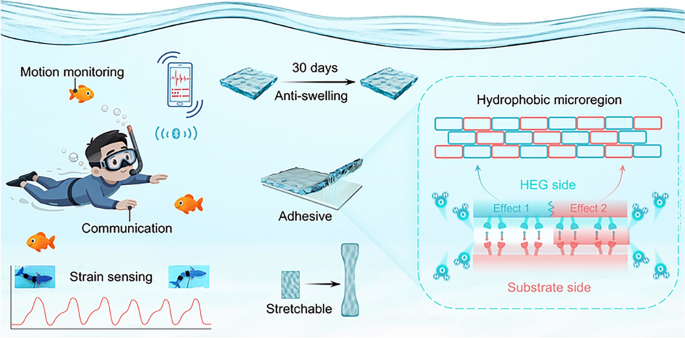

As underwater wearable electronics and marine monitoring increasingly demand materials that can remain mechanically robust, adhesive, and responsive in aqueous environments, conventional hydrogels often suffer from severe water uptake, swelling, mechanical degradation, and interfacial failure. Researchers from Dalian Polytechnic University, Zhejiang A&F University, Southwest Forestry University, and Central South University of Forestry and Technology have developed a multifunctional hydrophobic eutectogel that combines strong mechanical performance, long-term anti-swelling behavior, underwater adhesion, and sensitive strain sensing.
Why This Underwater Gel Matters
Traditional hydrophilic gels rapidly absorb water during immersion, causing swelling, structural weakening, and unreliable signal transmission. The new strategy addresses this challenge by integrating hydrophobicity, mechanical reinforcement, and interfacial adhesion within a single gel architecture. In particular, lignin nanoparticles provide a renewable and bio-based platform for constructing dynamic interactions, offering an attractive route toward sustainable underwater flexible electronics.
Innovative Design and Mechanism
The material, DPF-Zn@LNP-HEG, is fabricated through one-step UV-induced polymerization of a polymerizable hydrophobic deep eutectic solvent (PHDES), 2-phenoxyethyl acrylate (PEA), and Zn2+-coordinated lignin nanoparticles (Zn@LNP). The PHDES combines hydrophobicity with polymerizability, while PEA introduces flexible hydrophobic segments. Zn@LNP serve as dynamic sacrificial cross-linkers through reversible coordination and hydrogen-bond interactions, enabling efficient stress dissipation and network reinforcement. Meanwhile, the polymer networks and metal–phenolic complexes generate hydrophobic microdomains that disrupt surface hydration and create barriers against water penetration. DMF further improves interfacial compatibility and underwater adhesion.
Outstanding Performance
The optimized eutectogel achieves a tensile strength of 1.14 MPa, elongation at break of 667.6%, and toughness of 3.15 MJ m-3, while withstanding strains up to 600% and supporting a 5 kg load. It maintains excellent fatigue resistance over 100 cycles and exhibits a fracture energy of 145.08 kJ m-2. Importantly, swelling remains below 1% after 30 days of immersion, while underwater adhesion reaches 1.07 MPa on glass and remains effective across diverse substrates.
Applications and Future Outlook
The material also functions as a highly sensitive underwater strain sensor, achieving a gauge factor of 3.29–8.12 over 0–300% strain, with a response time of 480 ms and recovery time of 460 ms. Its practical capabilities extend from underwater Morse-code communication to marine-motion monitoring. Finger bending successfully transmitted “SOS,” while sensors attached to robotic whale and turtle models captured characteristic swimming motions. A Bluetooth-enabled system further enabled real-time monitoring and counting of swimming movements on a smartphone. These results establish the eutectogel as a promising platform for next-generation underwater wearable electronics, marine communication, and biological motion monitoring.

Editor of Nano-Micro Letters, which is an Open-Access, peer-reviewed journal reported papers that have at least one dimension ranging from a few sub-nanometers to a few hundreds of micrometers. The journal is published by Springer Nature and indexed by SCI, EI, SCOPUS, Pubmed, etc. The 2025 JCR Impact Factor is 38.5. The 2025 CiteScore is 58.9.
Follow the Topic
-
Nano-Micro Letters
Nano-Micro Letters is a peer-reviewed, international, interdisciplinary and open-access journal that focus on science, experiments, engineering, technologies and applications of nano- or microscale structure and system in physics, chemistry, biology, material science, and pharmacy.