In Search of Lost Tunnelling Time: Why Two Quantum Clocks Disagree
Published in Physics

Tunnelling is one of the most iconic predictions of quantum mechanics. A particle can cross a barrier that would be forbidden in classical physics. But once we ask a seemingly simple question — how long does that tunnelling take? — the answer becomes much less straightforward.
This question has been debated for decades, and over the years it has also become accessible experimentally. In strong-field ionization, a sufficiently intense laser field bends the atomic potential into a barrier, and the electron can escape by tunnelling through it. This has made tunnelling time an important question in attosecond studies of strong-field ionization.
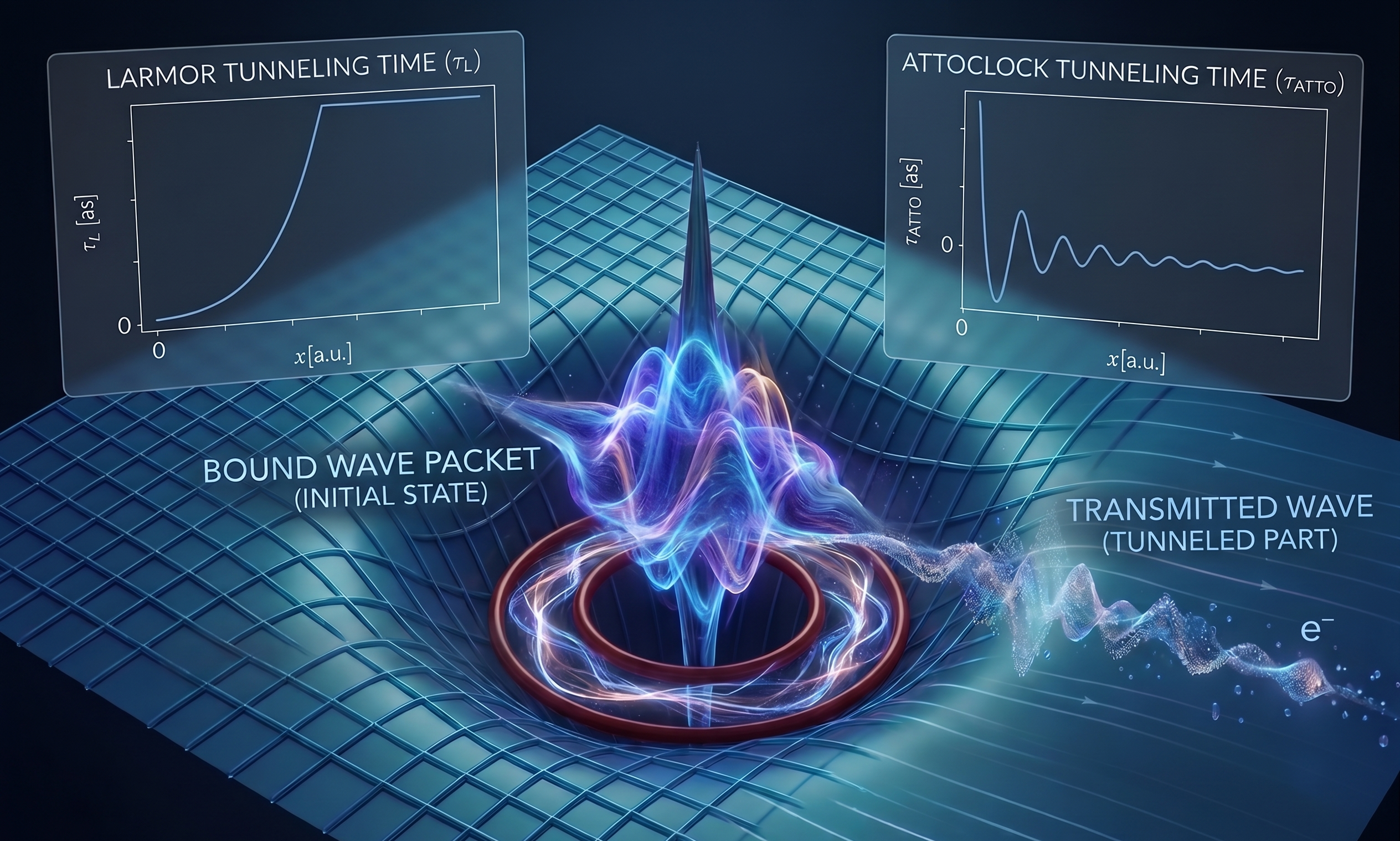
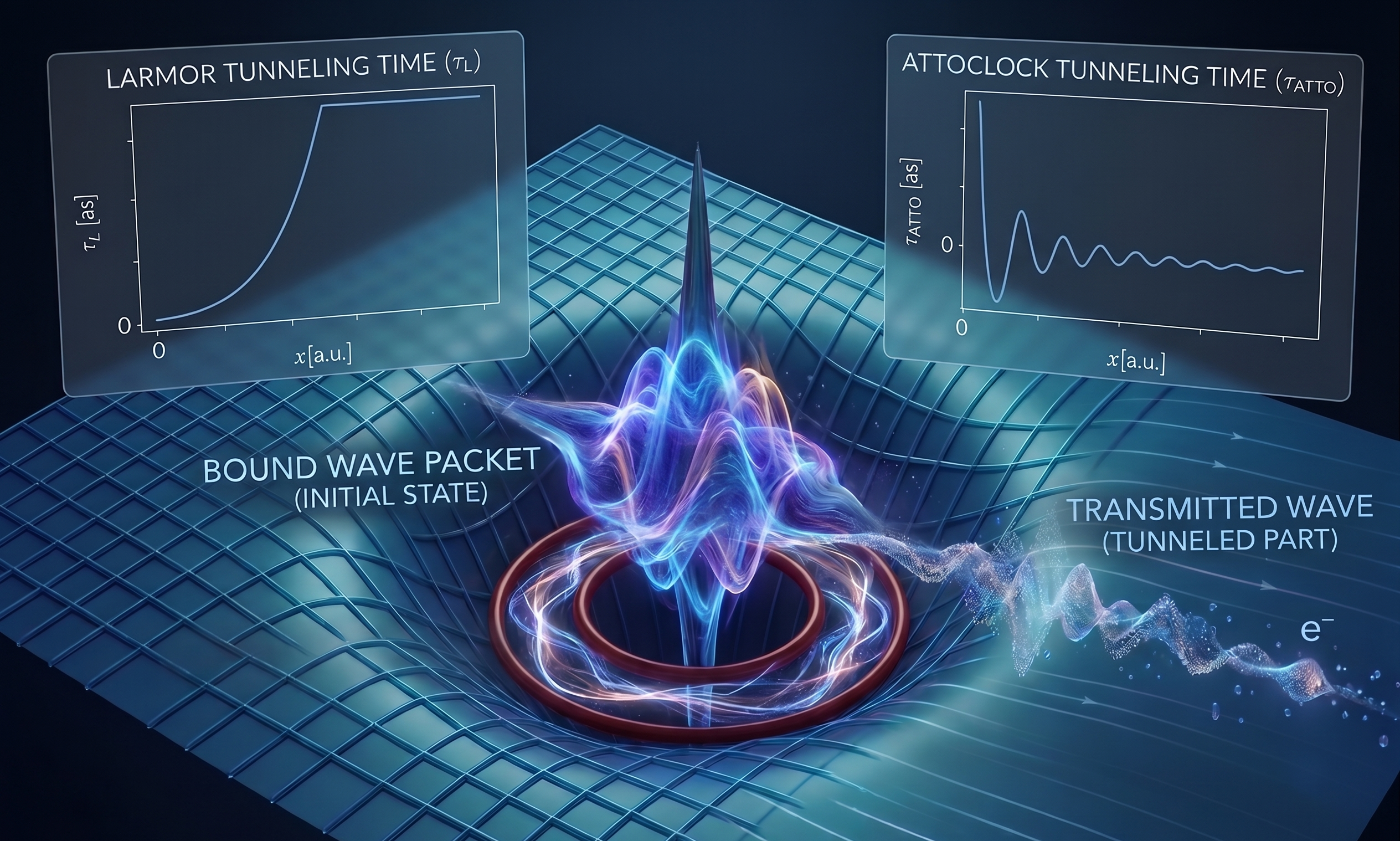
Two important approaches to tunnelling time came from very different experimental ideas. In the Larmor clock, a weak magnetic field confined to the barrier lets one infer how long the particle spends there from the amount of spin precession; experiments of this kind have found a non-zero tunnelling time. In strong-field ionization, the attoclock instead uses the rotating laser field as a clock hand and reads timing information from the final direction of the escaping electron. The obvious question is whether these two clocks are really measuring the same thing. Figure 1 shows this schematically.
An important motivation for our work came from earlier results on the attoclock itself. These showed that for short-range binding potentials, the attoclock yields no tunnelling delay. In the Coulomb case, by contrast, the observed offset angle is largely shaped by Coulomb scattering, and once that contribution is subtracted, the attoclock result again appears consistent with zero tunnelling time. This makes it difficult to identify the attoclock time with the Larmor time.
In our work, however, we show that the Larmor time in this setting is non-zero. That shifts the question in an important way: the issue is not simply why two clocks give different numbers, but whether they were ever measuring the same quantity in the first place. To answer that, we needed a common framework in which the attoclock and the Larmor clock could be compared directly.
The key step in our work is to express both clocks in a common language: the language of weak values. This gives us a direct way to compare them, because both can then be formulated in terms of quantum amplitudes rather than classical intuition.
Seen in this way, the difference between the two clocks becomes much clearer. Following Steinberg’s weak-value interpretation of the Larmor clock, the Larmor time is the weak value of the projector onto the barrier, divided by the probability current. This gives it a natural fluid-like interpretation: just as, in an ordinary flow, the amount of fluid inside a region divided by the flow rate through it defines a residence time, here the probability density in the barrier divided by the probability current defines a quantum time. The difference is that this is not an ordinary expectation value, but a weak value conditioned on the electron ultimately traversing the barrier. In this sense, it provides a local, position-resolved tunnelling time that accumulates across the barrier and reaches a finite value at the tunnel exit.
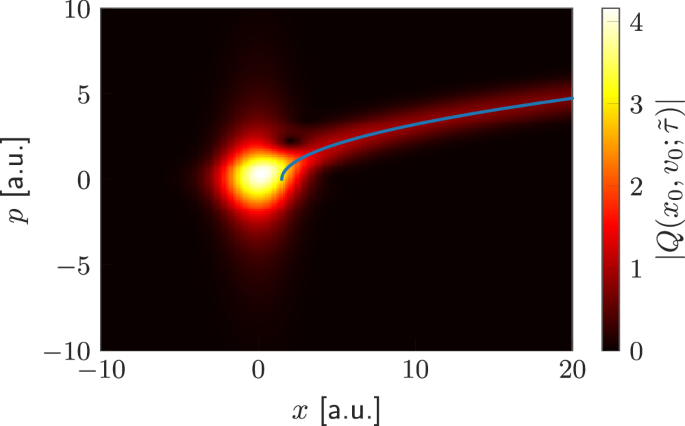
The attoclock, by contrast, is not tied to the barrier in the same local way. It is read out through the final momentum of the electron, far from the atom. We show that it too can be written as a weak value, but now of a temporal delay encoded in the ionization amplitude rather than of a projector onto the barrier. The idea of temporal delay originally comes from scattering, where one compares how a wavepacket emerges with and without the barrier. So although both clocks admit a weak-value interpretation, they correspond to different observables.
As illustrated in Figure 1, this is why the attoclock does not recover the Larmor time. The Larmor clock measures a local barrier time, whereas the attoclock measures a non-local delay extracted from the full ionization amplitude. The two clocks do not disagree because one is right and the other is wrong, but because they probe different aspects of the same process.
More broadly, this helps clarify why tunnelling time remains such a subtle concept. In quantum mechanics, the answer to the question “how long does tunnelling take?” depends on what observable is being measured and how that information is accessed experimentally. The attoclock and the Larmor clock are both meaningful, but they do not measure the same time.
Our results also suggest why this question remains experimentally challenging. If one wants direct access to a genuinely local tunnelling time at the barrier exit, then detecting only the final electron momentum at a distant detector is not enough. The relevant information is progressively lost during propagation.

Follow the Topic
-
Communications Physics
An open access journal from Nature Portfolio publishing high-quality research, reviews and commentary in all areas of the physical sciences.

Related Collections
With Collections, you can get published faster and increase your visibility.
Nonlinear dynamics of living systems
Publishing Model: Open Access
Deadline: Nov 09, 2026
Active, Entangled or Confined: Polymer Physics Across Synthetic and Living Matter
Publishing Model: Open Access
Deadline: Dec 31, 2026