Knowing Its Name, Not Its Nature: Unmapping the AI Illusion in Higher Education
Published in Education and Philosophy & Religion


As educators, we are currently witnessing a dangerous and pervasive illusion take root in our lecture halls. Over the past two years, students across all disciplines have rapidly adopted generative artificial intelligence. They use these platforms to draft essays, generate code, and synthesize complex literature. On the surface, this looks like technological fluency. However, when you stop a student and ask them to explain how the underlying language model actually arrived at its output, the fluency shatters. The realization hit us forcefully: our students are driving a high-performance vehicle at top speed, but they have absolutely no idea how the engine works, nor do they realize they are missing the steering wheel. They are treating generative AI not as a probabilistic, algorithmic tool, but as an omniscient, infallible oracle.
This observation was the primary catalyst for our recent open-access research published in the International Journal of Educational Technology in Higher Education. Hanife and I recognized that before we could build effective AI literacy programs, we first needed to accurately diagnose the cognitive void.
The immediate challenge was methodological. How do you accurately measure a student’s understanding of a disruptive technology? Traditional Likert-scale surveys and self-reporting questionnaires were inadequate. Students are highly adept at recognizing what they are supposed to say about AI ethics or data privacy, leading to socially desirable responses that mask their actual cognitive frameworks. We needed to bypass these conscious filters and examine the raw semantic networks inside their minds.
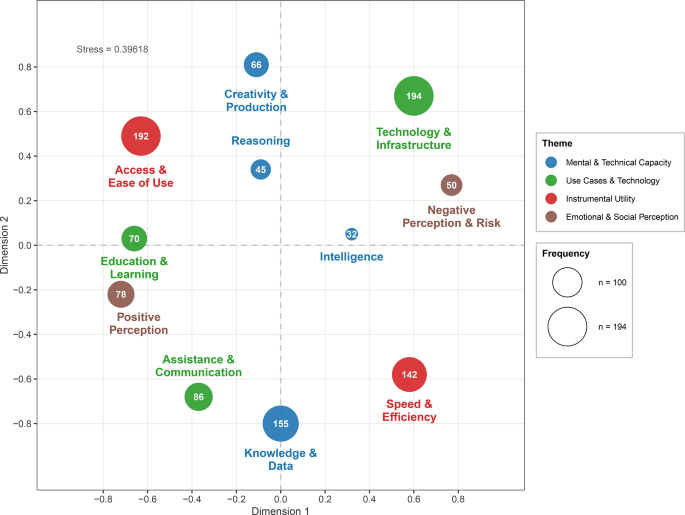
To achieve this, we turned to Word Association Mapping (WAM). By prompting students with core AI concepts and rigorously analyzing their immediate, unfiltered word associations, we could map the actual cognitive architecture of their understanding. We utilized advanced data analysis and network graphing to visualize these mental models. The process of categorizing and mapping these associations was painstaking, but it was absolutely necessary to separate what students genuinely understand from the buzzwords they merely parrot.
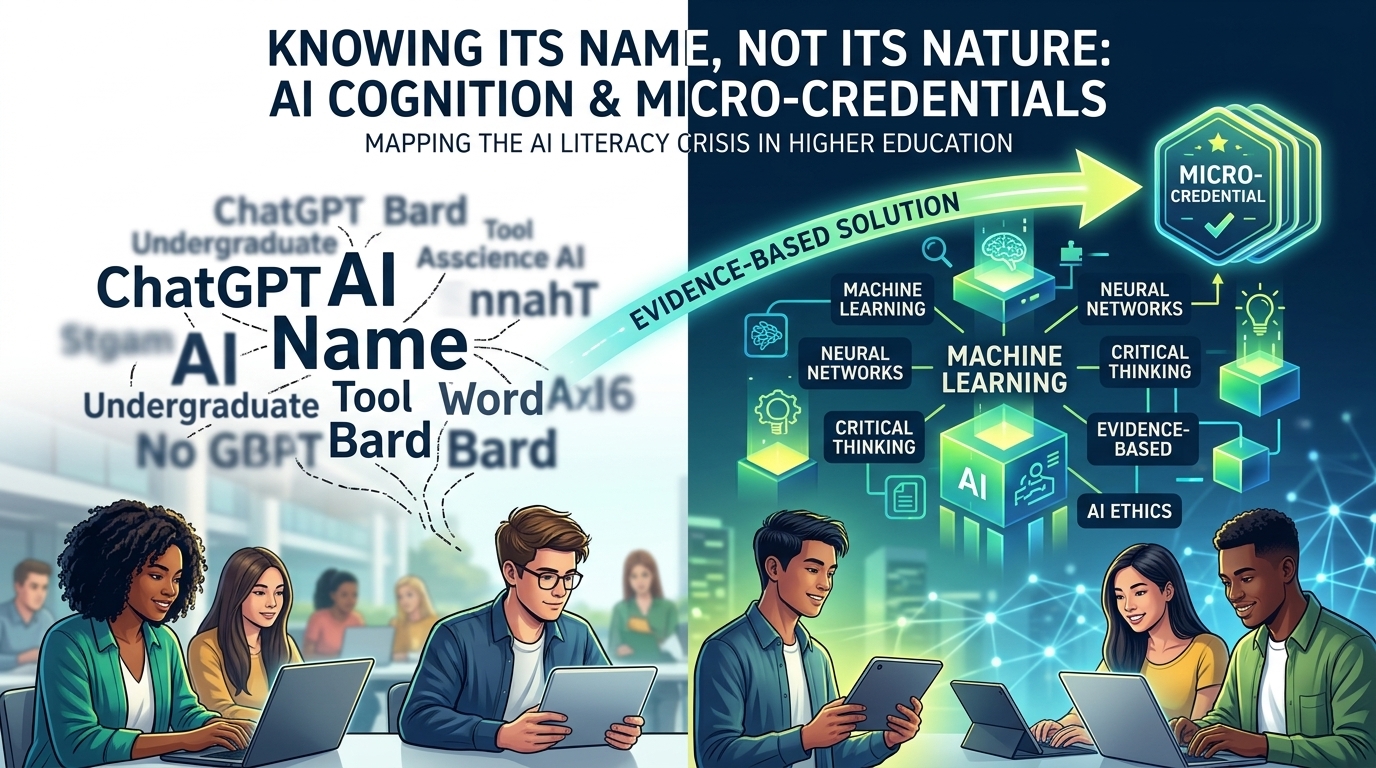
The network graphs revealed a terrifying clarity, leading to the core "oh, wow" moment of our study. The cognitive nodes surrounding commercial brand names—such as "ChatGPT," "Midjourney," and "Prompt"—were massive and highly interconnected. However, the nodes representing the fundamental mechanisms and risks of the technology—concepts like "Data Training," "Hallucination," "Algorithmic Bias," and "Probability"—were almost entirely non-existent. The data proved our hypothesis: students know the name of the tool, but they remain entirely ignorant of its nature.
This cognitive gap is not just an academic curiosity; it is a critical vulnerability. When students lack a structural understanding of neural networks and probabilistic text generation, their consumption of AI outputs becomes entirely uncritical. This leads directly to academic integrity crises, the amplification of systemic biases, and a deeply superficial integration of technology in the learning process. You cannot solve a cognitive gap of this magnitude by simply handing out a generic list of ethical guidelines at the beginning of a semester, nor can you solve it by fruitlessly attempting to ban the tools.
Our research explicitly transitions from diagnosing this problem to architecting a scalable solution. We argue that higher education must move beyond reactionary policies and implement structured, targeted interventions. In the paper, we detail the design of evidence-based micro-credentials specifically tailored to bridge this cognitive gap.
Designing these micro-credentials required moving past surface-level workshops. We grounded the curriculum architecture in robust instructional design frameworks, heavily utilizing the 5E instructional model (Engage, Explore, Explain, Elaborate, Evaluate) to force active cognitive friction. Rather than simply teaching students "how to prompt," our micro-credential design requires students to deconstruct AI outputs, analyze the probabilistic nature of the generated text, and critically evaluate the dataset biases. By integrating multimedia learning principles, we ensure that the complex, abstract mechanics of machine learning are rendered comprehensible and applicable for students across all academic disciplines, not just those in STEM fields.
We are sharing this "behind-the-scenes" perspective with the Research Community because we believe higher education is at an inflection point. We must transition our students from being passive operators of AI to becoming critically literate thinkers.
We invite our fellow educators, curriculum designers, and researchers in this community to reflect on their own institutions. Are our current assessment methods accidentally grading a student's prompt engineering skills rather than their actual subject comprehension? How are you actively disrupting the "omniscient oracle" illusion in your classrooms? We encourage you to read the full open-access paper to explore the cognitive mapping data and adapt our micro-credential framework for your own instructional contexts.
Follow the Topic
-
International Journal of Educational Technology in Higher Education
This peer-reviewed journal features current research in Educational Technology within Higher Education.