Lessons learned from adaptation opportunity windows in Europe
Published in Social Sciences and Earth & Environment




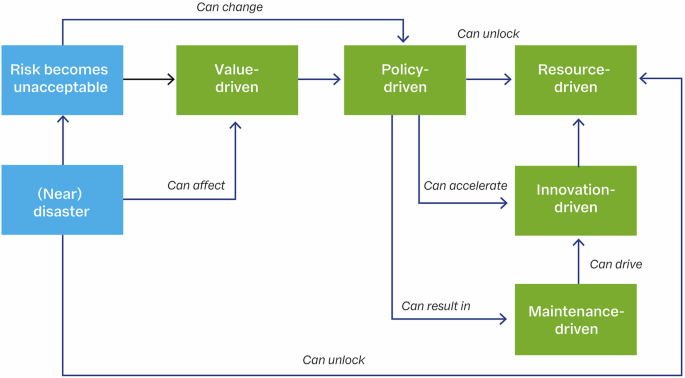

While the concept of adaption opportunities had been introduced earlier (Meijerink, 2005; Brown, Naylor & Quinn, 2017; Haasnoot et al., 2019; Birchall et al., 2023; Brullo et al., 2024), for this research we were curious whether we could find evidence of these in practice, and whether more could occur in the future. Our main objective was thus to build a larger evidence base in Europe of different adaptation opportunity window classes. To do so, we started by diving into existing literature, so to characterise different opportunity windows classes. This resulted in the identification of five classes, characterised by the different drivers which trigger the opening of adaptation windows: 1) maintenance-driven (triggered by approaching maintenance, end-of-life or repair of existing infrastructural measures), resource-driven (triggered by availability of (financial) resources), 3) policy-driven (triggered by new policies and/or institutional arrangements), 4) value-driven (triggered by changes in societal values and/or political context), and 5) innovation driven (triggered by innovations in adaptation technology and their mainstreaming/upscaling). We then proceeded to populate each class with real-life evidence of adaptation opportunity windows. We identified maintenance-driven opportunities in a quantitative manner, by diving into the GranD dataset (Lehner et al., 2011) and pointing out for which dams across Europe the opportunity window is open today due to approaching need for maintenance and upgrade. Similarly, we point to which dams will have a similar window open in the future and associate future adaptation opportunity windows with limits of the MOSE in Venice, Maeslant Barrier in Rotterdam and Thames Barrier in London.
We identified adaptation opportunity windows of other classes more qualitatively, through both academic and grey literature, by for example analysing upcoming deadlines of implementation of EU Directives such as the Water Framework Directive, but also Floods, Habitats and Birds Directives, and looked at the aftermath of recent climate disasters such as the 2021 floods in Germany, 2023 floods in Slovenia, multiple wildfires across Greece and multi-year drought in Europe for what regards value-changes, policies and available resources. We also looked for successful innovative climate adaptation technologies and pilots (floating and amphibious homes, transitional polders, but also the Dutch Sand Motor and Room for the River project). All in all, our analysis resulted in the identification of 34 adaptation opportunity windows which either opened and closed in the past, remain open today or may open in the future in Europe.
Not just waiting for an opportunity to open up
A key and positive finding that was striking to me was that adaptation opportunity windows can be shaped. Opportunity windows are often presented in the context of emerging windows (e.g. those driven by extreme (near) events, or aging infrastructure). Here, we found that some can instead be shaped, by governments at different scales through the creation of policies, (EU) directives, climate councils, and opening of recovery, but also innovation funds. The private sector may also shape opportunity windows (alone or through public-private collaborations) by bringing in innovative adaptation technologies which may open opportunities for replication, upscaling and mainstreaming.
What is next?
Our research identified 34 examples of adaptation opportunity windows in Europe in the past, present and future. The number is not intended to be exhaustive, rather, it provides a first-order assessment of how many opportunities emerge when one looks for them. We envision that our work inspires future research to expand the list through more systematic and quantitative mapping, focused on a specific class or on particular (sub-)national scales. We also welcome assessments of adaptation opportunities outside of the European context.
The authors will continue to build on these findings. Within the Pathways2Resilience (P2R) project - the EU project which supported part of this work - a large cohort of European regions will get the chance to apply and test the adaptation opportunities concept in practice, which should generate additional real-world examples. Similarly, the cascade-funding structure of the project may help catalyse action across Europe, potentially opening resource-driven opportunity windows and more.

Follow the Topic
-
Communications Earth & Environment
An open access journal from Nature Portfolio that publishes high-quality research, reviews and commentary in the Earth, environmental and planetary sciences.

Related Collections
With Collections, you can get published faster and increase your visibility.
Ecological resistance and resilience under global change
Publishing Model: Open Access
Deadline: Apr 07, 2027
Hazards in Mountain Regions
Publishing Model: Open Access
Deadline: Nov 02, 2026