Minerals for the Future of Europe
Published in Earth & Environment, Sustainability, and Civil Engineering




Why raw materials are central to the continent’s strategic transition.
The European Union has placed climate neutrality, digital transformation and strategic autonomy at the centre of its political agenda. Yet beneath these ambitious objectives lies a material foundation that is often overlooked. Every wind turbine, electric vehicle, data centre and battery depends on minerals extracted, processed and transported through complex global supply chains.
The paper “Minerals in the future of Europe | Mineral Economics | Springer Nature Link” explores a fundamental question: can Europe realistically achieve its climate and digital ambitions without securing reliable, sustainable access to critical raw materials?
The answer is nuanced. Europe does not lack geological potential. It lacks coordinated long term strategy.
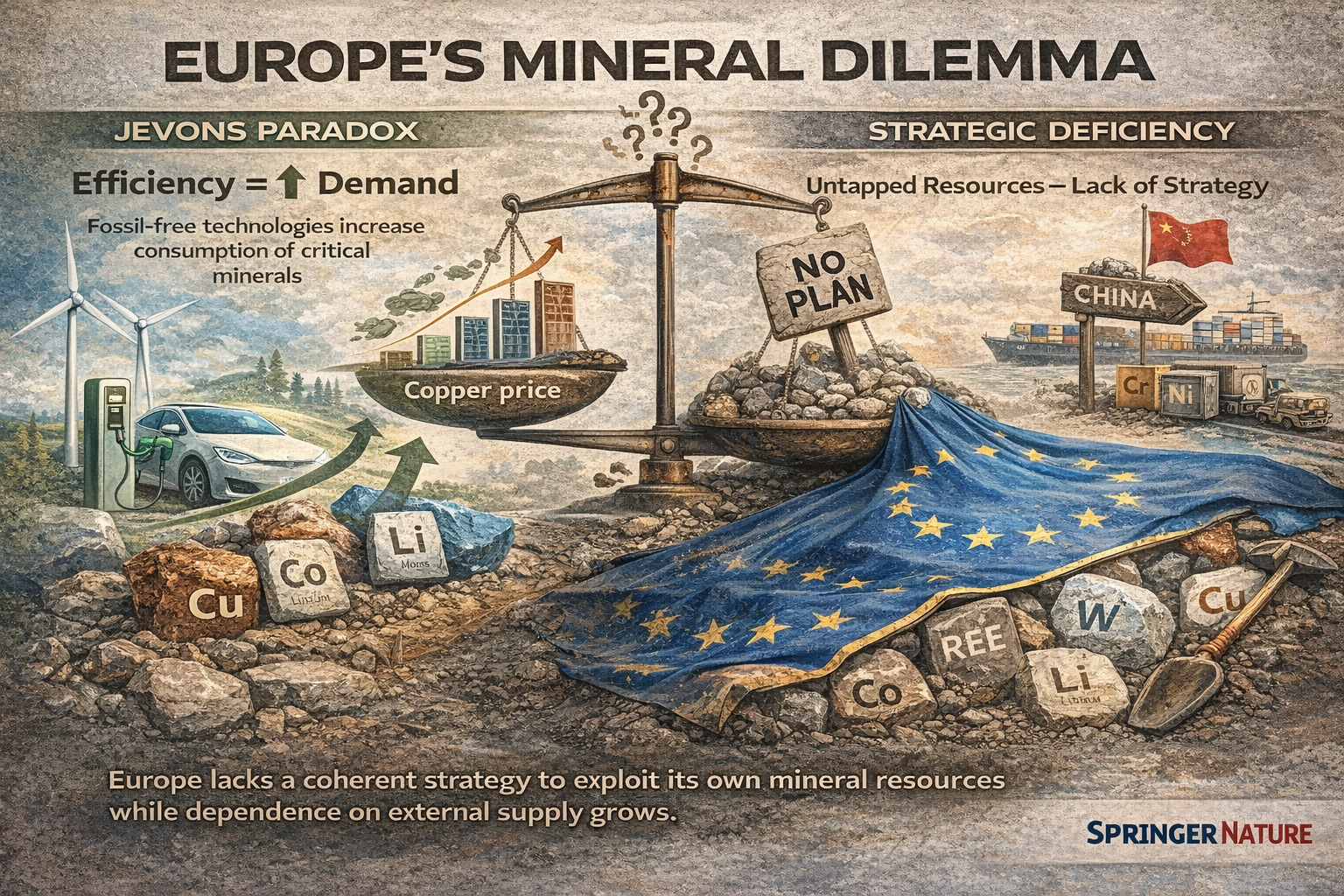
Over recent decades, mineral extraction gradually disappeared from public debate in many European countries. Production declined, social acceptance weakened and exploration investment shifted elsewhere. Meanwhile, demand for metals such as lithium, cobalt, rare earth elements, copper and nickel began to accelerate, driven by decarbonisation technologies.
The paradox is evident. Europe aims to electrify mobility, expand renewable energy and digitalise industry, while remaining heavily dependent on external suppliers for the very materials required to build this transformation.
According to European Commission assessments, the EU relies on imports for the majority of its supply of several critical raw materials. In some cases, a single country dominates global production or processing capacity. This concentration creates structural vulnerability.
The issue is not simply economic. It is geopolitical and technological.
The transition to a low carbon economy is mineral intensive. Electric vehicles require significantly higher quantities of copper than conventional cars. Wind turbines depend on rare earth elements for high performance magnets. Batteries require lithium, nickel, cobalt and graphite. Solar panels rely on silicon, silver and other specialty materials.
Demand projections indicate that several of these materials may increase by multiples over current consumption levels within the next decades.
This reality challenges a simplified narrative of energy transition as purely a question of replacing fossil fuels with renewables. It is equally a question of material systems.
The paper situates raw materials within a broader life cycle perspective. Securing supply does not mean expanding extraction indiscriminately. It means integrating three pillars:
First, responsible domestic production where geological resources exist and social license can be obtained. Europe hosts significant deposits of lithium, rare earth elements, tungsten and other strategic minerals. However, exploration and permitting processes are often lengthy and fragmented.
Second, strengthening recycling and circular economy systems. Urban mining, secondary raw materials and improved collection systems can reduce import dependence, although, as other studies have shown, recycling alone cannot fully offset rising demand in expanding markets.
Third, diversification of international partnerships. Strategic cooperation with producing countries must be based on environmental standards, transparency and long term stability.
The debate is sometimes framed as a tension between environmental protection and mining. The reality is more complex. A green transition without raw materials is impossible. At the same time, mineral extraction must meet increasingly stringent environmental and social standards.
The key challenge is governance.
Minerals policy can no longer be treated as a purely sectoral industrial issue. It intersects with energy policy, trade policy, defence, regional development and research strategy. The Critical Raw Materials Action Plan and subsequent initiatives reflect this recognition, but implementation remains uneven.
A central message of the paper is that Europe must rebuild technical and educational capacity in the raw materials sector. Exploration geologists, mining engineers, metallurgists and processing specialists are essential actors in the energy transition, yet training pipelines in several countries have weakened over time.
Research and innovation also play a decisive role. New extraction technologies, improved beneficiation processes, substitution research and advanced recycling techniques can reduce environmental footprint and increase efficiency. However, technological innovation cannot substitute for strategic planning.
Public perception is another critical dimension. Mining is often associated with historical environmental impacts. Communicating modern standards, transparency mechanisms and life cycle assessments is necessary to rebuild trust.
The mineral dimension of sustainability is frequently invisible to end users. Consumers see electric vehicles and solar panels as clean technologies, but rarely consider the upstream supply chains. Bringing material flows into public discussion is essential for informed policy.
The future of Europe’s green and digital transition is therefore inseparable from mineral governance.
If Europe seeks strategic autonomy, it must address raw materials not as a residual input, but as a foundational element of industrial and environmental policy. This requires integrated planning, investment in exploration and processing, reinforcement of circular economy strategies and constructive engagement with communities.
The transformation underway is not only an energy transition. It is a materials transition.
Understanding this shift is essential for researchers, policymakers and industry stakeholders alike.
Further details can be found in the full paper:
Minerals for the Future of Europe
[DOI ] https://doi.org/10.1007/s13563-021-00254-7
More of my research on raw materials policy, strategic autonomy and sustainable mineral governance is available on my Springer Nature author profile:
https://www.springernature.com/gp/authors/antonio-alonso-jimenez
Follow the Topic
-
Mineral Economics
This is an international, multidisciplinary journal focusing on economics and policy issues in the minerals, metals, mining industries, and its role in society.

What are SDG Topics?
An introduction to Sustainable Development Goals (SDGs) Topics and their role in highlighting sustainable development research.
Continue reading announcement