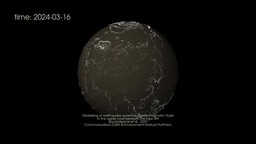
Modelling of earthquake swarms suggests magmatic fluids in the upper crust beneath the Eger Rift
Published in Earth & Environment
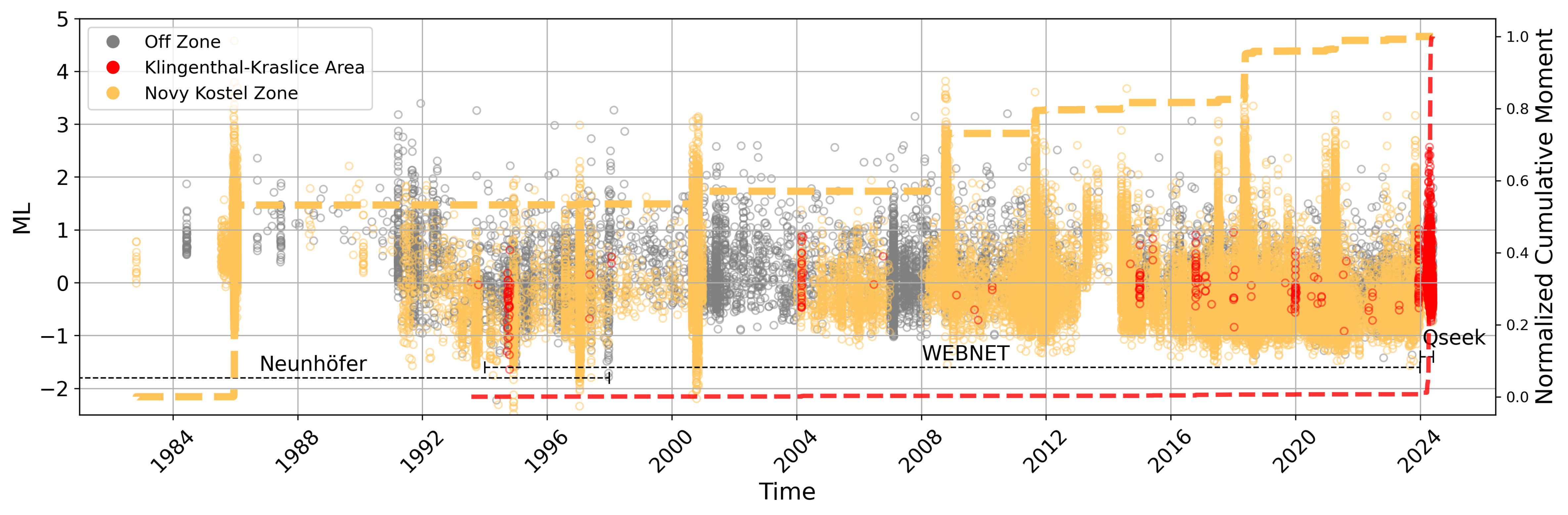
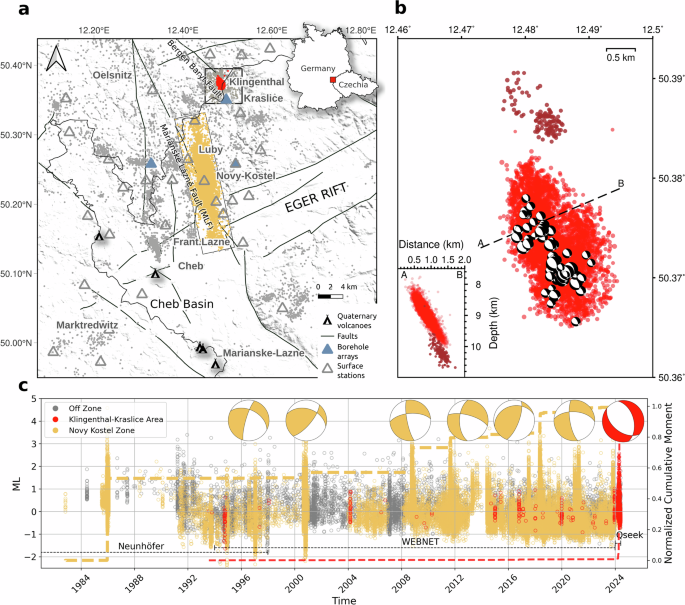

What made this swarm notable was not only its scale, but also where it happened: directly within one of the densest seismic observation infrastructures in Europe. Thanks to the ICDP “Drilling the Eger Rift” borehole arrays, multiple broadband stations, and the extensive WEBNET and Saxon networks, many of the stations were located just a few kilometers from the active fault. This allowed us to capture the swarm with exceptional resolution, detecting more than 8,000 events down to magnitude -0.5, with location uncertainties of less than 0.1 km.
From the outset, I was highly motivated to study this swarm in detail because it was directly connected to my CHASING project, funded by the German Research Foundation (DFG). In CHASING, we aim to locate earthquake swarms with high precision and understand the mechanisms that drive their formation.
During the analysis, two distinct evolutionary stages of the swarm became apparent: a rapid and strongly asymmetric bidirectional expansion of the seismic cloud, followed about one week later by a slower radial growth of the seismic front within a distinct fault zone over a period of more than five weeks. Additionally, we applied a novel specialized method to detect temporal changes in local seismic wave velocities (Vp/Vs), and we observed systematic changes in apparent stress drop between phases 1 and 2.
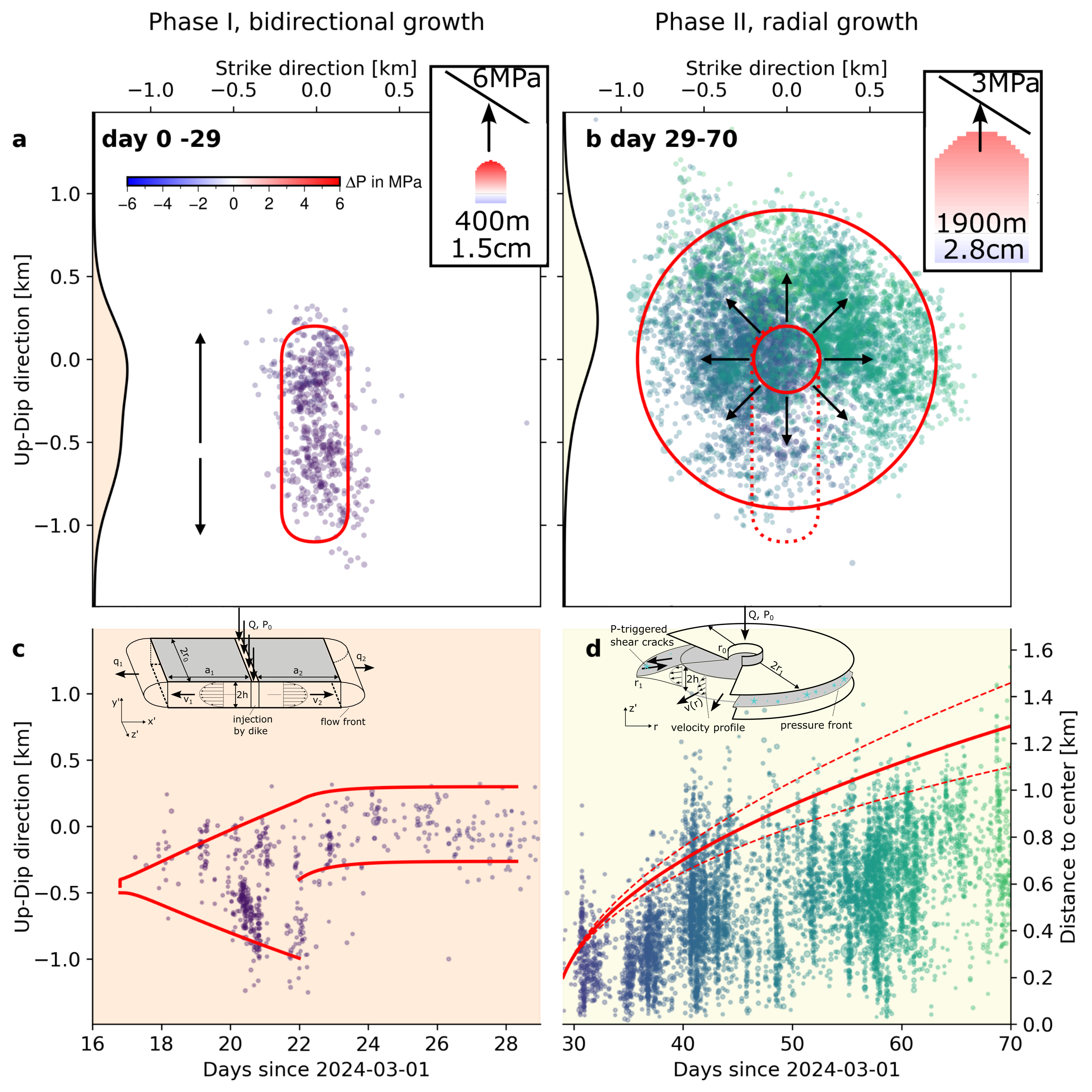
Phase I (left) shows bidirectional crack propagation driven by a small, buoyant fluid batch with high overpressure. Phase II (right) reflects radial widening caused by a larger, denser batch with lower overpressure. The sketches in the center illustrate the simplified theoretical models used to represent the two fluid intrusions, while the red curves show the predicted growth patterns that closely match the spreading of seismicity.
With theoretical modelling, we were able to recreate the spatial migration patterns and conclude that two separate batches of magmatic fluids must have generated the Klingenthal swarm, intruding one after the other into a pre-existing fault zone. We even attempted to estimate the overpressure, and thus the density, of the fluids and found that the first batch may have been a mixture of water and supercritical carbon dioxide, whereas the second batch must have been significantly heavier, consistent with a carbonatitic melt.
Beyond the scientific findings, the 2024 Klingenthal–Kraslice swarm highlighted the need for broader, denser, cross-border monitoring across the NW Bohemia and Vogtland region. This contributed to the momentum behind the EGER Large-N (ELISE) seismological experiment, coordinated by GFZ Potsdam. In August 2025, we began deploying approximately 300 seismic stations across a 100 × 100 km region for 12–18 months, forming one of the largest passive seismic arrays ever installed in this area. The last stations will be installed at the end of November this year. Being involved in the scientific coordination of such a large-scale experiment, contributing to the formulation of its scientific goals, integrating swarm-related research questions, and participating in fieldwork is a significant opportunity for me.
The ELISE experiment would not be possible without close collaboration between the GFZ teams and the commitment of our many partners, including the Universities of Potsdam, Leipzig, Jena, Freiberg, Erlangen-Nürnberg, and Munich, as well as colleagues from the Institute of Geophysics and the Institute of Rock Structure and Mechanics of the Czech Academy of Sciences, and from Charles University in Prague.
Related Project Links
CHASING Project (DFG)
CHASING Project – GFZ Project Page
ELISE – Eger Large-N Seismic Experiment
ELISE – GFZ Press Release

Follow the Topic
-
Communications Earth & Environment
An open access journal from Nature Portfolio that publishes high-quality research, reviews and commentary in the Earth, environmental and planetary sciences.

Related Collections
With Collections, you can get published faster and increase your visibility.
High-resolution modeling for Earth system
Publishing Model: Open Access
Deadline: Feb 07, 2027
Soil microbiomes and carbon sequestration under global change
Publishing Model: Hybrid
Deadline: Mar 18, 2027