Spatiotemporal Evolution of 2024 Klingenthal-Kraslice Swarm Beneath the Eger Rift
Published in Earth & Environment
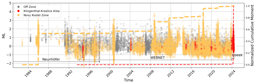
The Earthquakes in the Klingenthal Kraslice Area of Vogtland and Northwest Bohemia Area provide an exciting and rare look into the mechanisms shaping the distribution of earthquakes beneath the Eger Rift. This area along the German-Czech border is known for earthquake swarms (i.e., thousands of moderate to small-size earthquakes occurring over a period of weeks or months). The 2024 event was recorded with incredible detail due to a large number of seismic stations and deep boreholes, providing proving one of the best and highly detailed analysis ever conducted.
The video shows the evolution of the swarm at different times and places, it breaks down into two separate phases controlled by different physical mechanisms. The first phase represents a very fast propagation of seismicity, with the suggestion of a hydro-fracturing process driven by the upward movement of CO2 rich fluids from the lower crust and deep within the upper mantle. These fluids entered pre existing fault zones, their buoyancy and overpressure causing the formation of microfractures in the surrounding rock and triggering the earliest earthquakes. This initial phase lasted about five days and involved a relatively small volume of fluid dominated by water and supercritical carbon dioxide. The dense the seismic network allowed us to locate these early events with less than 0.1 km uncertainty, making it possible to track the initial fluid driven fracturing in remarkable detail.
The second phase of the swarm was marked by a slower, radial spread of earthquakes along a well defined fault zone. This phase corresponded to a hydro shearing process as denser magmatic or brine-rich fluids infiltrated the fault, reducing the density contrast with the surrounding rock and promoting shear fractures. The final phase of the earthquakes occurred for over 5 weeks and was characterized by a larger fluid volume than the previous phase. Earthquake activity in this phase was considered the primary activity of the swarm, exhibiting an intricate interaction among fluid pressure, rock strength and fault structure/geometry.
The research reveals how fluids control earthquake swarms. Hydro fractruing CO2-rich fluids cause swarms and denser magmatic fluids cause hydro shearing. This is how the Klingenthal Kraslice swarm developed the observed complex spatial and temporal patterns of seismicity. Furthermore, it highlights the need for scientists to have access to a dense seismic network with high-resolution measurements so that they can identify sub-crustal processes.
The video shows insight into the paths of fluid beneath the Eger Rift by following a visual timeline of the process. It demonstrates that a large number of earthquakes associated with deep-magma activity are responsible for inducing swarms in fault zones.