Moisture and dust in motion: the dual role of integrated vapour transport over West Africa
Published in Earth & Environment and Mathematics

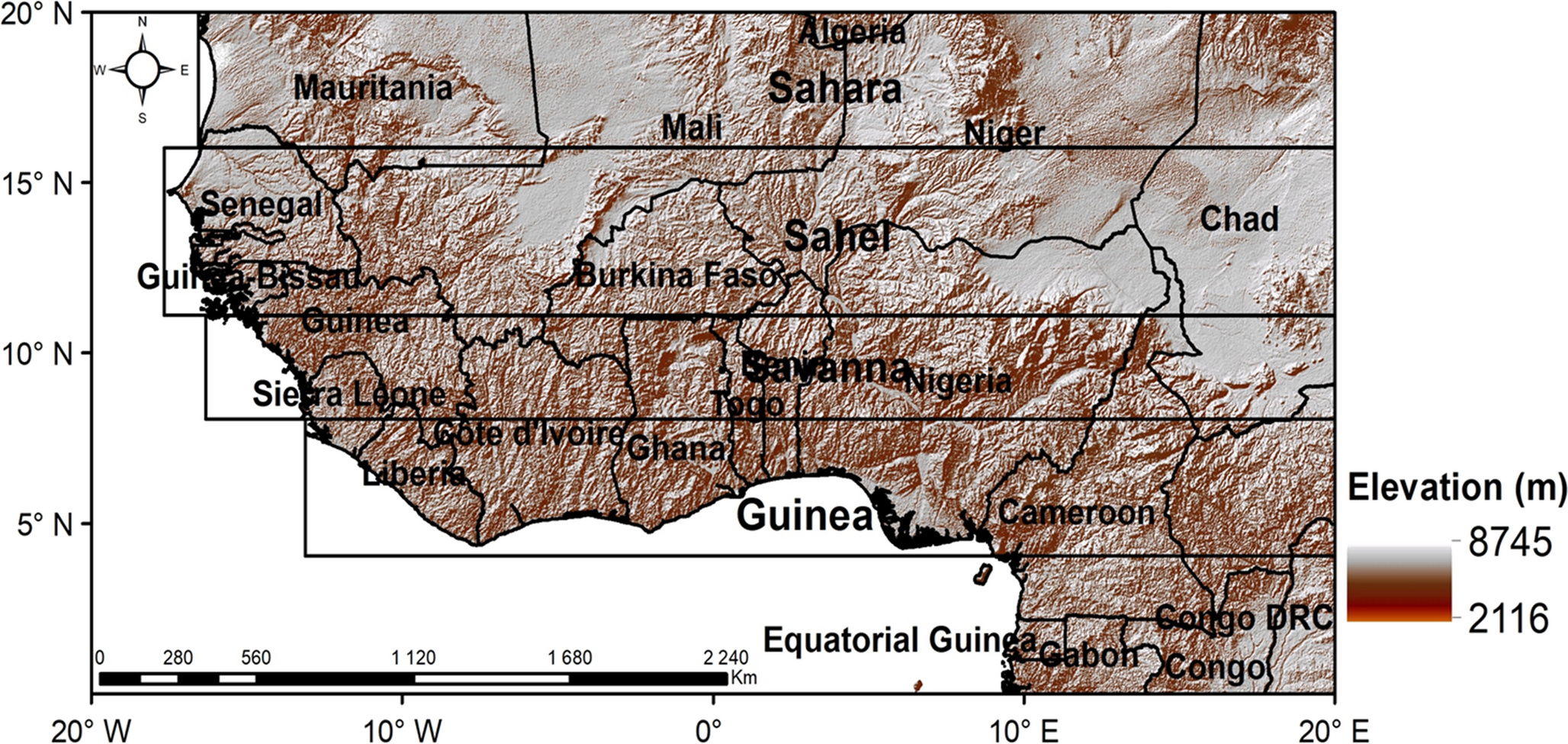

Integrated vapour transports (IVTs) are important drivers of tropical moisture transport; however, their structure, seasonality, and meteorological impacts over West Africa remain poorly characterised. This study provides a comprehensive evaluation of detected IVTs using a transport threshold of ≥ 250 kg m− 1 s− 1 during the 2024 West African monsoon season, combining reanalysis and gridded in situ datasets.
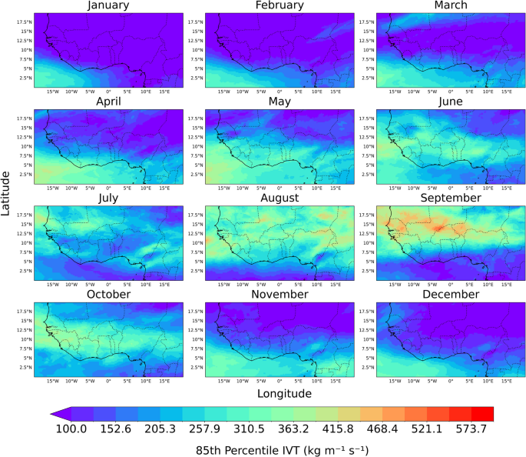
Results show a strong seasonal signal, with IVT frequency and intensity peaking between June and September, particularly over the Guinean and southern Sudano-Sahelian zones. Case studies of three extreme IVT (≥ 750 kg m− 1 s− 1) events (June 18, August 16, and September 25) revealed distinct structures, strong zonal wind cores at 700 hpa, and vertically coupled moisture fluxes that enhanced organised convection and upward motion. Moderate IVTs (250–500 kg m− 1 s− 1) contributed significantly to daily rainfall in coastal regions, while extreme transport (≥ 750 kg m− 1 s− 1) delivered intense, spatially focused precipitation in the Sahel. Also, the IVT played a critical role in the dynamics of atmospheric dust, where periods of extreme IVTs were associated with strong negative correlations with aerosol optical depth and dust concentrations, along with increased dust wet deposition. However, dust scavenging efficiency peaked beyond an IVT threshold of ~ 300 kg m− 1 s− 1, suggesting that rainfall variability, rather than moisture flux alone, contributes immensely to aerosol removal.
These findings position IVTs as key synoptic-scale systems that shape West African rainfall patterns and aerosol dynamics, with implications for seasonal weather variability, air quality, and convective organisation across the monsoon belt. Within the West African Monsoon (WAM), IVTs preferentially align with the southern flank of the AEJ where horizontal moisture flux and shear-induced convergence maximise, while jet-level (150–200 hPa) wind maxima suggest TEJ-entrance ascent that deepens the moist column. The Saharan heat low’s seasonal migration sharpens meridional pressure gradients that precondition strong southwesterlies, favouring IVT initiation and inland penetration.
Full article at:
https://doi.org/10.1007/s00704-025-05913-1

Follow the Topic
-
Theoretical and Applied Climatology
Theoretical and Applied Climatology, founded in 1949, showcases latest and significant developments from global studies in climate, atmosphere, and meteorology. A successor to Meteorologische Zeitschrift, it carries forward the traditions of one of the world’s oldest meteorological journals.

Related Collections
With Collections, you can get published faster and increase your visibility.
Satellite-Enabled IoT Networks for Remote Environmental Monitoring
This topical collection focuses on the emerging role of satellite-enabled Internet of Things (IoT) networks in advancing remote environmental monitoring. Traditional ground-based monitoring systems often suffer from limited coverage, high infrastructure costs, and unreliable connectivity in remote or inaccessible regions such as forests, oceans, and polar areas. The integration of satellite communication with IoT technologies enables global-scale, real-time environmental data collection, supporting applications such as climate change monitoring, disaster prediction, biodiversity conservation, and smart agriculture.
Recent advancements in Low Earth Orbit (LEO) satellite constellations, nanosatellites, edge computing, and AI-driven analytics are transforming the feasibility and scalability of such systems. These technologies enable continuous, energy-efficient, and intelligent monitoring solutions capable of addressing environmental challenges worldwide.
This collection invites contributions on innovative architectures, algorithms, and applications, including hybrid satellite-terrestrial IoT systems, geospatial analytics, AIoT-based environmental prediction, UAV integration, and secure communication frameworks. The goal is to provide a platform for interdisciplinary research that supports sustainable environmental management and global resilience.
Publishing Model: Hybrid
Deadline: Dec 31, 2026
Climate Extremes and Urban Resilience: Integrating Physical Process, Adaptation Strategies, and Socio-Economic Impacts
The increasing frequency and intensity of climate extremes, coupled with rapid global urbanization, creates an urgent need for integrated research that bridges physical climate science with urban planning and socio-economic analysis. This collection addresses the critical knowledge gap between understanding extreme weather processes and implementing effective urban resilience strategies, providing a platform for interdisciplinary research that can inform evidence-based adaptation policies and practices. The collection will advance interdisciplinary collaboration between climate scientists, urban planners, engineers, and social scientists, fostering methodological innovations in coupled human-natural systems research. It will contribute to improved urban climate modelling capabilities, enhanced understanding of climate-society interactions, and development of transferable adaptation strategies. The research will also inform international climate assessment reports and support evidence-based policy development for urban climate resilience. This collection primarily addresses urban climatology and applied climatology, with significant contributions from mesoscale meteorology, climate extremes research, and climate impact assessment. It encompasses urban boundary layer dynamics, heat island effects, precipitation patterns in urban environments, and the modification of extreme weather events by urban morphology, while integrating these physical processes with adaptation science and climate services.
Publishing Model: Hybrid
Deadline: Dec 31, 2026