Nuclear Power Plants Release Powerful Environmental Tracers
Published in Earth & Environment, Sustainability, and Mechanical Engineering

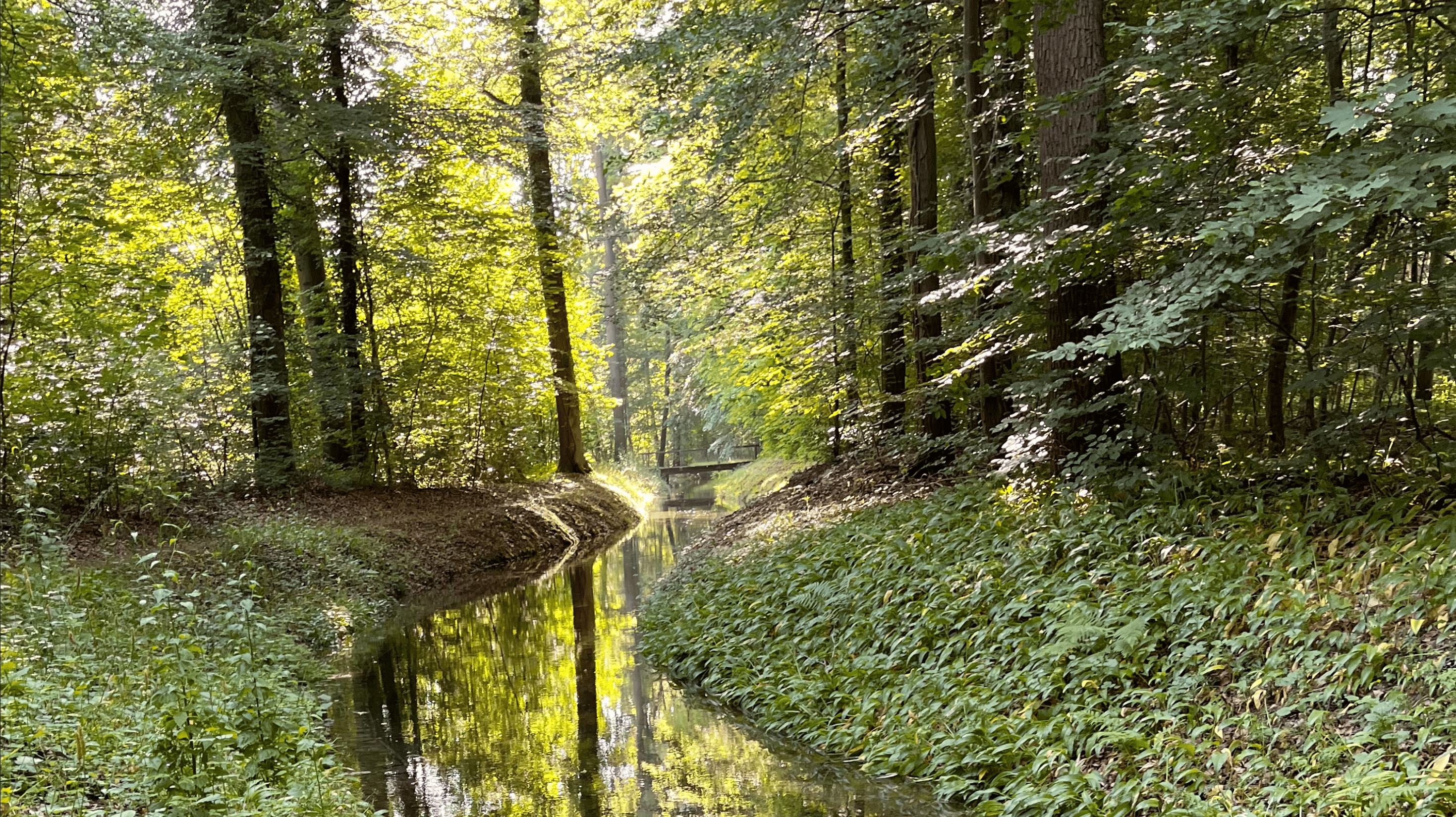





Understanding how, and at what rate, rivers recharge groundwater remains difficult, particularly at the spatial scales relevant for water management. This work began with a simple observation. Nuclear power plants release tritiated water into rivers during routine operation. These releases are controlled and environmentally safe, but they introduce temporally variable signals into river systems. Rather than viewing these signals only from a regulatory perspective, we considered whether they could be used to trace the movement of river water beyond the channel.
The key idea emerged from recognising that these releases are not constant. They occur in scheduled pulses linked to plant operation and regulations. As a result, rivers downstream of nuclear facilities carry distinct isotope signals that vary over time. If river water infiltrates into groundwater systems, whether through natural riverbank filtration or managed aquifer recharge, these signals are transferred into the subsurface. This provides a direct way to trace river-derived recharge using signals that are already present in the system.
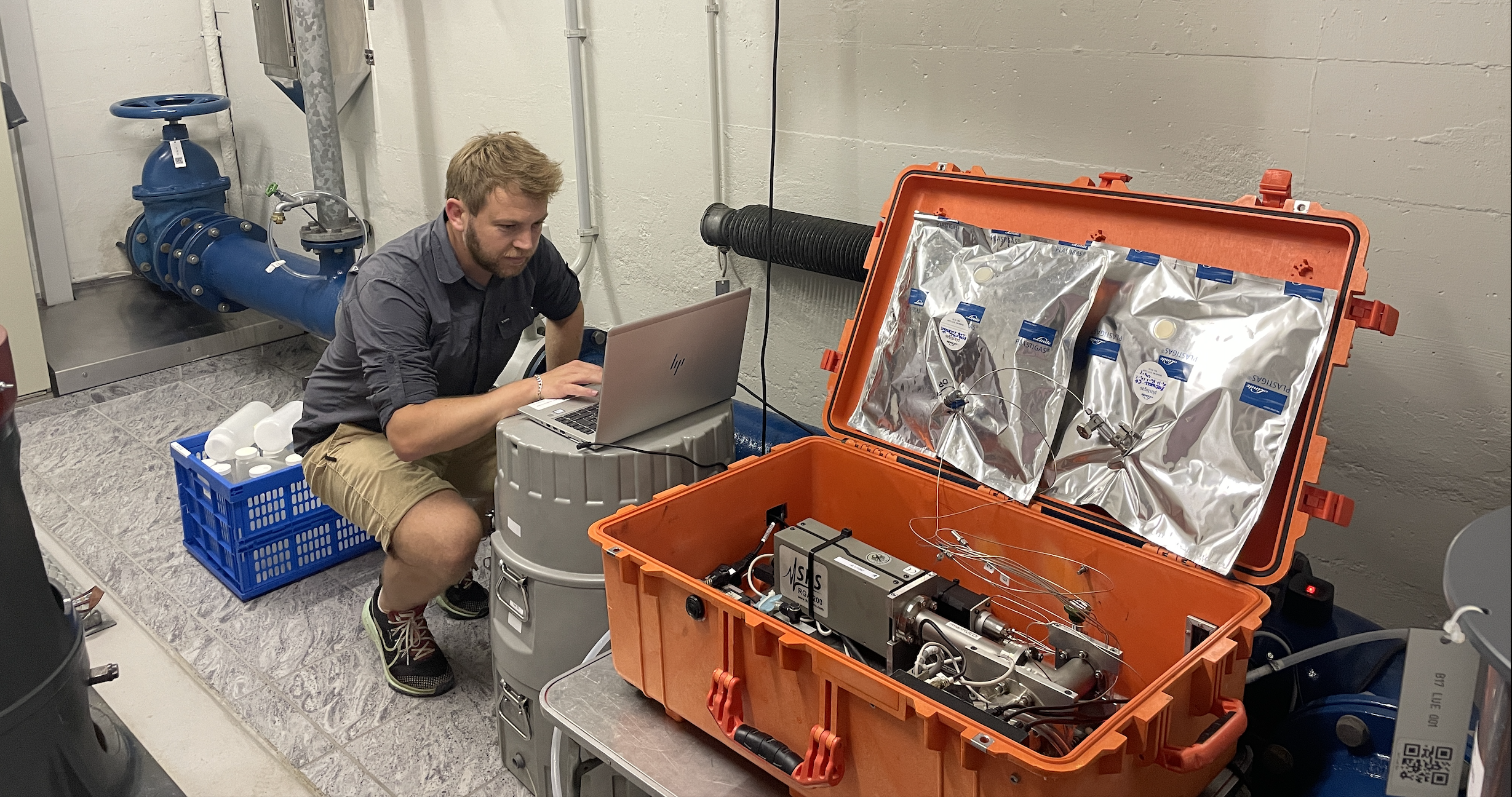
Switzerland provided an ideal setting to test this idea. The country hosts several nuclear power plants along major rivers and has well-characterised hydrological systems with strong surface–groundwater connectivity. Riverbank filtration and managed recharge are widely used, and monitoring infrastructure is extensive. This combination allowed us to investigate whether isotope signals released into rivers could be detected in adjacent aquifers (in our case, a managed aquifer recharge scheme) and whether they could be used to resolve flow paths and travel times.
The advantage of these signals is their temporal structure. Unlike many environmental tracers, which are often spatially distributed and invariant over short timeframes, nuclear-derived isotopes provide high-frequency inputs at known locations. As these signals move through rivers and into aquifers, they are attenuated and delayed. Detecting them in groundwater provides information on the timing and extent of river infiltration. This complements established tracers such as stable isotopes of O and H, which are effective for characterising integrated catchment responses but often lack the resolution to capture short-term exchange processes.
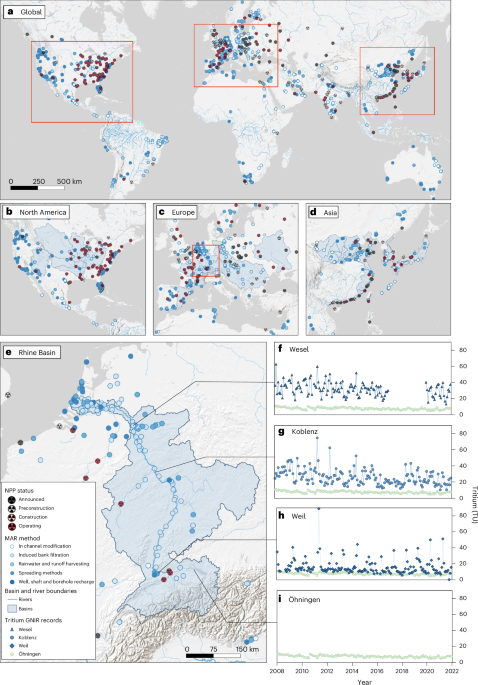
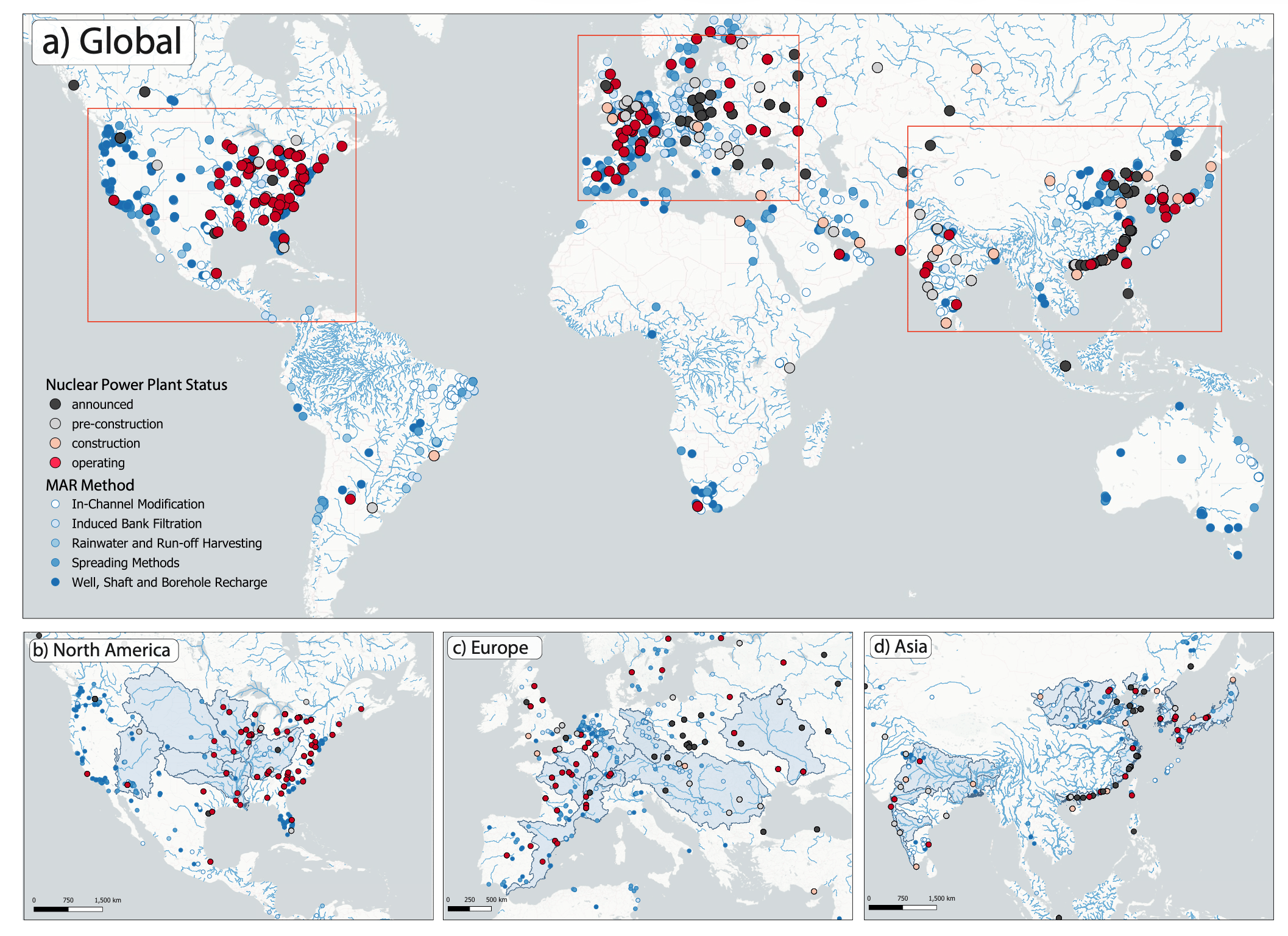
Although this study focuses on Switzerland, the implications extend beyond a single region. Nuclear power plants are located along many major rivers globally, which means similar tracer signals are present in a wide range of hydrological settings (Fig.1). These signals represent an existing and largely unexploited resource for studying river–groundwater interactions at larger scales. The supplementary analysis shows that this applies across multiple continental river basins.
From a water management perspective, the ability to quantify river-derived recharge is important. Many drinking water systems rely on riverbank filtration or managed aquifer recharge, yet the extent and variability of these processes are often uncertain. Using isotope signals already present in rivers provides a practical way to constrain these contributions and to better understand how surface water supports groundwater resources under changing conditions. More broadly, this work highlights that anthropogenic signals can be used constructively to study environmental processes. Low-level radioactive releases from nuclear facilities are tightly regulated and typically considered only in terms of compliance. However, they also provide a tracer signal that can be used to investigate hydrological connectivity without the need for artificial tracer experiments.
This study reframes an existing signal as a tool for hydrology. By using nuclear-derived isotopes as tracers of river water, it becomes possible to observe how rivers recharge aquifers and how these connections vary in space and time. This information is directly relevant for managing freshwater resources and for understanding the role of river–groundwater interactions in the broader hydrological cycle.
A great thank you must be extended to all the stakeholders involved in this project, who, through their tireless efforts, access (IWB and Hardwasser AG), expertise and innovation, made this work possible.
All information regarding the method and data can be found in our paper: van Rooyen, J., Vennemann, T., Purtschert, R. et al. Anthropogenic tritium as a continental-scale tracer in river-derived recharge. Nat Water (2026). https://doi.org/10.1038/s44221-026-00616-x
Follow the Topic
-
Nature Water
This journal publishes research on the evolving relationship between society and water resources on a monthly basis. It covers the natural sciences, engineering, and social sciences, with a particular interest in regards to interdisciplinary research.