Pharmaceutical Treasures from the Deep Sea
Published in Chemistry



Bridging the Deep-Sea and Diabetic Wounds
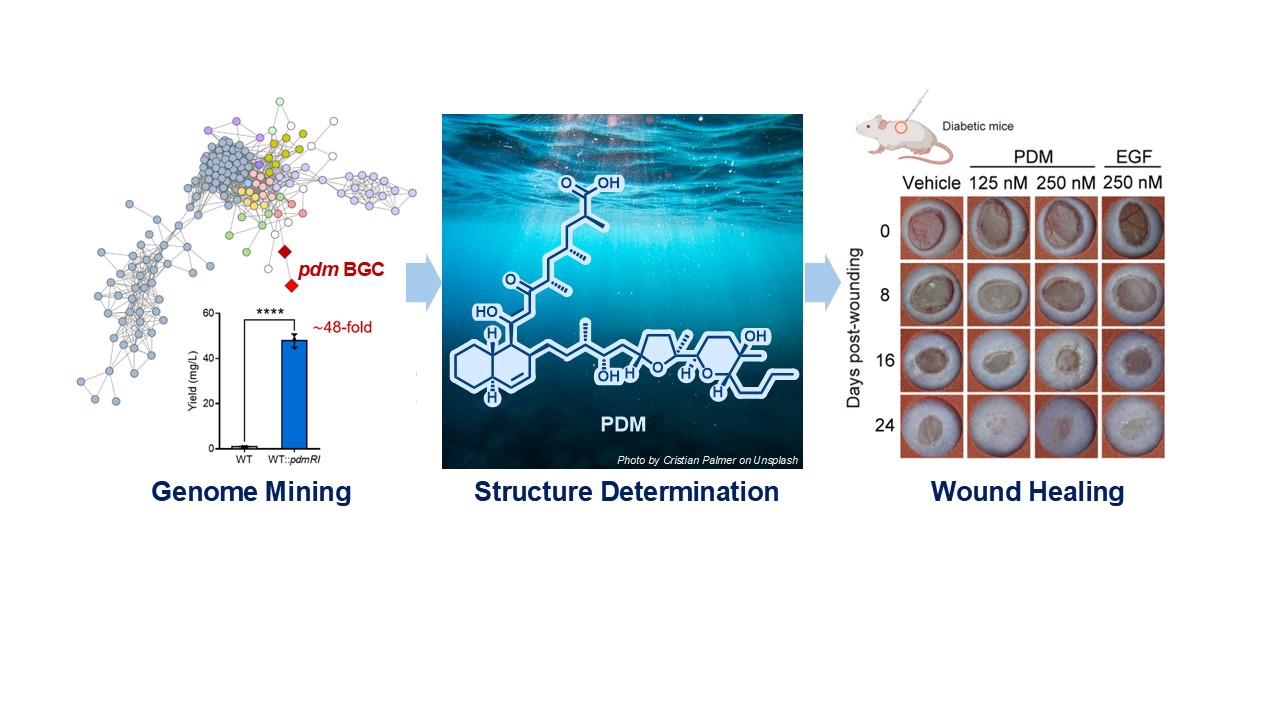
The ocean covers 71% of Earth's surface and harbors an extraordinary diversity of life. For natural-product researchers, it is also one of the world's great pharmaceutical treasure houses. Many essential clinical drugs originated from marine organisms, such as rifampicin and cephalosporins. At the other end of the spectrum are diabetic chronic wounds, including diabetic foot ulcers, which are among the most debilitating complications of diabetes and have become a growing global health challenge. At first glance, the deep sea and diabetic wounds could hardly seem more distant. Yet our research unexpectedly connected these two worlds through the genome mining and discovery of a remarkable natural product called polydecalinmycin (PDM). The journey from a microbial genome to a potential wound-healing agent was not straightforward. It involved extensive efforts to the molecule production, a challenging structural puzzle, and an unexpected biological finding that ultimately changed the direction of our research.
A Structural Puzzle with 14 Chiral Centers
Our journey began with genome mining. Through comprehensive bioinformatic analysis, we identified an unusual biosynthetic gene cluster in a deep-sea-derived Streptomyces strain that suggested the production of a previously unknown polyether-like natural product. However, finding a promising gene cluster was only the beginning. After extensive optimization of the regulatory system, we eventually obtained the PDM compound from an engineered high-yield strain and could start the next important step: determining its structure, particularly its 3D architecture. This was no small feat. PDM contains an unusual octalin ring center, with one arm extending into a tetrahydrofuran–tetrahydropyran ring system and the other into a polyketide-derived chain. Most challenging of all, the molecule contains 14 chiral centers, many of which are located on the flexible side chains, making its three-dimensional structure particularly difficult to establish. To solve this structural puzzle, we worked through the configurations piece by piece, combining multiple complementary approaches. These included bioinformatics-guided structural analysis, intensive NMR analysis (2D NMR and J-based configuration analysis), high-resolution mass spectrometry (HRESIMS) and MS/MS analysis, chemical derivation using Mosher’s method, and computational analysis. After years of work, we were finally able to establish the complete structure and absolute stereochemistry of PDM. The experience taught us that structural elucidation of complex natural products is often a process of detective work, in which different approaches provide complementary pieces of evidence. It also taught us the importance of patience and persistence: when the solution to the puzzle seems far away, every small piece matters. We hope that the lessons learned from this study will also be useful to other researchers tackling similarly challenging natural product structures with multiple chiral centers.
From Cancer Cells to Wound Healing
How we discovered the wound-healing activity of PDM was one of the most interesting surprises in our work. Our initial biological studies followed a fairly conventional path. Because many natural polyether ionophores show anticancer potential, our collaborators tested PDM activity on a panel of human cancer cell lines and normal cell lines. Unexpectedly, when PDM was tested with normal human cell lines, it significantly promoted cell proliferation at nontoxic concentrations. Could PDM have a therapeutic application in wound healing? This question led us down a completely new path. We pivoted our focus and launched a comprehensive investigation into PDM's wound-healing potential and mechanisms of action. The results were very encouraging. We found that PDM significantly promoted chronic wound closure in diabetic mice, which demonstrated superior efficacy relative to clinically used epidermal growth factor (EGF). Continuing studies further uncovered distinct mechanistic insights into PDM’s biological activity, opening up exciting possibilities for exploring PDM as a potential lead for the development of new therapeutic strategies for diabetic wound repair. As a small, well-defined molecule, PDM may offer practical advantages over protein-based EGF therapies, including greater flexibility in dosing and manufacturing and potentially lower production costs, while providing a promising starting point for further therapeutic translations.
Looking to the Ocean for Tomorrow's Medicines
Our work in this paper bridges two seemingly different worlds: the deep-ocean microorganism exploration and diabetic wound care. This study also brought together a diverse team of researchers specializing in bioinformatics, synthetic biology, natural-product chemistry, pharmacology, and clinical-based wound-healing. Close collaboration across these disciplines allowed us to overcome the challenges encountered at each stage, from identifying a promising biosynthetic gene cluster and producing its product, to solving its complex structure, and to uncovering its unexpected biological activity. We are deeply grateful for this highly supportive, multidisciplinary partnership.
The discovery of PDM from a deep-sea derived Streptomyces not only expanded the chemical repertoire of marine natural products but also lays the groundwork for PDM-based therapies that could one day really benefit the clinical treatment of human diabetic chronic wounds. More broadly, our story highlights the enormous potential of marine microorganisms as an untapped source of previously unexplored chemistry and biological activity. We hope this study could inspire future research to look to ocean resources for potential solutions to medicine's most stubborn challenges.
Follow the Topic
-
Nature Communications
An open access, multidisciplinary journal dedicated to publishing high-quality research in all areas of the biological, health, physical, chemical and Earth sciences.

Related Collections
With Collections, you can get published faster and increase your visibility.
Women's Health
Publishing Model: Hybrid
Deadline: Ongoing
Tumor Microenvironment Crosstalk and Therapeutic Implications
Publishing Model: Hybrid
Deadline: Nov 02, 2026