Platinum-Based Intermetallics for Oxygen Reduction Catalysis: From Binary to High-Entropy

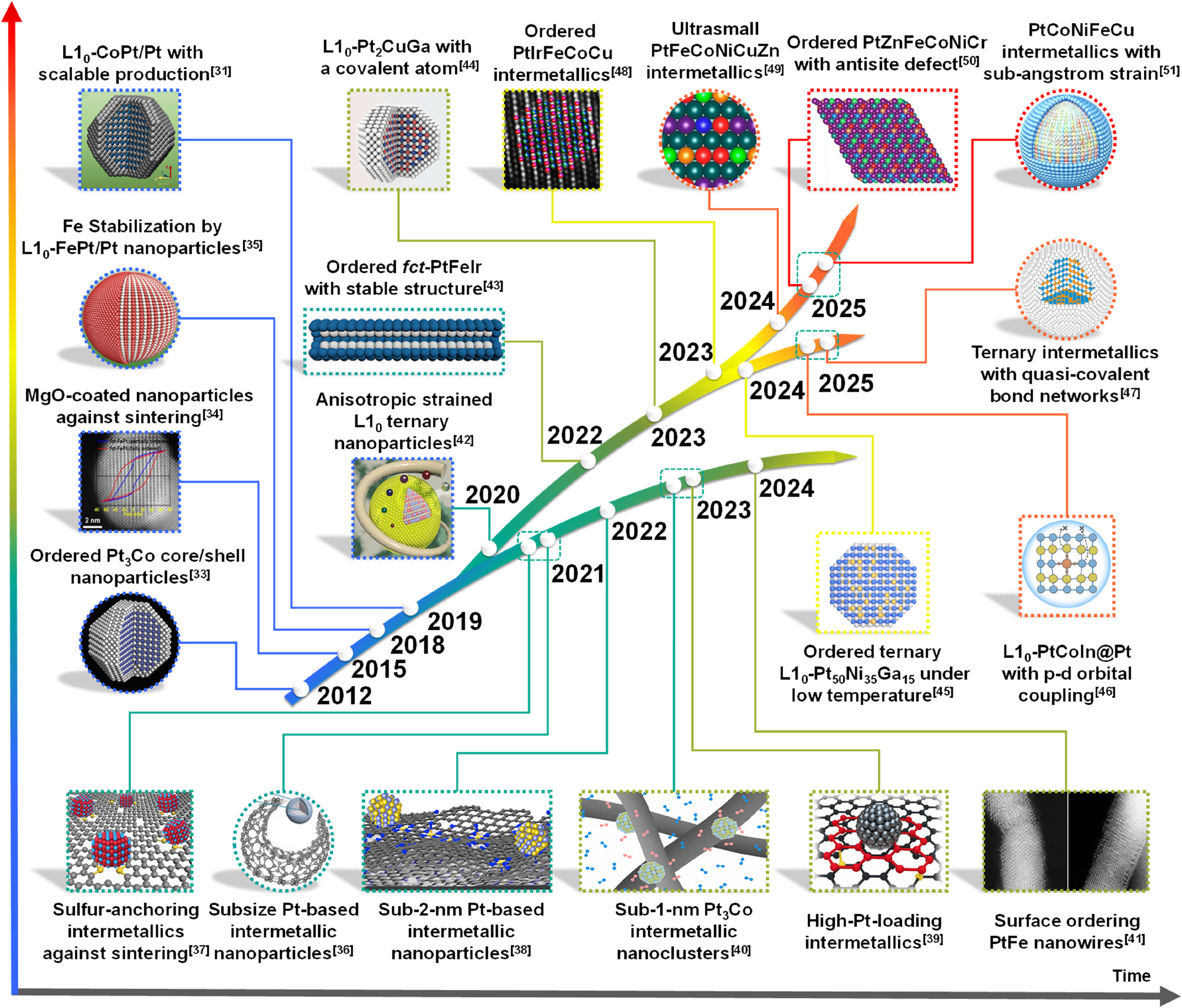

A research team from Harbin Institute of Technology has recently published a comprehensive review in Catal titled “Platinum-based intermetallics for oxygen reduction catalysis: From binary to high-entropy.” The paper systematically summarizes the latest progress in platinum-based intermetallic compounds for the oxygen reduction reaction (ORR) in fuel cells.
Background
The ORR is a key half-reaction in proton exchange membrane fuel cells (PEMFCs), but its sluggish kinetics remain a major bottleneck for fuel cell development. Conventional Pt-based alloy catalysts face challenges such as metal dissolution and insufficient durability. In contrast, intermetallic compounds with long-range ordered structures offer a promising route to enhance catalytic performance by tuning electronic structures and improving stability.
Key Highlights
-
Advantages of Intermetallic Compounds: Compared with disordered alloys, intermetallics feature long-range ordered crystal structures and precise stoichiometry. These properties enable geometric and ligand effects to optimize Pt’s electronic structure, weaken excessive adsorption of oxygen intermediates, and boost intrinsic activity. Stronger Pt–M bonding and higher formation energy also suppress metal leaching and particle sintering, significantly improving durability.
-
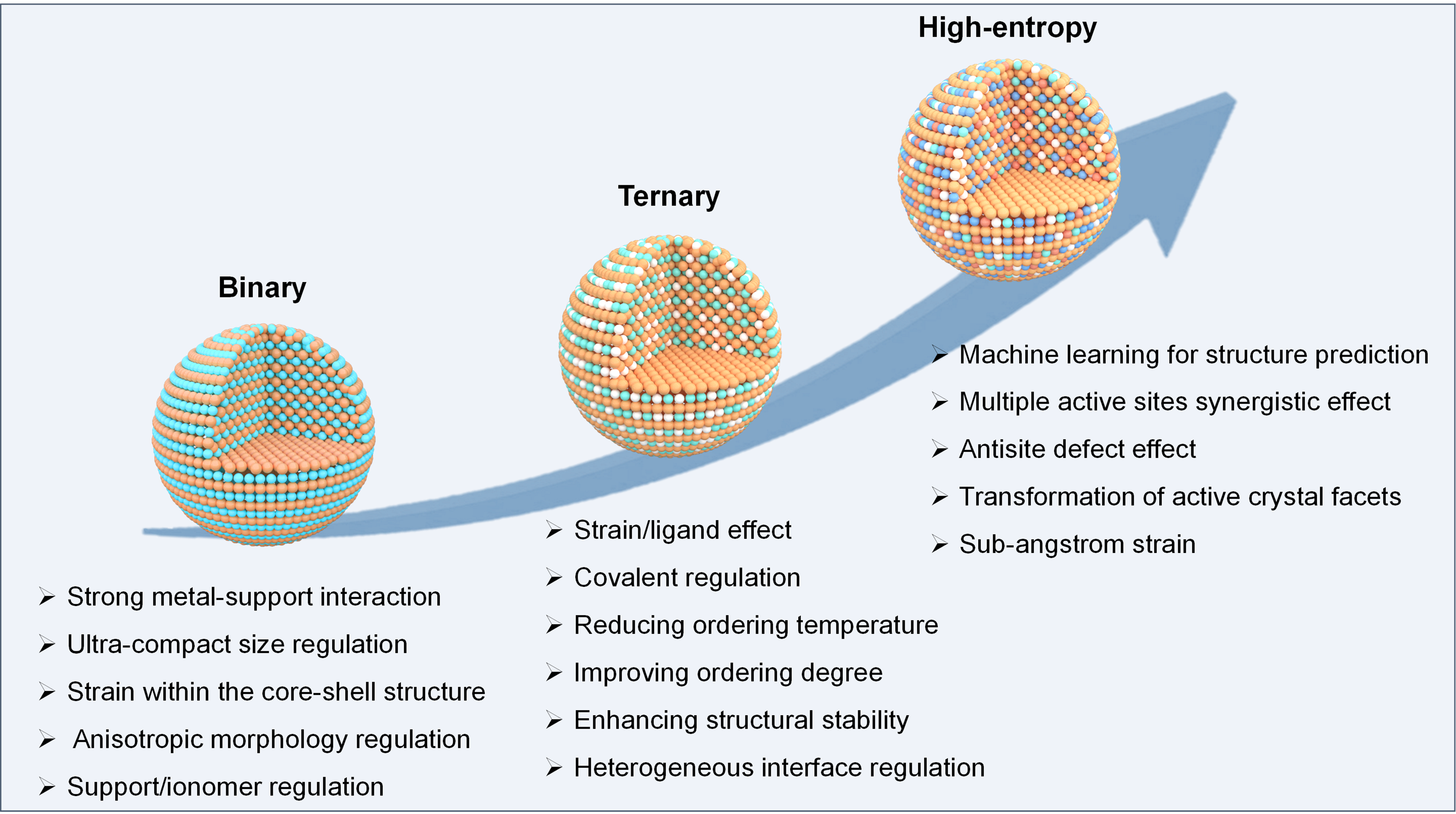
Binary Systems: Traditional high-temperature annealing for ordering often causes nanoparticle sintering. Strategies such as strong metal–support interactions and low-temperature ordering synthesis can overcome this issue. Core–shell structures and anisotropic morphology control further enhance activity and stability.
-
Ternary Systems: Introducing a third element with atomic size differences induces lattice strain, optimizing Pt’s d-band center and adsorption energy. Some elements strengthen covalent bonding through strong p–d orbital hybridization, improving resistance to dissolution. Low-melting-point metals can also promote atomic diffusion, reducing ordering temperatures and enabling highly ordered nanocrystals.
-
High-Entropy Systems: High-entropy intermetallics incorporate five or more elements, combining ordered structures with high configurational entropy. This synergy allows precise electronic tuning and multiple active sites. Their unique sluggish diffusion and entropy stabilization effects confer exceptional structural stability, pushing intermetallic catalysts to new heights.
-
Performance Summary: Across binary, ternary, and high-entropy systems, Pt-based intermetallics exhibit mass and specific activities far exceeding commercial Pt/C catalysts, with minimal degradation after tens of thousands of accelerated durability cycles. This demonstrates that structural ordering and compositional diversification are effective strategies to simultaneously overcome activity and stability bottlenecks.
-
Future Outlook: Research will focus on scalable, precise synthesis methods; advanced characterization to reveal dynamic evolution of active sites; machine learning-assisted design; entropy-mediated catalytic mechanisms; and integration into practical membrane electrodes and industrial-scale validation—key steps toward commercialization.
Significance
This review outlines the evolution of Pt-based intermetallics from binary to high-entropy systems, revealing universal strategies for tuning electronic structures and strengthening atomic bonding through structural ordering and compositional diversity. It provides insights into current challenges and future directions for designing next-generation high-performance catalysts.
Authors & Institutions
• Changlin Li, Xiaoyue An, Yajing Qi, Xinyu Wang, Tongbo Zhang, Yu Liu, Lin He, Fengyu Wu, Weiwei Yang
Corresponding Authors: Menggang Li, Yongsheng Yu
School of Chemistry and Chemical Engineering, Harbin Institute of Technology, Harbin, China
Corresponding Authors & Emails
• Menggang Li – mengg.li@hit.edu.cn
• Yongsheng Yu – ysyu@hit.edu.cn
Follow the Topic
-
Catal
Catal is an open access journal covering full spectrum of catalysis critical advances. From biocatalysts to heterogeneous catalysts, it integrates fundamental and applied sciences. Catal offers a primary platform for researchers and practitioners in the field.

Related Collections
With Collections, you can get published faster and increase your visibility.
Porous Materials for Sustainable Green Catalysis
The advancement of our collective understanding in the field of porous materials for sustainable green catalysis is crucial as we face urgent environmental challenges and the need for sustainable energy solutions. The integration of porous materials into catalytic processes has opened new avenues for improving efficiency, selectivity and stability while minimizing waste. Significant advances have been made, including the development of zeolites, mesoporous materials, metal-organic frameworks (MOFs) and covalent organic frameworks (COFs), which have demonstrated remarkable catalytic performance in various reactions.
Future research holds immense potential, with speculations ranging from the design of novel porous materials with tailored properties to their application in industrial catalysis, biocatalysis, H2 production and carbon capture technologies. By continuing this research, we can drive progress toward achieving Sustainable Development Goals (SDGs), particularly in clean energy (SDG 7) and climate action (SDG 13), ultimately fostering a sustainable future for our planet.
We invite researchers to contribute to this special Collection by submitting research articles, brief communications, perspectives, reviews, and analyses.
Topics of interest include but are not limited to:
- Synthesis of porous materials
- Catalytic performance evaluation
- Green synthesis methods
- Application in environmental remediation
- CO2 conversion technologies
- Biocatalysis in porous matrices
- Design of multifunctional porous catalysts
- Mechanistic studies of catalysis
Publishing Model: Open Access
Deadline: Dec 31, 2026
National Catalysis Conference 2025
The 22nd National Catalysis Conference, held in December 2025 in Xiamen, China, stands as the largest national academic event in the field of catalysis, bringing together leading scientists from academia and industry to discuss frontier research and emerging technologies across catalytic science.
In collaboration with several internationally recognized researchers from Xiamen University - the main organizer of the conference - Catal will publish a Special Issue featuring selected contributions from the meeting. This joint effort ensures high academic standards and showcases the scientific breadth and excellence presented at the conference.
Potential topics include, but are not limited to:
• Catalytic materials
• Thermocatalysis
• Electrocatalysis
• Biomass and CO₂ conversion
• Industrial catalysis
• Theoretical and computational catalysis
Publishing Model: Open Access
Deadline: Dec 31, 2026