Pollination and dispersal networks in the Amazonian tree flora
Published in Ecology & Evolution and Plant Science




It has been a long-time dream of mine to have pollination data for the Amazonian trees. When Lorena Valadão-Mendes and colleagues published on the pollination systems of the biomes of Brazil1, with a very large dataset, the dream reawakened. We had published on tree traits before2 and included potential nectar production based on a new paper of Caio Ballarin and colleagues3. So, now the idea came up to build a new dataset with reproductive traits of Amazonian trees, their dispersers4 and flower visitors (i.e. potential pollinators). The first step was to collect all possible publications with pollination-network data on Amazonian trees and add those to Lorena’s data. After that I contacted all the responsible authors for reproductive data (dispersal: Pablo Stevenson, David Correa; pollination: Lorena Valadão-Mendes, Cris Giannini; Flower reward data: Caio Ballarin; Atlantic Forest Tree data: Renato Lima, Carlos Pinto; breeding data: Matt McGlone; and Amazonian trees: Vitor Gomes) and asked if they were interested to move from this data project to a more in-depth publication. All agreed. We added fruit type, seed mass, flower colour, flower size, flower symmetry, pollination reward, and breeding type for the 5,201 tree species found in plots of the Amazon tree diversity network, for which population estimates had been published5,6. The 5,201 Amazonian trees species correspond to ~50% of all known tree species7 and 94% of all estimated individuals in Amazonia5,6.
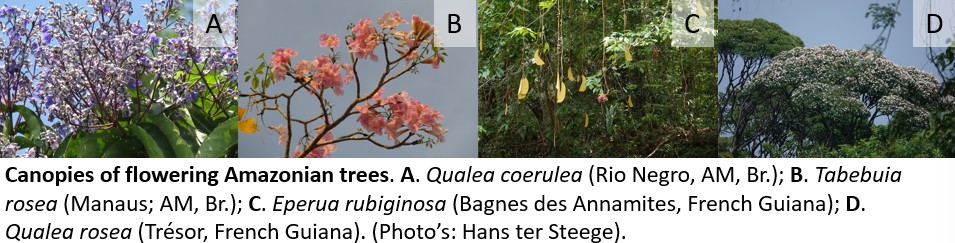
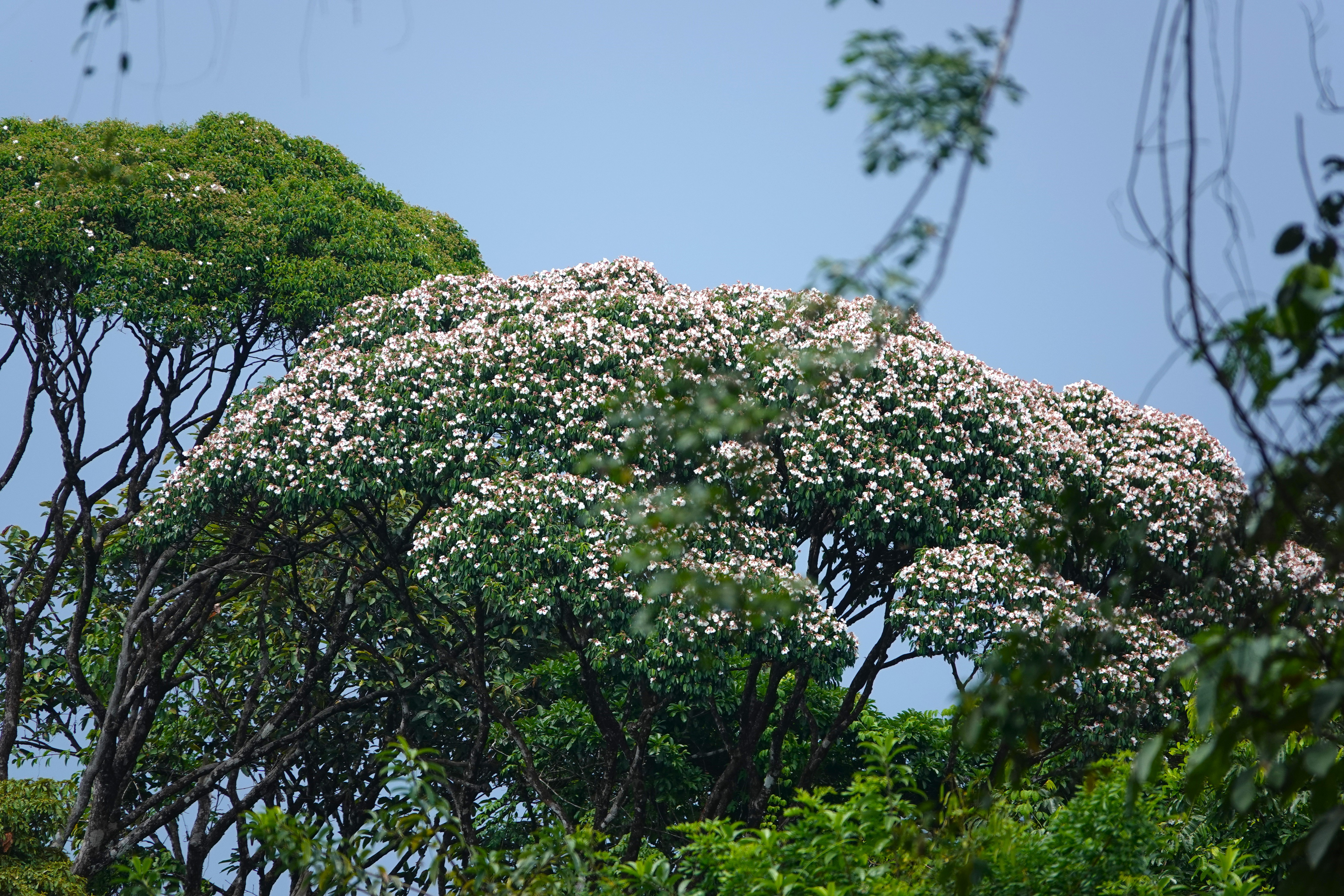
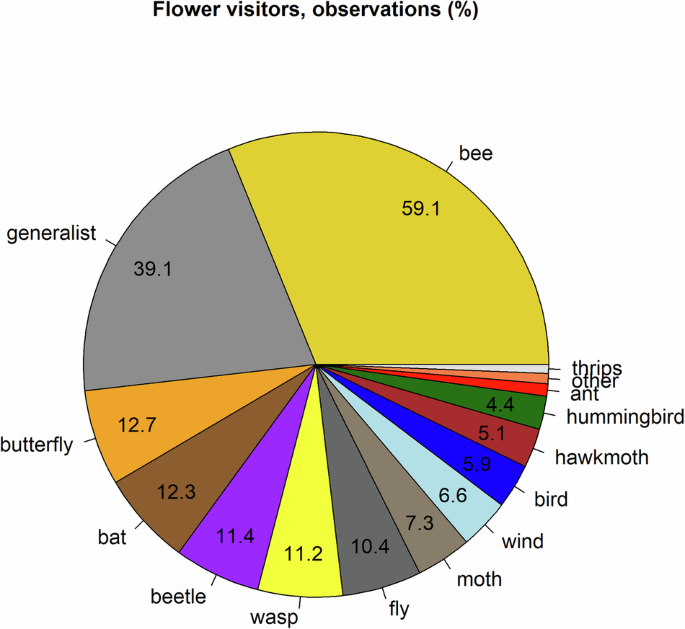
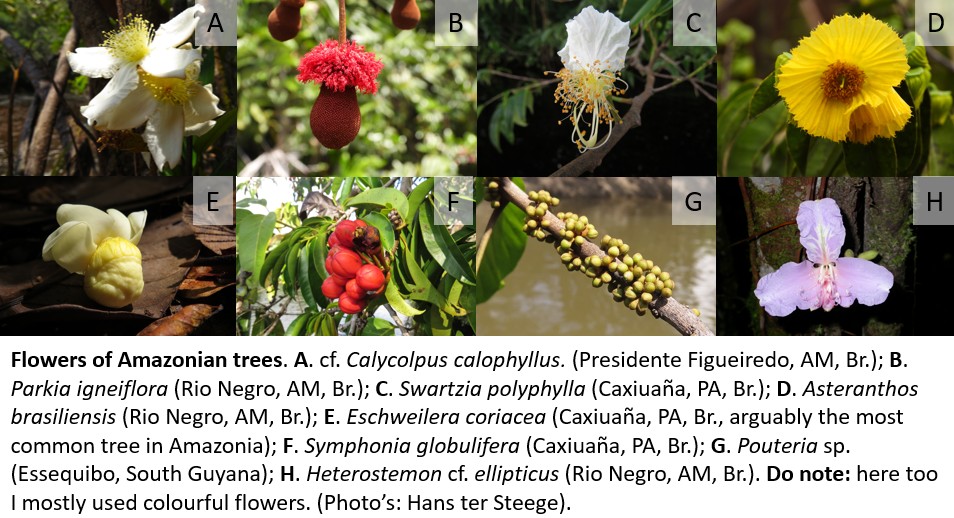
While coloured trees are a remarkable portray of Amazonian forests, we found that nearly 70% of all species had white flowers that were mostly small. Cream, yellow and green were 2nd to 4th in number and about 10% of the species had red, pink, purple, blue or orange colour – the ones that generally feature in books. Nectar and pollen were the most common rewards offered. As expected, bees were the most common flower visitors, followed by generalist flower-visitors.
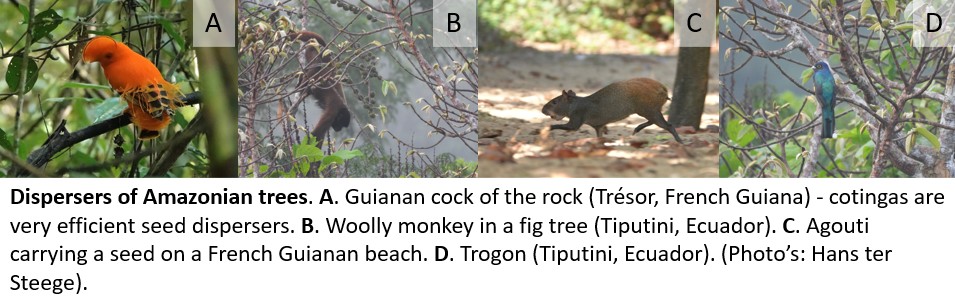
Sixteen tree genera make up 50% of all estimated interactions between tree genera and their flower-visitors and forty hyperdominant genera are responsible for half of the estimated fruit resources of the Amazonian disperser community. Nearly 80% of the Amazonian tree species rely on animals for both pollination and seed dispersal, 20% on one of both, and less than 1% are free from animal involvement in these key life stages. This strong biotic dependence highlights a critical point: animal-mediated interactions are not peripheral but central to the maintenance, regeneration, and spatial structure of Amazonian forests, which makes halting of defaunation in these forests a priority. In addition to that, two recent publications have shown that insectivorous birds in undisturbed Tiputini, Ecuador have declined dramatically9, arguably caused by a decline in insects, that have limited thermal tolerance10. Thus, increasing heat may further affect the abundance of insect communities in undisturbed Amazonian forest and subsequently affect the pollination networks of Amazonian trees, and also its bird communities.
The new dataset provides an unprecedented basis to explore large-scale patterns in pollination and seed-dispersal networks across Amazonian tree communities. By linking reproductive traits, pollination systems, and dispersal modes for thousands of species, it opens the possibility of analysing how animal declines may reshape the structure and functioning of Amazonian forests.
1 Valadão-Mendes, L. B. et al. A Cross Biome Synthesis on Pollination Systems in a Megadiverse Tropical Country. The Botanical Review (2024). https://doi.org/10.1007/s12229-024-09309-0
2 ter Steege, H. et al. Functional composition of the Amazonian tree flora and forests. Communications Biology 8, 355 (2025). https://doi.org/10.1038/s42003-025-07768-8
3 Ballarin, C. S. et al. How many animal-pollinated angiosperms are nectar-producing? New Phytologist 243, 2008-2020 (2024). https://doi.org/https://doi.org/10.1111/nph.19940
4 Correa, D. F. et al. Geographic patterns of tree dispersal modes in Amazonia and their ecological correlates. Global Ecology and Biogeography 32, 49-69 (2023). https://doi.org/https://doi.org/10.1111/geb.13596
5 ter Steege, H. et al. Hyperdominance in the Amazonian tree flora. Science 342, 1243092 (2013). https://doi.org/10.1126/science.1243092
6 ter Steege, H. et al. Biased-corrected richness estimates for the Amazonian tree flora. Scientific Reports 10, 10130 (2020). https://doi.org/10.1038/s41598-020-66686-3
7 ter Steege, H. et al. Towards a dynamic list of Amazonian tree species. Scientific Reports 9, 3501 (2019). https://doi.org/10.1038/s41598-019-40101-y
8 ter Steege, H. et al. Pollination and dispersal networks in the Amazonian tree flora. Communications Biology (2026). https://doi.org/https://www.nature.com/articles/s42003-026-09896-1
9 Blake, J. G. & Loiselle, B. A. Sharp declines in observation and capture rates of Amazon birds in absence of human disturbance. Global Ecology and Conservation 51, e02902 (2024). https://doi.org/https://doi.org/10.1016/j.gecco.2024.e02902
10 Holzmann, K. L. et al. Limited thermal tolerance in tropical insects and its genomic signature. Nature 651, 672-678 (2026). https://doi.org/10.1038/s41586-026-10155-w

I am keenly interested in the study of plant diversity and mechanisms generating and regulating diversity at regional and local scale, with a focus on the Amazon Rain Forest. I have built up large network of collaborating colleagues in the Amazon and outside: The Amazon Tree Diversity Network. With this network we study patterns and processes of species composition, relative abundance patterns, and functional behavior of the Amazon forest, and its evolution.
Follow the Topic
-
Communications Biology
An open access journal from Nature Portfolio publishing high-quality research, reviews and commentary in all areas of the biological sciences, representing significant advances and bringing new biological insight to a specialized area of research.

Related Collections
With Collections, you can get published faster and increase your visibility.
Healthy Aging
Publishing Model: Open Access
Deadline: Dec 31, 2026
DNA repair and human disease
Publishing Model: Hybrid
Deadline: Oct 31, 2026