Rebuilding Soil Health, Reducing Food Loss
Published in Earth & Environment and Materials

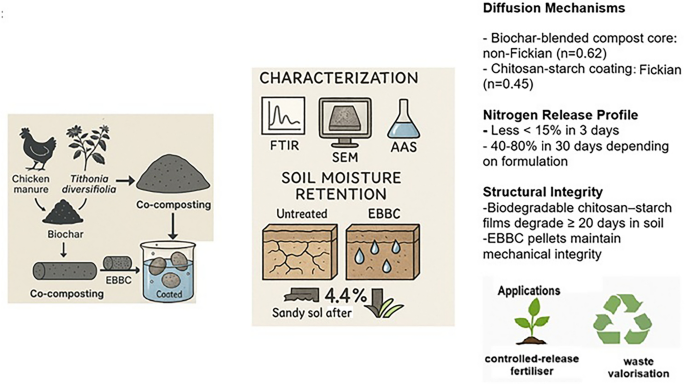

Soil degradation is one of the most urgent and least visible crises in global agriculture. Across Africa and beyond, farmers face declining fertility, rapid nutrient losses, and soils that can no longer hold water. For years, we have known that compost and biochar can help, but when applied in loose, unstructured forms, their benefits are inconsistent and short‑lived.
Our newly published study, https://doi.org/10.1007/s10163-025-02338-w, grew from a simple but transformative question:
What if we could turn African organic amendments into regenerative fertilizers?
Where the Idea Began
For generations, farmers have enriched soils using compost, manure, ash, and charcoal. These practices are rooted in deep agricultural wisdom, yet they often struggle with:
-
Rapid nutrient losses
-
Poor water retention
-
Low nutrient density
-
Inconsistent field performance
We wanted to honor this heritage while solving its limitations. The inspiration came from observing how biochar acts as a long‑lasting carbon sponge, while compost provides rich nutrients but releases them too quickly.
The breakthrough emerged when we asked:
What if we combined them , and then encapsulated them?
Why Encapsulation Became the Turning Point
Encapsulation was not just a technical step; it was the conceptual leap that made the entire system work.
Our study shows that coating biochar‑blended compost pellets with a biodegradable chitosan–starch film dramatically improves performance. The optimized coating — 67% chitosan and 33% starch — delivered:
-
Moderate swelling (up to 188%)
-
Sustained nitrogen release (<70% in 30 days)
-
Strong mechanical stability
-
Progressive biodegradation without environmental risk
The coating functions like a smart membrane:
-
Slowing nutrient release
-
Preventing the “burst effect” of raw compost
-
Improving pellet durability
-
Enhancing water retention
-
Leaving no microplastic footprint
Encapsulation transformed a traditional amendment into a precision‑engineered, climate‑smart fertilizer.
What Surprised Us Most
One of the most striking findings was the impact on soil moisture. In sandy soils, where water loss is severe, EBBC pellets helped retain up to 4.4% moisture after 30 days, compared to 0% in unamended soil.
This means the pellets do more than feed crops. They help soils breathe, hold water, and recover.
Another insight was how the pellets behaved in soil. Instead of breaking down too quickly or remaining rigid, they biodegraded gradually, releasing nutrients in sync with plant needs.
A Regenerative Vision for Agriculture
The pellets developed in this study are more than a fertilizer. They are soil‑healing agents that:
-
Improve soil aggregation
-
Increase water retention
-
Support microbial life
-
Reduce nutrient losses
-
Enhance long‑term carbon storage
They represent a shift from “feeding crops” to regenerating soil ecosystems.
Why This Matters Now
As fertilizer prices rise and climate stress intensifies, farmers urgently need solutions that are:
-
Affordable
-
Locally sourced
-
Environmentally safe
-
High‑performing
-
Scalable
Our approach uses waste biomass, renewable biopolymers, and low‑tech production methods, making it accessible to smallholder farmers and adaptable for commercial manufacturing.
What Comes Next
This work opens several exciting pathways:
-
Optimizing coating thickness and biodegradation rates
-
Field‑scale trials across diverse climates
-
Integrating beneficial microbes or micronutrients
-
Life‑cycle and carbon footprint assessments
-
Developing farmer‑friendly application guidelines
We see a future where organic, regenerative fertilizers like EBBC pellets become mainstream — helping farmers grow more food while restoring the soils that sustain us.

Hadijah applies materials‑science and biosystems principles to food systems from farm to table. At Ecolife, her work spans organic fertilizers and post‑harvest technologies — including cold rooms, solar mills, and dryers — where she designs local technologies and processes that reduce food loss and enhance food safety in rural Uganda.
Follow the Topic
-
Journal of Material Cycles and Waste Management
This journal specializes in the interdisciplinary science of material cycles and waste management.