Reimagining Sustainable Futures: How My Metaverse Framework Bridges Virtual and Physical Worlds
Published in Social Sciences, Earth & Environment, and Law, Politics & International Studies
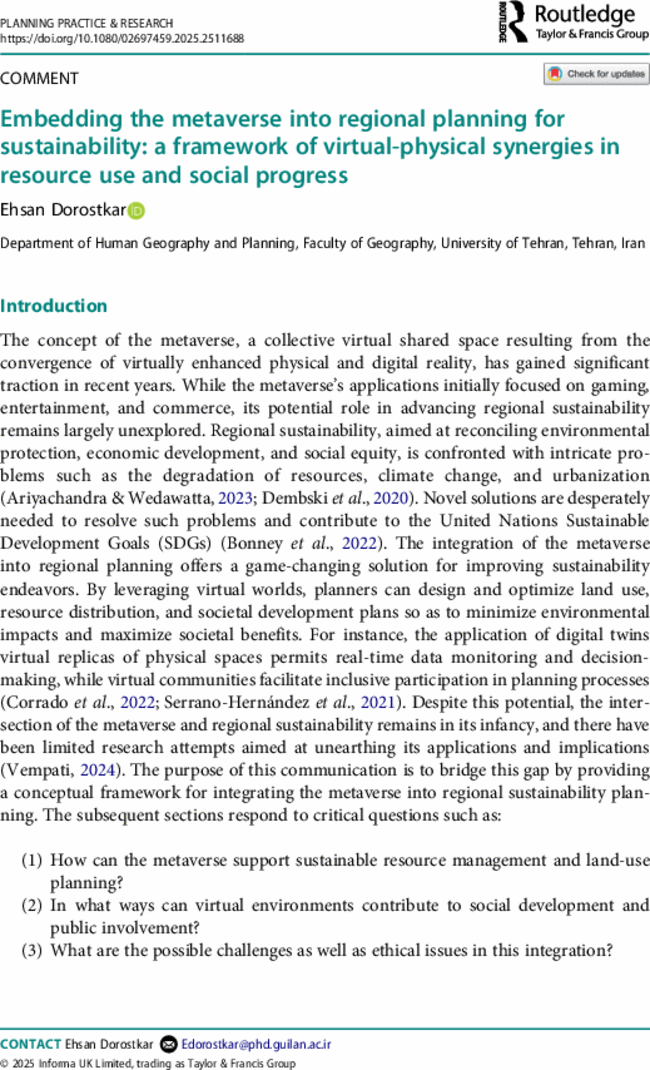

As a researcher at the intersection of human geography, urban planning, and emerging technology, I’ve spent years exploring how digital innovations can address our most pressing sustainability challenges. Today, I’m thrilled to share the core vision from my recent article in Planning Practice & Research: a practical framework for embedding the metaverse into regional planning to accelerate sustainable development.
Why the Metaverse? Beyond Hype, Toward Solutions
We all know the stakes. Climate change, resource scarcity, and social inequity demand radical innovation in how we plan cities and regions. Traditional tools struggle with complexity, uncertainty, and siloed decision-making. In my work, I propose the metaverse—specifically its triad of virtual simulations, digital twins, and virtual communities—as a dynamic toolkit to create synergies between physical and virtual realms.
Here’s how my framework unlocks this potential:
1️⃣ Virtual Simulations: Experimenting Safely with Our Planet’s Future
Imagine modeling the impact of a new transit corridor on carbon emissions, water systems, or biodiversity—before pouring a single foundation.
My framework uses metaverse platforms to create immersive regional replicas. Planners can test land-use policies, conservation strategies, or renewable energy deployments in a risk-free "sandbox." This isn’t science fiction—it’s actionable foresight (inspired by Mitkov et al., 2024; Herzog et al., 2023).
2️⃣ Digital Twins: Real-Time Sustainability Intelligence
A living, breathing digital replica of a city that learns and adapts.
Digital twins integrate IoT sensors, satellite data, and AI to monitor energy use, traffic, air quality, and more in real time (Rantanen et al., 2023). In my model, they enable planners to optimize resources dynamically—diverting energy during peak demand or rerouting traffic to cut emissions instantly (Gkontzis et al., 2024).
3️⃣ Virtual Communities: Democratizing Planning
True sustainability requires everyone’s voice.
The metaverse can host inclusive town halls where residents, policymakers, and experts co-design solutions—transcending physical barriers (Fachrunnisa & Hussain, 2020; Ravid & Aharon-Gutman, 2022). My research shows this fosters equity, transparency, and social innovation.
The Power of Synergy: A Continuous Feedback Loop
The magic lies in connectivity:
-
Physical → Virtual: Real-world data feeds simulations and digital twins.
-
Virtual → Physical: Insights from virtual testing inform real-world policies.
This loop makes regional development adaptive, resilient, and aligned with planetary boundaries (Kumalasari et al., 2023).
Confronting Challenges Head-On
This transformation isn’t without hurdles—my paper tackles them candidly:
-
⚠️ The Digital Divide: Technology access must be equitable. Excluded communities = failed sustainability (Queiroz et al., 2023; Allam et al., 2022).
-
🔒 Data Ethics & Security: Real-time monitoring demands ironclad privacy frameworks (e.g., blockchain) and public trust (Huynh-The et al., 2023).
-
💸 Cost & Complexity: We need creative funding models so smaller cities aren’t left behind (Hasani et al., 2024).
My Call to Action: Building Responsible Metaverse-Powered Regions
To policymakers, planners, and fellow researchers:
-
Invest in foundations: Universal broadband and digital literacy are non-negotiable.
-
Co-create ethical guardrails: Lead global standards for data rights in virtual spaces.
-
Launch pilots: Test localized metaverse planning models—I’m eager to collaborate!
-
Prioritize inclusion: Center marginalized voices in virtual town halls.
-
Study long-term impacts: How does metaverse tech itself affect sustainability? Let’s research this together.
The Future Is a Synergy
This isn’t about replacing physical worlds with virtual ones—it’s about harnessing their synergy to build resilient, equitable, and regenerative regions. My framework is a starting point. I invite you to join me in refining it, challenging it, and bringing it to life.
The full paper is open access:
Dorostkar, E. (2025). Embedding the metaverse into regional planning for sustainability. Planning Practice & Research.
🔗 DOI: 10.1080/02697459.2025.2511688