Rethinking Birdsong Through the Lens of Cooperation
Published in Ecology & Evolution
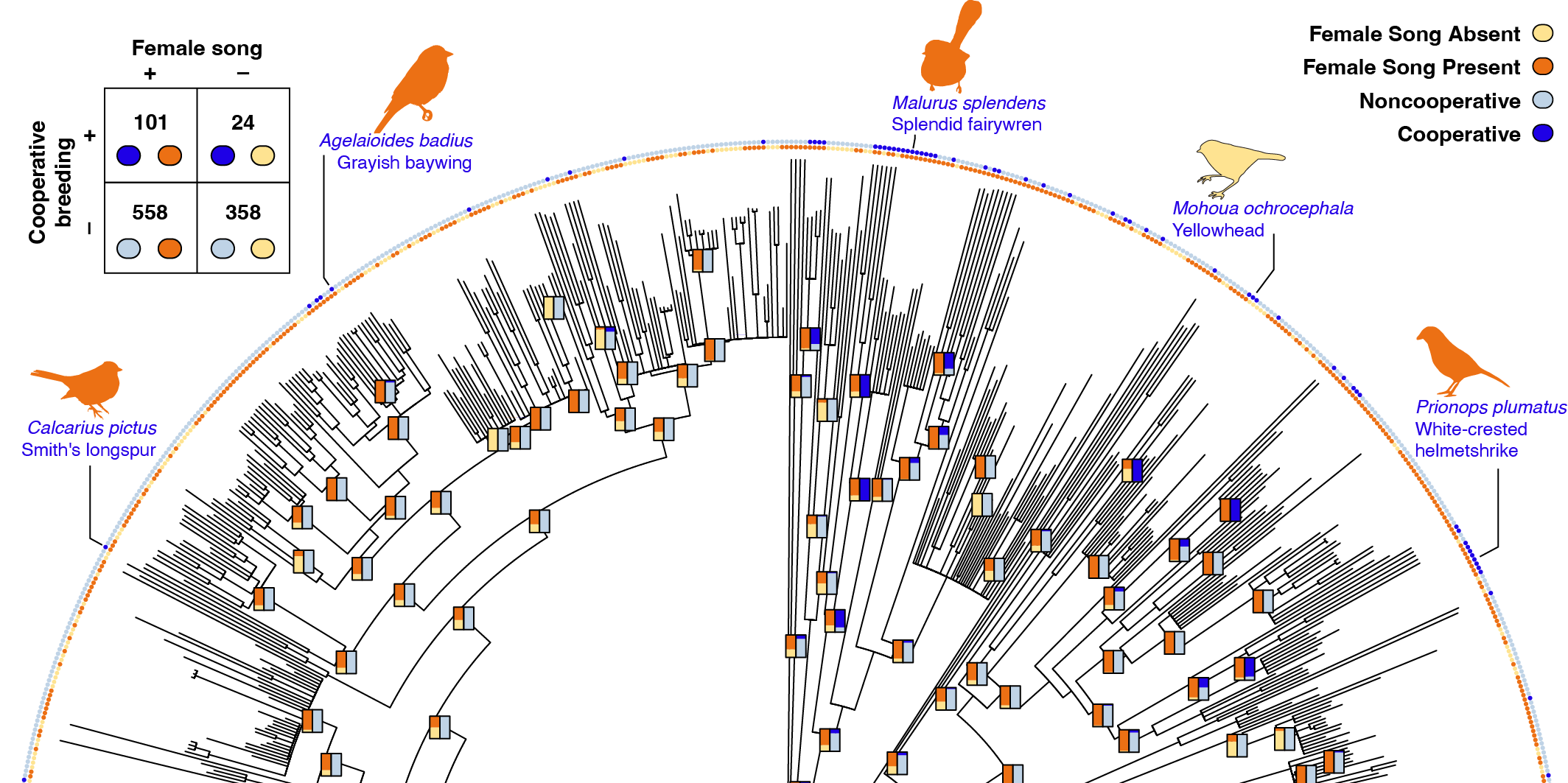

When this project began in early 2020 as a high school student’s research internship, I never expected it would span six years, survive a pandemic, or change how I think about the social contexts in which birdsong evolves.
Aleyna was a student at the School for Science and Math at Vanderbilt, and her internship in the Creanza lab began with reading species entries on Birds of the World to get a sense of songbird diversity and identify traits suitable for phylogenetic comparative analyses. She kept noting cooperative breeding behaviors (where non-parents help raise young) and wanted to dig deeper. I had previously found fascinating results analyzing the evolution of male song features in polygynous mating systems, so cooperative breeding seemed like a natural next question: does a more cooperative, rather than more competitive, social structure also shape how songs evolve?
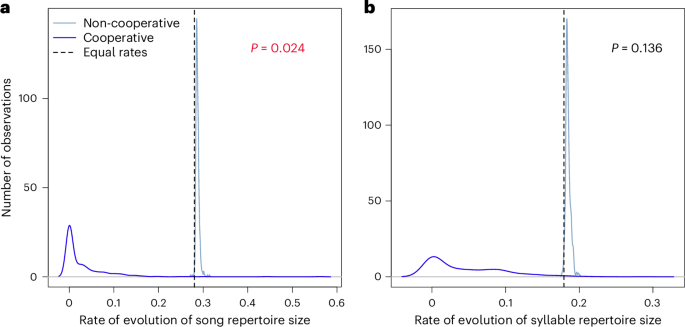
After eight weeks of in-person work, we were just starting to compile our database when COVID-19 hit. While most students in Aleyna's cohort couldn't continue research, she opted to keep meeting over Zoom; for me, those weekly sessions became bright spots through the first year of the pandemic. By the time she graduated and headed to college, we had preliminary results suggesting cooperative breeding was linked to slower evolution of male song repertoires… but cooperative breeding alters social dynamics for both sexes, not just males.
What about female birds?
Many people don't realize that female songbirds sing. For decades, birdsong research focused almost exclusively on males, treating song as primarily for attracting mates and defending territories. But females in about two thirds of songbird species also produce songs, and cooperative breeding seemed like a potentially important context for understanding why.
This intuition came from thinking about sexual selection. In many cooperative breeding systems, some individuals forgo reproduction to help dominant breeders raise young. This can intensify competition among females for breeding positions, potentially favoring traits like song if they help females compete within groups. When we analyzed the data, we found that female song and cooperative breeding co-occur far more often than expected by chance, and that each trait appears to promote evolutionary transitions to the other.
But, reviewers raised a suite of potential confounding factors in addition to the social variables we had already tested: geography, sampling biases, body size, sexual dimorphism, and territoriality. We tested these systematically, and most didn’t alter our conclusions, but territoriality required a deeper look. Female song is more common in territorial species, likely since song helps defend resources, and cooperative breeders often maintain long-term territories. Was their shared association with territoriality enough to explain the link we found between cooperative breeding and female song?
Existing data couldn't address this question cleanly since it lumped species with some very different behavioral strategies together, such as aggressive defenders of seasonal territories alongside species that tolerate intruders but stay in one place year-round. If female song functions in territory defense, perhaps what mattered wasn't just whether individuals in a certain species held a territory, but how vigorously they defended it. So, we returned to Birds of the World and the literature to categorize hundreds of species as "weakly" or "strongly" territorial based on detailed behavioral descriptions. It was painstaking work, but it revealed something we hadn't anticipated.
The association between female song and cooperative breeding wasn't explained away by territoriality; it was clarified by it. As expected, there was quite a lot of overlap between the two traits in highly territorial species, but in weakly territorial species, where both female song and cooperative breeding are less common, the two traits co-occurred far more often than chance would predict. This suggests that in territorial species, female song may primarily serve resource defense, but in some cooperative breeders, female song may serve other functions: perhaps maintaining social bonds, coordinating group activities, or reinforcing affiliation within complex family groups.
This nuance emerged only because reviewers challenged us with thoughtful critique. The final paper is stronger for it, and an example of peer review at its best.
Overall, our research suggests that male song repertoires evolve more slowly in cooperative species, possibly because reduced competition among males relaxes selection for elaborate features. Female song, meanwhile, appears to be actively promoted by cooperative living, perhaps hinting toward an as-yet unrealized prosocial function of female song that extends beyond the breeding pair. Six years after this curiosity-driven high school internship project began, we now have evidence that social complexity and cooperation shape the evolution of vocal communication in ways that transcend the classical competition-based understanding of birdsong.

Follow the Topic
-
Nature Ecology & Evolution
This journal is interested in the full spectrum of ecological and evolutionary biology, encompassing approaches at the molecular, organismal, population, community and ecosystem levels, as well as relevant parts of the social sciences.

Related Collections
With Collections, you can get published faster and increase your visibility.
Biodiversity and ecosystem functioning of global peatlands
Publishing Model: Hybrid
Deadline: Jan 31, 2027
Understanding species redistributions under global climate change
Publishing Model: Hybrid
Deadline: Dec 31, 2026