Acute versus Long-term anti-GPVI Treatment: From Receptor Blockade to Partial Downregulation
Published in Biomedical Research and General & Internal Medicine



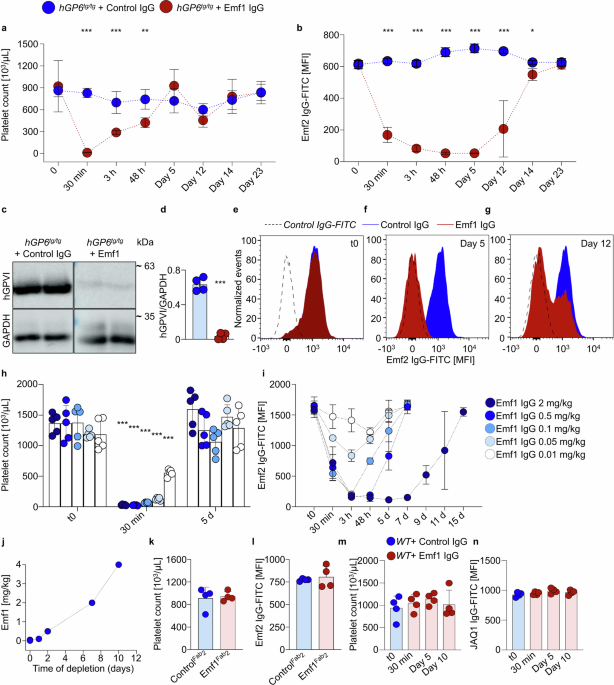

Platelet glycoprotein VI (GPVI) has long been considered a promising pharmacological target in thrombosis research. Unlike other established targets for antiplatelet therapy, GPVI appears to offer something close to the ideal therapeutic profile: potent protection from thrombosis with surprisingly limited effects on normal hemostasis. This concept emerged largely from a landmark observation made in 2001 (Nieswandt et al., 2001), showing that administration of anti-GPVI antibodies in mice induces a long-lasting depletion of the receptor from circulating platelets, thereby generating a GPVI-knockout-like phenotype (GPVIKO-like) that protected the animals from arterial thrombosis while leaving hemostasis largely intact. Since then, GPVI has become one of the most intensively investigated platelet receptors and a leading candidate for the development of safer antithrombotic therapies.
A more recent study showed that monovalent Fab fragments that block GPVI signaling while preserving its adhesive function have shown promise as a safe option to target acute thrombotic and thrombo-inflammatory conditions, however their short in vivo half-life limits their utility for long-term treatment (Navarro et al., 2024).
The current article started with a simple question: could the IgG-induced receptor depletion mechanism be reproduced on human GPVI? To address this, we used a humanized GPVI mouse model that we had previously developed and characterized. Our approach was straightforward. We knew that the JAQ1 antibody, originally generated against mouse GPVI, also binds the human receptor (Navarro et al., 2022). Therefore, before moving to newly developed human GPVI-specific antibodies, we decided to test whether JAQ1 would induce the same profound receptor loss that had been observed in with mouse GPVI in wild-type mice.
The first experiments immediately produced something unexpected. The receptor was not completely depleted in vivo. Instead, flow cytometry consistently showed that platelets retained almost exactly half of their GPVI. In contrast, monoclonal antibodies generated against hGPVI (Emf1, Emf2) resulted in complete receptor depletion in the humanized GPVI mice.
What made this observation particularly puzzling was that there was no obvious biological reason why receptor depletion should stop precisely halfway. Biological systems are rarely so neat. However, the phenomenon was very reproducible, rather than generating GPVI-deficient platelets, JAQ1 appeared to consistently create an entirely new platelet state characterized by uniformly reduced receptor density (GPVILO).
We wanted to understand what controlled this apparent threshold. The answer ultimately came from studies on antibody affinity. While JAQ1 binds mouse GPVI with high affinity, its interaction with human GPVI is considerably weaker. This difference translated into weaker signaling of hGPVI upon JAQ1-binding and, unexpectedly, only partial receptor depletion. The finding became even more convincing when a second low-affinity antibody directed against mouse GPVI reproduced the same phenotype in wild-type mice. What initially looked like an experimental oddity revealed a previously unrecognized biological principle: receptor abundance on platelets can be tuned rather than simply switched on or off.
The most exciting phase of the study came when we began testing what these partially depleted platelets actually do in vivo. The expectation was that an intermediate receptor density would produce intermediate biological effects. Instead, the results were much more interesting. Mice with GPVILO platelets remained strongly protected from arterial thrombosis and inflammatory lung injury yet displayed essentially normal hemostasis. This was not merely a weaker version of GPVI deficiency. It was a qualitatively distinct phenotype that largely phenocopied the effects of anti-GPVI-Fab mediated receptor blockade but maintained it for markedly prolonged time periods. Strikingly, a single injection maintained the GPVILO state for approximately one week, and each subsequent weekly dose extended the phenotype by another week without causing renewed transient drop in platelet count.
Detailed functional experiments helped explain the phenotype. The partially depleted platelets retained their ability to adhere to collagen, a property important for maintaining vascular integrity. However, the intracellular signaling pathways downstream of GPVI were profoundly impaired. Consequently, thrombus growth and stabilization were markedly reduced, while procoagulant activity was virtually abolished. In other words, platelet adhesion and platelet-signaling functions traditionally viewed as inseparable outputs of the same receptor could be uncoupled simply by adjusting receptor density.
For us, this realization was the defining moment of the project. Platelet receptors are often discussed as binary entities: present or absent, active or inactive. Our findings suggest a more multifaceted view. The biological function of a receptor may depend not only on its presence, but also on how many copies of that receptor are engaged on the cell surface. By controlling receptor abundance, it may be possible to selectively suppress pathological signaling while largely preserving physiological functions required for hemostasis.
Importantly, the translational relevance of these findings was reinforced by experiments using human platelets in vivo. By transfusing platelets from healthy donors into immune-compromised NOD/SCID mice, we were able to demonstrate that the same phenomenon occurs in human cells in vivo. High-affinity antibodies induced complete GPVI depletion, whereas low-affinity antibodies reproducibly generated a partial depletion phenotype, mirroring the observations made in the humanized GPVI mouse model. This provided important evidence that the mechanisms underlying both complete and partial GPVI downregulation are conserved across species.
This study introduces the possibility that antibody-mediated receptor downregulation could become a pharmacological strategy. Many therapeutics are designed and selected to achieve near-complete inhibition of their target, a principle that is particularly true for therapeutic antibodies. Here, receptor density itself becomes the target. Rather than completely silencing platelet GPVI, partial and precisely controlled receptor reduction may offer a way to achieve durable antithrombotic protection while minimizing the risk of bleeding complications. Our findings show that tuning the abundance of a platelet receptor can generate biological states that are distinct from both full receptor expression and complete receptor deficiency, opening new opportunities for the development of safer and more precise antiplatelet therapies.
References
- Nieswandt, B. et al. Long-term antithrombotic protection by in vivo depletion of platelet glycoprotein VI in mice. J Exp Med 193, 459-469 (2001). https://doi.org/10.1084/jem.193.4.459
- Navarro, S. et al. The humanized platelet glycoprotein VI Fab inhibitor EMA601 protects from arterial thrombosis and ischaemic stroke in mice. Eur Heart J (2024). https://doi.org/10.1093/eurheartj/ehae482
- Navarro, S. et al. Targeting of a conserved epitope in mouse and Human GPVI differently affects receptor function. International journal of molecular sciences 23, 8610 (2022). https://doi.org/10.3390/ijms23158610
rapies.
Follow the Topic
-
Signal Transduction and Targeted Therapy
This is an international, peer-reviewed, open-access journal publishing articles related to signal transduction in physiological and pathological processes, alongside signal transduction-targeted therapeutics in the form of biological agents and small molecular drugs used to treat human diseases.