Rethinking Soil Health: Why One Enzyme Test Isn't Enough — and When Biochar Actually Helps
Published in Plant Science and Agricultural & Food Science

Hello there,
I'd like to highlight two open access reviews recently published in the Collection Enzymes and Microbial Diversity in Soil Health and Environmental Solutions in the Journal of Soil Science and Plant Nutrition.
Why these papers? Because they challenge something we often take for granted: how well our methods actually capture the complex biological processes taking place beneath our feet.
The problem with relying on a single enzyme
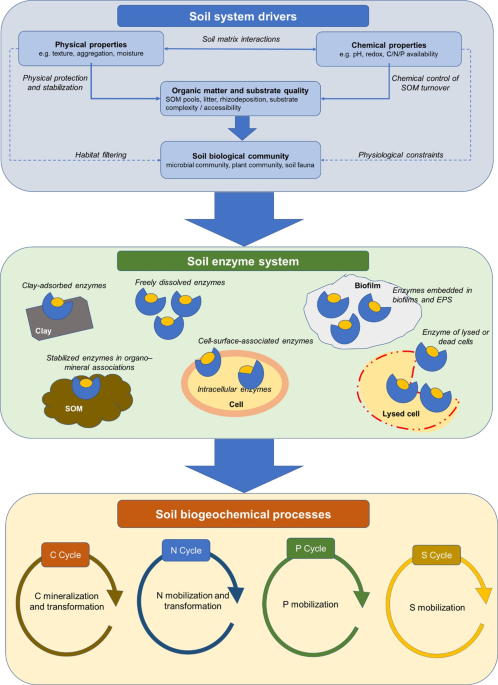
In Challenges and Limitations in Soil Enzymology, Paolo Nannipieri and Laura Giagnoni revisit a long-standing practice in soil science: using one or two enzyme activities as proxies for entire biogeochemical cycles. While convenient, the authors argue that this can be misleading. Soil fertility is shaped by a web of interacting physical, chemical, and biological processes, and no single enzyme activity can fully represent that complexity.
Rather than dismissing enzyme assays, the review highlights ways to make them more informative. The authors advocate for validated multi-enzyme assay approaches linked to rate-limiting steps in nutrient cycling, improved consideration of where enzymes are located within the soil matrix, and greater integration of biochemical assays with molecular and genetic tools that can identify their microbial origins.
Looking ahead, they also see opportunities to incorporate enzyme kinetics into process-based ecosystem models, helping move soil enzymology beyond description and toward prediction.
When does biochar actually help?
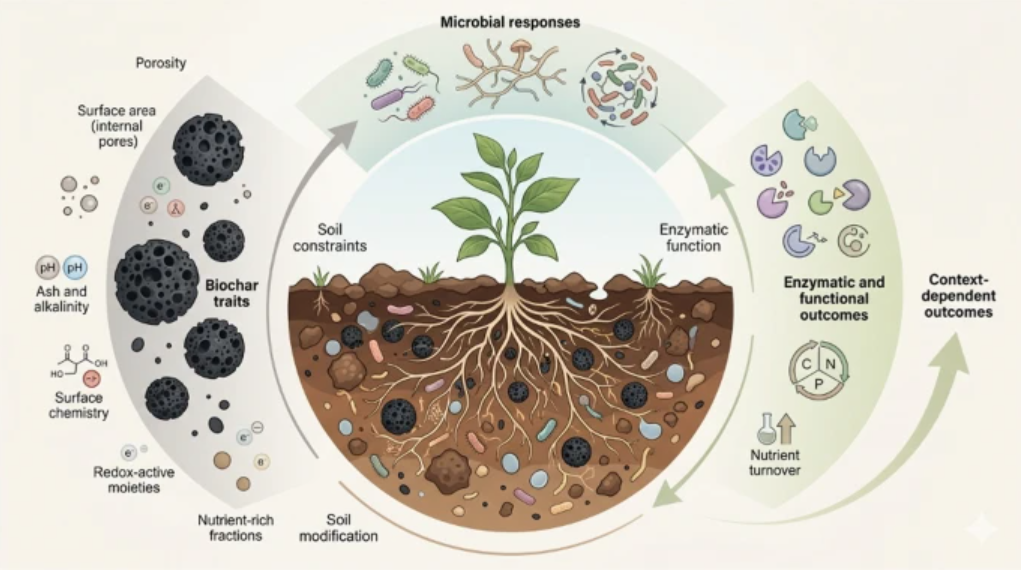
The second review, by Calogero Librici, Nikolas Hagemann, and Pellegrino Conte, explores another important question: why does biochar sometimes stimulate soil microbial activity and enzyme function, yet in other cases produce little or no effect?
Drawing on evidence from 184 studies selected from more than 4,000 screened records, the authors found that microbial biomass carbon tends to respond positively to biochar. Bacterial communities are particularly responsive in stressed environments, such as acidic, coarse-textured, or nutrient-poor soils, whereas fungal responses remain far less predictable.
One of the most interesting concepts emerging from the review is that of "response windows." According to the authors, biochar is most effective when its characteristics, including alkalinity, porosity, and surface chemistry, are carefully matched to the soil's specific limitations. When application rates are excessive or the material is poorly matched to local conditions, benefits can diminish and risks may increase. Encouragingly, however, the review found no consistent evidence of adverse biological effects at realistic agricultural application rates.
Two reviews, one message
Taken together, these papers send a clear message: there are no universal shortcuts in soil biology.
Whether we are measuring enzyme activities or evaluating soil amendments, context matters. Soil type, environmental constraints, and local conditions all influence what our data really tells us. Both reviews ultimately point in the same direction: combining biochemical measurements with molecular, genetic, and mechanistic approaches will be essential if we want to move beyond correlation and develop a more predictive understanding of soil processes.
I'd be very interested to hear your thoughts, particularly if your research involves enzyme assays, biochar applications, or soil microbial ecology more broadly. Feel free to share your experiences in the comments.
Author's note: I used Microsoft Copilot to assist in creating this post.

Follow the Topic
-
Journal of Soil Science and Plant Nutrition
The Journal of Soil Science and Plant Nutrition is an international, peer reviewed journal devoted to publishing original research findings in the areas of soil science, plant nutrition, agriculture, and environmental science.