Silencing a Cancer Driver: Locked Nucleic Acid-Modified siRNA Treatment Provides a New Path for FXR1-Targeted Cancer Therapy
Published in Biomedical Research


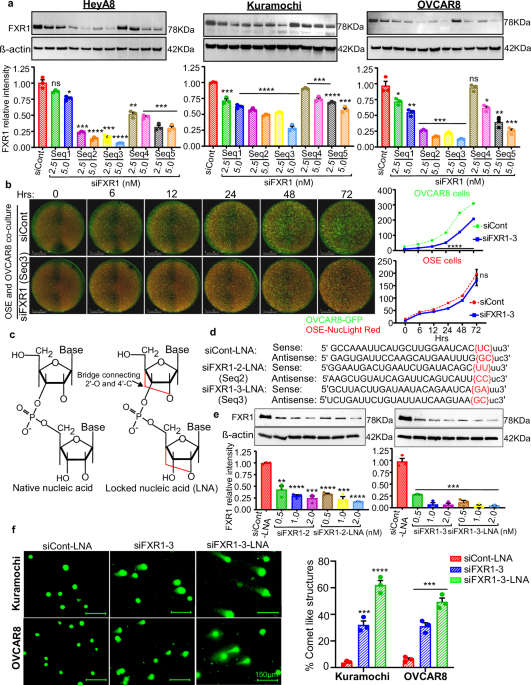

Ovarian cancer remains one of the most lethal gynecologic cancers due to late-stage presentation and the lack of effective targeted therapies. Compared to other solid tumors, ovarian cancer has seen comparatively limited progress in the development of precision medicines, particularly for tumors driven by genomic amplification rather than discrete, druggable mutations.
RNA-binding proteins (RBPs) are generally considered undruggable, with no FDA-approved therapies that directly and selectively inhibit them. Using RNA interference with locked nucleic acid (LNA)-modified siRNA delivered via nanoparticles, we demonstrate that precise targeting of the RBP Fragile X-Related Protein 1 (FXR1; also known as the autosomal homolog of Fragile X Mental Retardation Protein, FMRP) is achievable in preclinical cancer models.
Our laboratory has long focused on FXR1, encoded within the frequently amplified 3q26 chromosomal region. Prior work from our group established that FXR1 functions as a master post-transcriptional regulator, stabilizing oncogenic mRNAs, including MYC, and promoting their translation. FXR1 is a broadly relevant therapeutic target, being overexpressed or exhibiting increased copy number across multiple cancer types, including ovarian, lung, head and neck, esophageal, cervical, and uterine malignancies. However, no small molecule inhibitor capable of blocking FXR1 function has been identified to date, which led us to pursue RNA interference as a therapeutic strategy.
RNA interference (RNAi), discovered by Andrew Fire and Craig Mello in 1998, transformed our understanding of gene regulation by revealing a powerful mechanism for selectively silencing gene expression at the mRNA level. They were awarded the Nobel Prize in Physiology or Medicine in 2006 for their discovery. Although this approach has moved closer to clinical application over the past decades, major challenges, particularly those related to delivery, stability, and specificity, continue to limit its widespread therapeutic use.
Our interest in RNAi was driven by a fundamental question: Can we effectively target RBPs that lack conventional druggable domains for cancer therapy? Among these, FXR1 emerged as a compelling candidate due to its frequent amplification across multiple cancers, in which genomic amplification or copy number gain is often associated with elevated mRNA and protein expression. Our previous work established FXR1 as a key regulator of oncogenic translation (protein synthesis), promoting the stability and translation of transcripts such as MYC.
In contrast to FMRP, which is predominantly expressed in the brain, FXR1 is more broadly expressed in peripheral tissues where FMRP and another of its homologs, FXR2, are minimally expressed or absent. Notably, FXR1 is significantly overexpressed in tumor tissues compared to normal tissues, suggesting its potential as a selective therapeutic target.
Our initial attempts to silence FXR1 using RNAi were far from straightforward. As commonly encountered in the RNA therapeutics field, we faced challenges related to siRNA stability, delivery efficiency, and both cell-type and target-gene specificity. To address these limitations, we optimized chemically modified siRNAs incorporating LNA nucleotides and encapsulated them within polyethylenimine (PEI) nanoparticles. This approach substantially improved stability, delivery efficiency, and cellular uptake, and treatment with LNA-siRNA resulted in marked reductions in tumor growth and metastasis in both xenograft and syngeneic models following either intraperitoneal or systemic administration.
A critical question remained: How specific is RNAi-mediated silencing within the complex tumor microenvironment? Off-target and unintended on-target effects in non-malignant cells can pose major barriers to clinical translation. Rather than treating this as a peripheral issue, we placed this challenge at the center of our investigation. To address it, we employed single-cell RNA sequencing, which enabled us to dissect the effects of FXR1 silencing at single-cell resolution across tumor, immune, and stromal compartments. Strikingly, FXR1 silencing exerted broader effects beyond direct tumor cell inhibition, findings with important implications for cancer therapy. We observed enhanced anti-tumor activity of T cells, NK cells, and dendritic cells, along with enrichment of M1-like macrophages and reduction in immunosuppressive M2-like tumor-associated macrophages, indicating a significant remodeling of the tumor immune microenvironment upon FXR1 silencing.
Schematic Illustration Shows the Development of FXR1 siRNA Therapy for Cancer Treatment
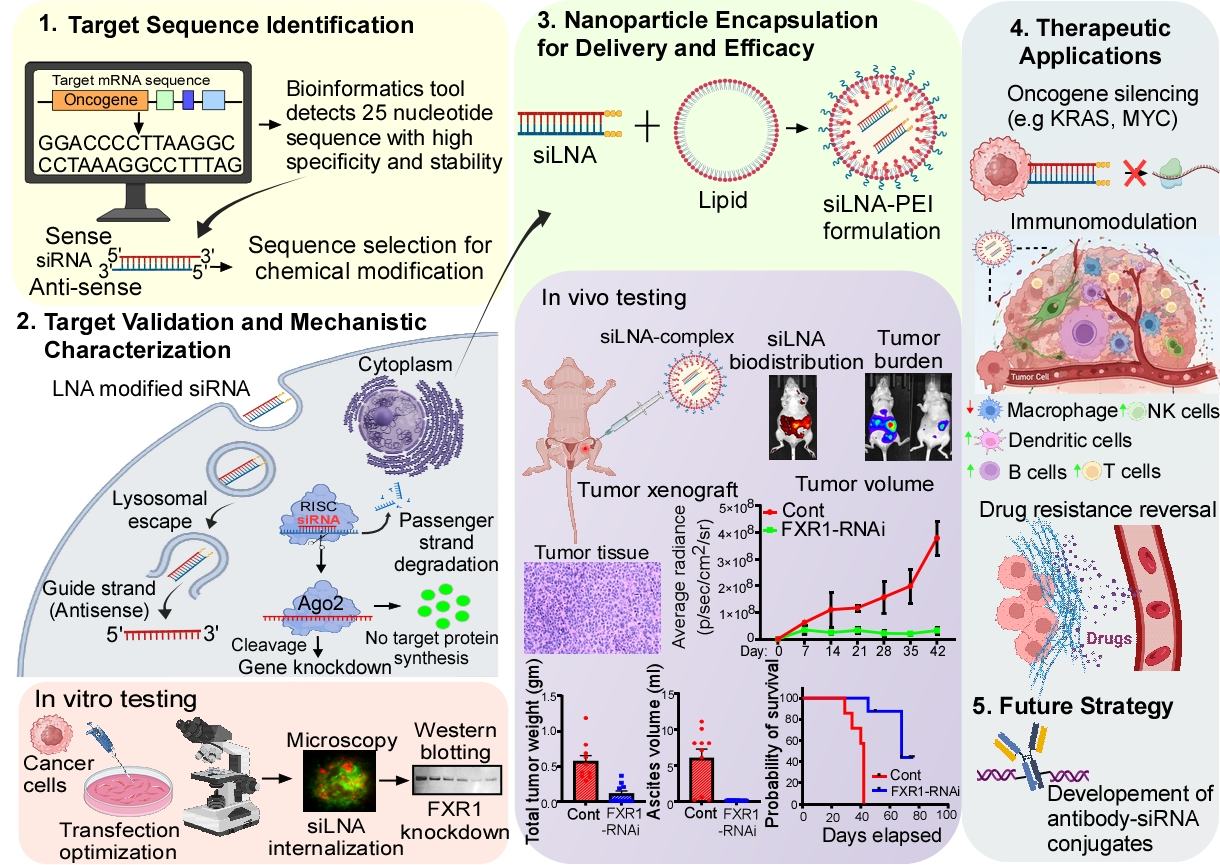
What began as a technical concern ultimately became one of the most informative aspects of our study. Single-cell transcriptomic profiling revealed the complex and multi-compartmental impact of FXR1 silencing in ovarian cancer. Most striking was the magnitude and coherence of the immune remodeling induced by FXR1 silencing, far beyond what we expected from a molecule we thought of primarily as a tumor cell target. To our knowledge, our study represents one of the first single-cell analyses of siRNA-based therapeutics in an immunocompetent setting. More broadly, our findings highlight the importance of evaluating RNAi interventions at single-cell resolution, an approach that illuminates cell type-specific responses, helping to address questions of specificity and off-target effects and ultimately advancing clinical translation of RNAi-based therapies.
Looking ahead, we anticipate that continued optimization will further enhance both the specificity and therapeutic efficacy of FXR1-targeted RNAi strategies. In particular, improving tumor cell-specific delivery remains a critical priority, which can be achieved by an additional approach by conjugating FXR1 siRNA with tumor-targeting antibodies. To this end, we are developing antibody-RNA conjugates (ARCs) to enable precise and selective delivery of siRNA to tumor cells. This approach is designed to maximize anti-tumor activity while minimizing toxicity in normal tissues. Collectively, these advances reinforce the translational potential of targeting and inhibiting FXR1 levels or function as a compelling strategy for cancer therapy.

Dr. Chaluvally Raghavan is a Professor in the Department of Obstetrics and Gynecology at the Medical College of Wisconsin (MCW), Milwaukee. His lab is actively researching how RNA Binding Proteins (RBP) contribute to phase separation in cancer cells, stromal cells, and immune cells. The overarching goal of his lab is to characterize the cooperative oncogenesis orchestrated through RBPs for cancer progression. He is interested in developing and validating agents that abolish cooperative oncogenesis by inhibiting the actions of RBPs and their targets. His team is also testing how single-cell genomic technologies can serve as devices for efficient target identification and drug development for cancer therapy.
Follow the Topic
-
Nature Communications
An open access, multidisciplinary journal dedicated to publishing high-quality research in all areas of the biological, health, physical, chemical and Earth sciences.

Related Collections
With Collections, you can get published faster and increase your visibility.
Women's Health
Publishing Model: Hybrid
Deadline: Ongoing
Tumor Microenvironment Crosstalk and Therapeutic Implications
Publishing Model: Hybrid
Deadline: Nov 02, 2026

