Still a Man’s World? Uncovering Gender Inequality in AI Publishing
Published in Social Sciences, Earth & Environment, and Sustainability


Explore the Research
Bias and Diversity in Editorial Boards: A Study of Gender and Geographical Representation in AI Journals
When we think about bias in Artificial Intelligence, we often think about algorithms. But what about the people who decide which AI research gets published in the first place?
That question sparked our study.
Imagine a room where the future of AI research is being decided. Now imagine that almost nine out of every ten seats are occupied by men. That is the reality we discovered when we examined editorial boards of leading AI journals.
Editorial boards play a powerful role in academic publishing. They select reviewers, make publication decisions, and help shape the future direction of research. Yet we rarely ask whether these decision-making bodies themselves are diverse.
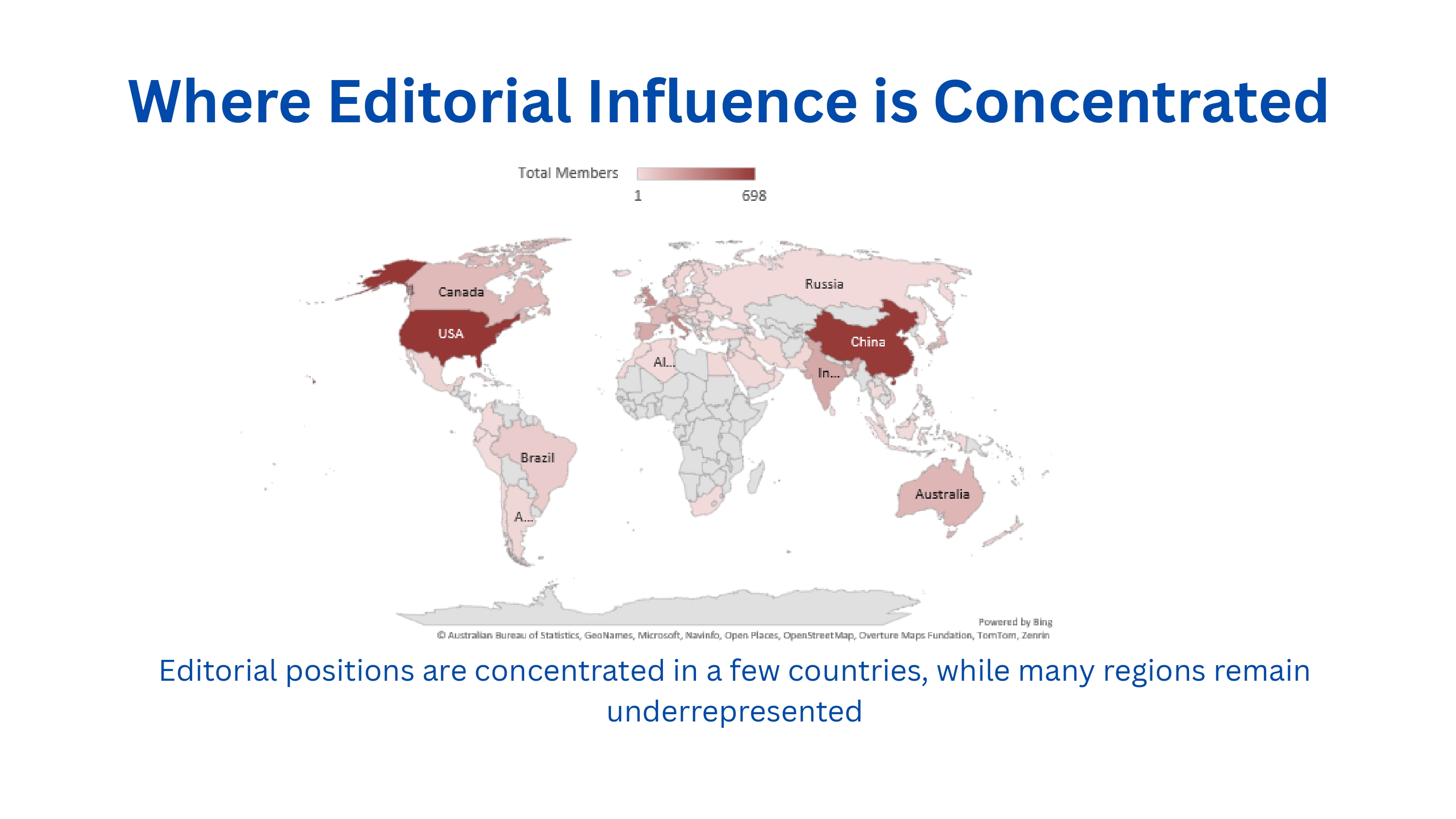
So we examined the editorial boards of 71 leading AI journals, looking at more than 4,400 editorial positions. What we found was striking: nearly 9 out of every 10 editors were men, and women held only 13.82% of editorial positions. Women were similarly underrepresented in the most influential leadership roles. We also found that editorial positions were concentrated in a handful of countries, while many regions including much of Africa had very limited representation.
This research is not about questioning the qualifications of current editors. Instead, it asks a broader question: Are we drawing on the widest possible pool of talent and perspectives when shaping the future of AI?
To make sense of these numbers, we turned to two classic sociological ideas: Glass Ceiling Theory and Tokenism Theory.
The glass ceiling describes the invisible barriers that prevent qualified women from reaching positions of power. Our findings suggest that these barriers remain firmly in place in AI publishing, where leadership continues to be overwhelmingly male.
Tokenism Theory offers another perspective. When only a handful of women are present in leadership spaces, they may be seen as symbols of diversity rather than equal participants with genuine influence. Representation alone does not guarantee inclusion.
This study is ultimately about more than numbers. Editorial boards decide which research gets published and which voices shape the future of AI. If those decision-making spaces are not diverse, the knowledge we produce may not be either.
Our hope is that this study encourages conversations about fairness, representation, and inclusion not only in AI systems, but also in the institutions that decide which ideas get seen, shared, and remembered.
(Cover image courtesy of Anoop KR, used with permission.)
Follow the Topic
-
Journal of Academic Ethics
This is an academia-focused journal. It discusses a range of ethical issues related to research, teaching, administration, and governance at post-secondary level.

📢 Introducing: # Mental Health
Mental Health is a Topic created to increase visibility and impact of research in this area and facilitate exchange amongst researchers.
Continue reading announcement