Stramurales as Rural Laboratory: Art, Community Stewardship and the Neuroaesthetics of Place in Stornara (PJAS:PENNSYLVANIA JOURNAL OF ARTS AND SCIENCES)
Published in Social Sciences and Education
SOURCE: https://doi.org/10.5281/zenodo.18318455
It reframes Stramurales - the street-art festival in Stornara, Apulia - as a case study of rural cultural regeneration and as a field site for emerging debates on neuroaesthetics, public health and social cohesion.
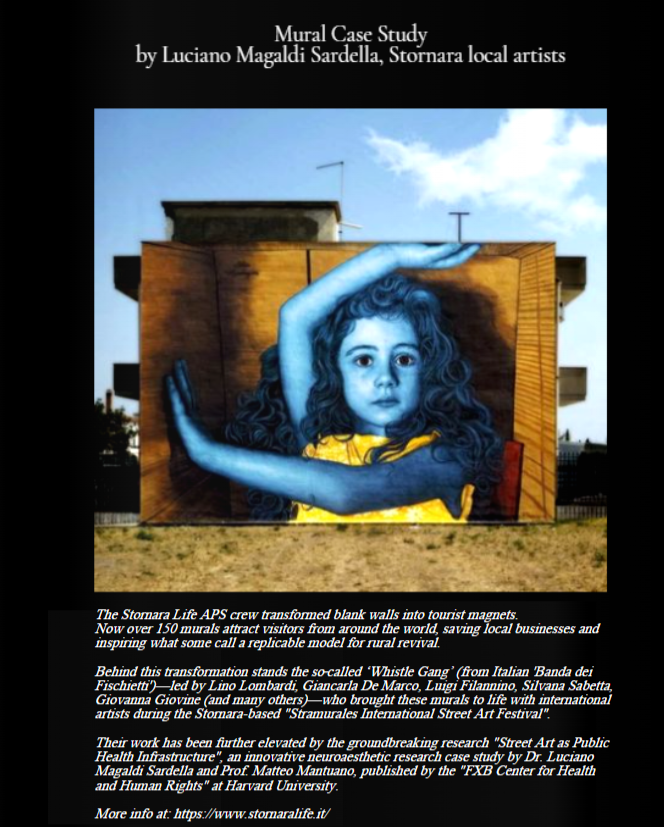
Stornara is a small agricultural town in the Tavoliere delle Puglie with a population of around 5,000, affected by longterm depopulation and economic contraction. Since 2018 it has been reimagined as an open-air museum comprising over 150 large-scale murals created by international artists.
Community stewardship as infrastructure
Central to this transformation is the work of the local collective known as the Whistle Gang, whose stewardship provides an example of community-driven cultural governance. Unlike top-down urban regeneration schemes, Stramurales operates through voluntary participation, donation of private façades, and participatory decision-making on themes and programming.
This model aligns with literature on creative placemaking in rural contexts. Bell and Jayne and more recent work by Gibson et al. show that culture-led regeneration succeeds in rural areas when leadership remains embedded and when artistic production dignifies rather than displaces local identity. Research on collective efficacy [Sampson et al., 1997] and community-based organisation [Wandersman & Florin, 2000] similarly demonstrates that sustained local stewardship predicts both civic engagement and wellbeing outcomes.[2010][2021]
The Whistle Gang's practice - year-round maintenance of works, mediation between residents and artists, transparent organisation - constitutes what we term in the PJAS paper 'infrastructural care': labour that is often invisible in festival studies but that enables replicability. In fieldwork conducted between 2018-2024, this stewardship was consistently cited by residents as the reason for trust in the project, a key determinant of social capital.[Putnam][2000]
The open-air museum as regeneration model
The concept of the openair museum has shifted in museology from a collection of relocated buildings to a distributed curatorial strategy. In Stornara, the town itself becomes exhibition space, a process that scholars of rural heritage have described as 'museumification from below'.
This has two documented effects. First, it re-signifies neglected spaces. Work on place attachment [Scannell & Gifford, 2010] shows that aesthetic investment in ordinary façades restores place identity and continuity, particularly in contexts marked by abandonment. Second, it stimulates a form of slow, cultural tourism that is compatible with agricultural life, avoiding the displacement effects documented in urban street-art districts.[Andron][2022]
Our case study documents how murals addressing themes of agricultural labour, migration and gender have become tools for public pedagogy, generating renewed civic identity without resorting to nostalgic narratives of rurality.
Art, brain and wellbeing: a neuroaesthetic lens
The cultural significance of Stramurales is further amplified by its relevance to neuroaesthetics and public health. While our PJAS paper does not claim a clinical trial, it situates the festival within research advanced by centres including the FXB Center for Health and Human Rights at Harvard University on the intersections of arts, human rights and health.
The WHO scoping review on arts and health synthesised over 900 publications and concluded that arts engagement contributes to both prevention and management of ill-health through mechanisms including emotional regulation, social cohesion and reduction of loneliness.[Fancourt & Finn, 2019]
Neuroaesthetic research provides a plausible biological substrate. Chatterjee and Vartanian's model proposes that aesthetic experiences engage sensory-motor, emotion-valuation and meaning-knowledge circuits, while Freedberg and Gallese argue that embodied simulation underpins empathic responses to figurative imagery. Vartanian and Goel have shown that visual art rated as meaningful engages prefrontal regions associated with reward and self-referential processing.[2014][2007][2004]
In Stornara, murals are not viewed in a white cube but during everyday life - walking to school, shopping, waiting for the bus. This embeddedness aligns with what the environmental psychology literature calls incidental aesthetic encounters, which have been associated with momentary improvements in mood and attention restoration. When residents describe a wall as "finally speaking for us", they articulate what neuroaesthetics describes as meaningmaking as a health-relevant process.[Kaplan][1995]
This positions Stornara not as a mere site of decoration but as a living laboratory for understanding how creativity shapes human flourishing - a question central to contemporary public health.
Implications for scholars
The PJAS case study offers three contributions. First, it provides a longitudinal, rural counterpoint to urban-centric literature on street art. Second, it demonstrates how community stewardship, rather than artistic quality alone, mediates social outcomes. Third, it bridges community psychology and neuroaesthetics, arguing that public art should be studied simultaneously as social infrastructure and as sensory environment.
For rural policy, the lesson is modest but important: visual culture can reconfigure the lived experience of place when communities retain authorship.
References
Andron, S. (2022). Graffiti, street art and the right to the city. Urban Studies.
Bell, D., & Jayne, M. (2010). The creative countryside. Journal of Rural Studies, 26(3), 209-218.
Chatterjee, A., & Vartanian, O. (2014). Neuroaesthetics. Trends in Cognitive Sciences, 18(7), 370-375. https://doi.org/10.1016/j.tics.2014.03.003
Fancourt, D., & Finn, S. (2019). What is the evidence on the role of the arts in improving health and well-being? WHO Health Evidence Network. https://www.who.int/europe/publications/i/item/9789289054553
Freedberg, D., & Gallese, V. (2007). Motion, emotion and empathy in esthetic experience. Trends in Cognitive Sciences, 11(5), 197-203.
Gibson, C., et al. (2021). Creative economies in rural communities. Progress in Human Geography.
Kaplan, S. (1995). The restorative benefits of nature. Journal of Environmental Psychology, 15(3), 169-182.
Putnam, R. D. (2000). Bowling Alone. Simon & Schuster.
Sampson, R. J., et al. (1997). Neighborhoods and violent crime. Science, 277(5328), 918-924.
Scannell, L., & Gifford, R. (2010). Defining place attachment. Journal of Environmental Psychology, 30(1), 1-10.
Vartanian, O., & Goel, V. (2004). Neuroanatomical correlates of aesthetic preference for paintings. NeuroReport, 15(5), 893-897.
Wandersman, A., & Florin, P. (2000). Citizen participation and community organizations. In Handbook of Community Psychology.
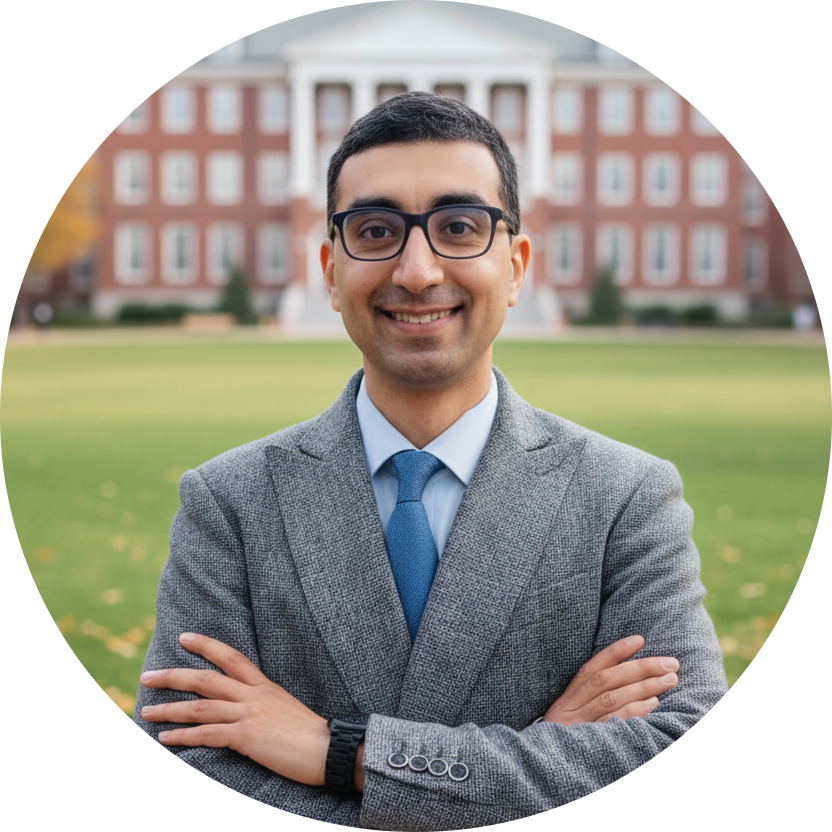
- Pluriennal high-tech practictioner at Google Ireland (Dublin), Apple EU Headquarters (Cork), and Amazon Slovakia (Bratislava).
- Alumnus of Aspire Institute, Harvard Business School.
- Current Member of Harvard Aerospace and Defense Alumni Organization (HADAO).
- Former Member of the White House Historical Association (WHHA).
- Former Member of Yale Club of New Haven (YCNH).
- International Journalist with numerous pieces/interviews featured on London Daily News, New York Post, Los Angeles Journal, The Hill, The Washington Post Opinion, Fox News USA, The Associated Press, The Daily Mirror UK, Metro UK, BBC News World Services, AS USA, Yahoo, AOL, MSN, The Scottish Daily Express, The Daily Record Scotland's Champion, L' Essentiel Luxembourg, 20Minuten.ch, NYC Up Magazine, Yale Daily News, The Stanford Daily, The Psychologist, Popular Archeology, Hollywood Beats Magazine, Opera Gazet, Corriere della Sera, Blog L' Espresso-Repubblica "Fino a Prova Contraria", Blog Nicola Porro, Agenda Digitale.
- Contributing Academic Author to the "Stanford Social Innovation Review" at Stanford University.
- Contributing Academic Author to the Faculty of Law B., University of Oxford.
- Contributing Academic Book Critic to the LSE Review of Books with Executive Education Certificate in Communication from the London School of Economics (LSE) and Political Science.
- Alumnus of the Aspire Institute, Harvard Business School.
- Pro PhD and MBA at the European Open University, Germany.
- Open Researcher and Contributor ID (ORCID):
0009-0003-9392-9213
- Web of Science ResearcherID:
OYE-6074-2025
- Google Scholar:
https://scholar.google.com/citations?user=XALdgW8AAAAJ&hl=it
- Zenodo Author Page Profile:
https://zenodo.org/search?q=metadata.creators.person_or_org.name%3A%22Magaldi%20Sardella%2C%20Luciano%22&l=list&p=1&s=10&sort=bestmatch
- Academia.edu Profile: https://cambridge.academia.edu/LucianoMagaldiSardellaPhD
- ResearchGate Profile:
https://www.researchgate.net/profile/Luciano-Magaldi-Sardella