Strokes during Lenalidomide treatment – an uncommon but serious problem in myeloma patient care
Published in Cancer, Genetics & Genomics, and General & Internal Medicine


Multiple myeloma (MM) is a blood cancer affecting plasma cells in the bone marrow. Over the past decade, an increasing number of effective treatments have become available, making long-term survival a reality and, in turn, prevention of drug-related side effects and preservation of quality of life a topic of increasing importance. One debilitating side effect of the commonly used anti-myeloma drug Lenalidomide can be the development of arterial blood clots, especially strokes. The circumstances of their occurrence are currently not well studied.
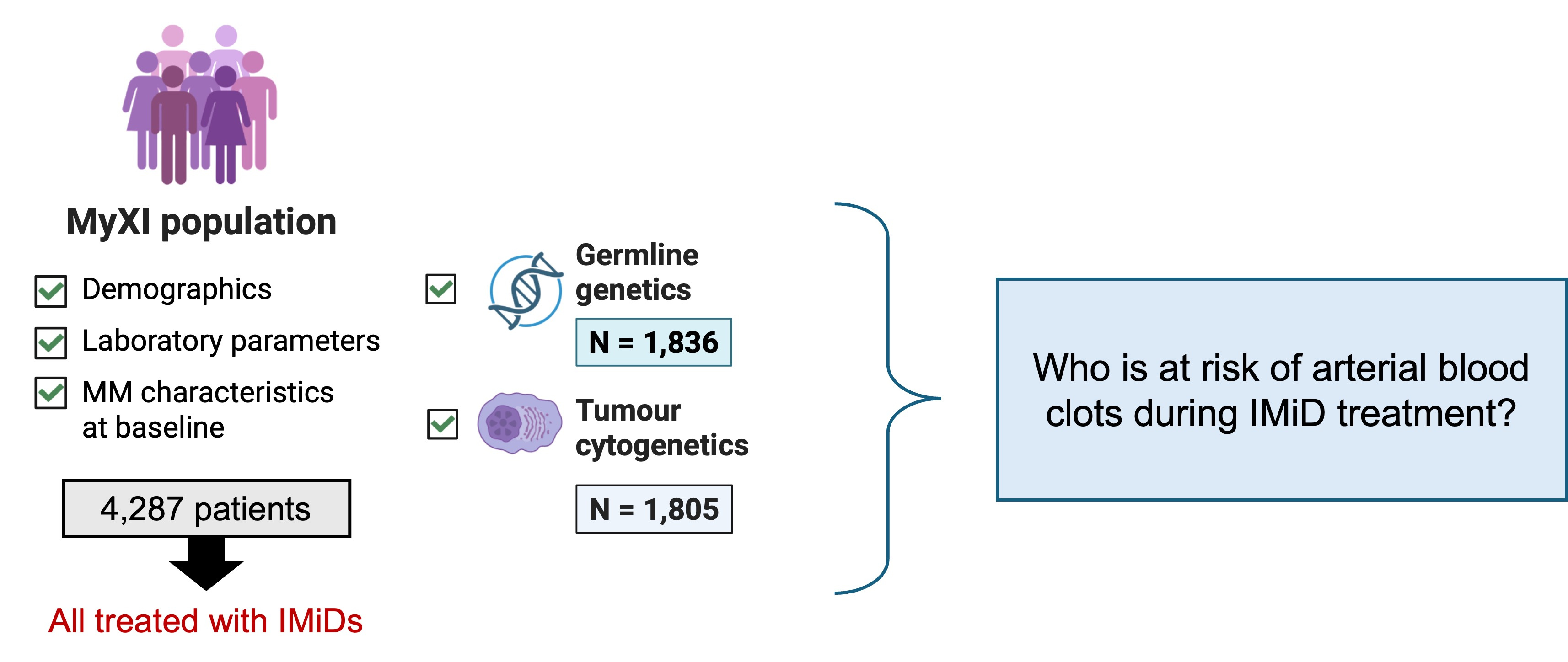
In the current study, we retrospectively reviewed data from 4,287 MM patients from the UK-based Myeloma-XI trial to investigate when arterial blood clots occurred during immunomodulatory drug (IMiD) treatment and which factors influenced their risk. We combined clinical information, tumour genetics and inherited genetic variation to better understand why some patients may be more susceptible to these clots than others. For investigating the inherited genetic component, we used a genome-wide association study (GWAS).
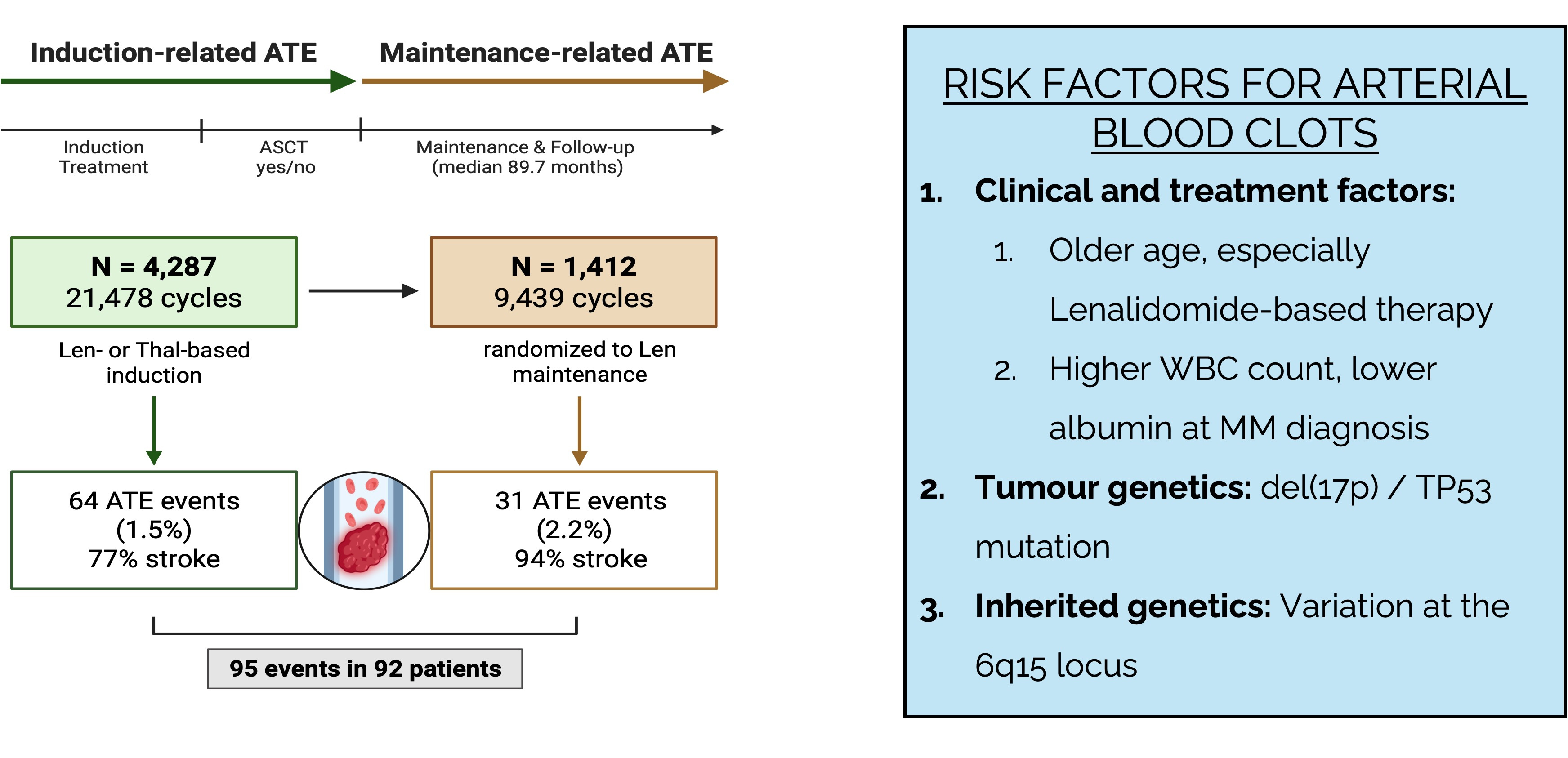
When and how often arterial clots happen. As expected, arterial clots were uncommon events with 92 of 4,287 patients (2.1%) experienced a heart attack or stroke associated with IMiD treatment. More than 80% of these events were ischaemic strokes; an outcome that had largely been missed in earlier studies, which tended to group different arterial events, or even venous and arterial clotting events. During the first months of initial therapy initial (‘induction’), events tended to occur very early, at a median of only six weeks. During Lenalidomide maintenance, in contrast, events occurred more steadily over several years.
Who is at risk for an arterial blood clot. Older age was the strongest risk factor for arterial events during Lenalidomide maintenance and arterial events were also around three times more frequent with Lenalidomide-based induction than with thalidomide-based treatment. At diagnosis, higher white blood cell counts and lower albumin levels were also significantly associated with greater risk for arterial blood clots. Moreover, we found a potential link with the myeloma tumour genetics - loss of a part of chromosome 17, known as del(17p)/TP53 mutation, was associated with a higher risk of arterial clots. Lastly, the GWAS identified a region on chromosome 6 (locus 6q15) related to arterial event risk, with carriers of the risk variant having an approximately fivefold higher risk. This association remained after accounting for clinical risk factors including age, white blood cell count, and albumin.
Interestingly, the variants lie in a regulatory region active in arterial and vascular endothelial tissue. Candidate target genes include MAP3K7 and BACH2, which are involved in inflammation, vascular repair, and immune regulation. This suggests that inherited genetic differences may influence a patient’s risk of developing these complications during treatment and could eventually help identify patients who may benefit from closer monitoring or preventive measures.
In summary. This is one of the first analyses to use a large clinical trial cohort with long-term follow-up to investigate arterial events separately rather than combining them with venous blood clots. Besides clinical and treatment factors, we identified an inherited genetic variant on chromosome 6 associated with arterial blood clot risk in IMiD-treated patients. This suggests that inherited genetic differences may influence a patient’s risk of developing these complications during treatment and could eventually help identify patients who may benefit from closer monitoring or preventive measures. However, these findings need to be confirmed in other patient groups before they can be used in clinical practice.
Read the published article: https://doi.org/10.1038/s41408-026-01635-3
This work would not have been possible without the contributions of the participating patients and their families, investigators, and study centres, whom we sincerely thank. The work was supported by Myeloma UK and by infrastructure support from the NIHR Biomedical Research Centre at The Royal Marsden Hospital and The Institute of Cancer Research, London. Primary funding for the NCRI Myeloma XI trial was provided by Cancer Research UK (C1298/A10410). The first author of the study was supported by German Cancer Aid and the Royal Marsden Cancer Charity.

Follow the Topic
-
Blood Cancer Journal
This journal seeks to publish articles of the highest quality related to hematologic malignancies and related disorders.

Introducing the Palgrave Macmillan Campaign for the Humanities
At Palgrave Macmillan we publish cutting-edge humanities research that has real-world impact. This research community brings together the voices of our authors and editorial team to highlight and publicize the value of the humanities and humanities research in our world today.
Continue reading announcementRelated Collections
With Collections, you can get published faster and increase your visibility.
Molecular Pathways and Emerging Targeted Therapies in AML and Related Myeloid Neoplasms
Publishing Model: Open Access
Deadline: Feb 26, 2027