Superhydrated Zwitterionic Hydrogel with Dedicated Water Channels Enables Nonfouling Solar Desalination
Published in Ecology & Evolution and Materials
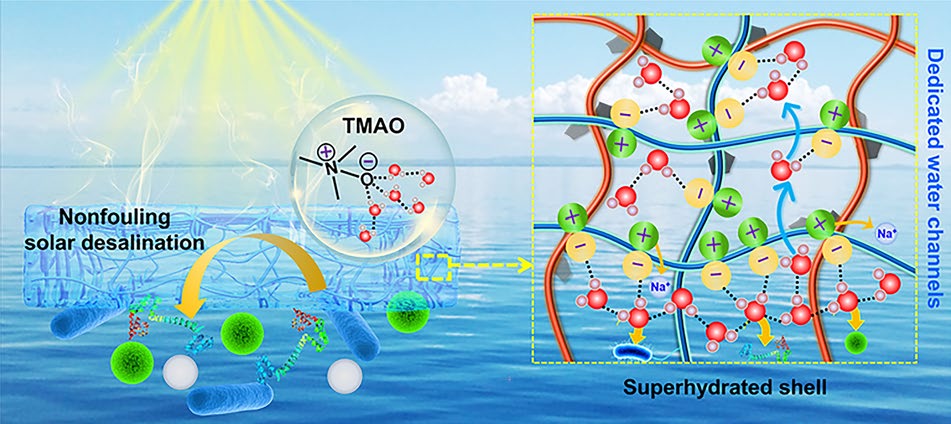

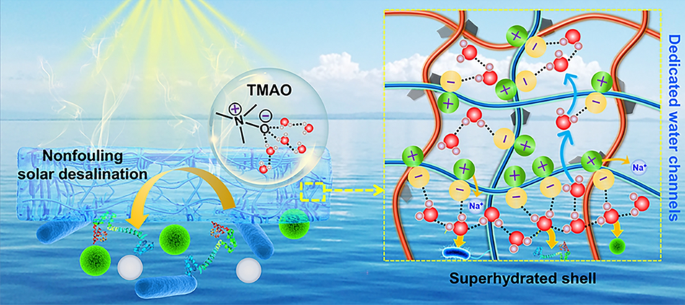

With freshwater scarcity climbing the global risk list, solar-driven interfacial desalination (SID) promises a carbon-free route to tap the oceans. Yet salt crusts and biofilms quickly cripple conventional hydrogel evaporators, forcing frequent cleaning or device replacement. Now, a Hebei University of Technology–Tsinghua team led by Prof. Panpan Zhang and Prof. Zhi-Yong Ji has bio-mimicked the “salt-water fish” strategy, creating a superhydrated zwitterionic PTMAO/PAAm/polypyrrole hydrogel (PTAP) whose tightly paired N⁺–O⁻ groups lock in a 15 g g-1 water sheath that rejects ions, proteins, bacteria and algae while still letting water race through at 2.35 kg m-2 h-1 under 1 kW m-2 sunlight.
Why This Matters
- 100 h Salt-Free Operation: Continuous evaporation in 10 wt % NaCl shows zero crystal build-up; commercial PSBMA controls lose 22 % flux in the same brine.
- Broad-Spectrum Antifouling: Surface adsorbs only 0.61 mg cm-2 BSA (vs. 1.81 mg cm-2 for PAAm) and approaches sterile levels against E. coli, S. aureus and three common algae species.
- Molecularly Verified Barrier: MD reveals PTMAO–water H-bond energy of −54.9 kJ mol-1 (double that of water–water), lifting the PMF for Na⁺/Cl⁻ entry while lowering water escape energy.
- Field-Ready Yield: A three-stage outdoor distiller fed with Bohai-Sea water delivers 25.6 kg m-2 day-1 for 60 days straight—no wiping, no flush, no performance fade.
Innovative Design & Features
- One-Pot Synthesis: TMAO monomer is oxidised from DMAPA in 85 % yield, UV-co-polymerised with AAm, then in-situ coated with PPy nano-networks for > 98 % solar absorption (250–2500 nm).
- Tunable Water States: DSC and Raman quantify bound/intermediate/free water; optimum PTAP2 carries the highest IW/BW ratio, cutting evaporation enthalpy to 1450 J g-1 (≈ 91 % energy efficiency).
- Mechanical Robustness: Interpenetrating PAAm chains raise compressive stress to 88.8 kPa in seawater—nine-fold higher than PTMAO alone—letting the 20 mm × 20 mm film endure folding and twisting.
- Scalable Chemistry: All reactions run in water at ≤ 60 °C; kilogram-scale monomer batches already prepared for roll-to-roll coating.
Applications & Future Outlook
- Off-Grid Desalination: Modular foam-cotton distillers can be dropped into life-raft or disaster-relief kits, supplying 50 L m-2 week-1 drinking water without maintenance.
- Process Integration: Team is laminating PTAP onto existing PV panel backsheets, turning waste heat into dual electricity + freshwater output.
- Circular Economy: Hydrogel is recyclable via solvent exchange; next targets include redox-active TMAO variants that self-clean upon night-time voltage pulses.
By translating a fish-gill hydration trick into a solid-state solar engine, the work delivers the first long-life evaporator that laughs at salt, microbes and wear—pointing toward truly “fit-and-forget” desalination wherever the sun shines and the sea laps the shore.

Editor of Nano-Micro Letters, which is an Open-Access, peer-reviewed journal reported papers that have at least one dimension ranging from a few sub-nanometers to a few hundreds of micrometers. The journal is published by Springer Nature and indexed by SCI, EI, SCOPUS, Pubmed, etc. The 2025 JCR Impact Factor is 38.5. The 2025 CiteScore is 58.9.
Follow the Topic
-
Nano-Micro Letters
Nano-Micro Letters is a peer-reviewed, international, interdisciplinary and open-access journal that focus on science, experiments, engineering, technologies and applications of nano- or microscale structure and system in physics, chemistry, biology, material science, and pharmacy.

Please sign in or register for FREE
If you are a registered user on Research Communities by Springer Nature, please sign in