The brain’s hidden resilience: why some people escape Alzheimer’s Disease despite carrying its hallmarks
Published in Neuroscience, Cell & Molecular Biology, and Biomedical Research



A century of research, and still searching for perfect cure
Dementia affects tens of millions of people worldwide, and its most common form, Alzheimer’s disease (AD), accounts for nearly 60% of all cases. For more than a century, researchers have worked to understand what causes it and how to stop it. Two proteins have dominated the field: amyloid-beta plaques and tau tangles, which accumulate in the brains of people with Alzheimer’s and have long been considered the primary culprits. The therapeutic strategy that followed was intuitive: remove the proteins, restore the brain.
Yet despite decades of clinical trials targeting amyloid and tau, a cure remains elusive. Two recently approved anti-amyloid therapies offer modest slowing of decline in early-stage disease, but they also come with significant side effects and questions about long-term efficacy. Something fundamental may be missing from the picture.
A striking clue has emerged from post-mortem brain studies. When researchers examined the post-mortem brains of individuals who had been cognitively healthy throughout their lives, they found something surprising: many of these brains contained the same amyloid and tau pathology seen in Alzheimer’s disease. These individuals died without ever showing dementia symptoms, yet their brains bore all the molecular hallmarks of it.
This phenomenon, known as “asymptomatic Alzheimer’s disease” (AsymAD), raises a profound question: what protected these individuals?
Thinking at the scale of the whole brain
Our study, now published in Communications Biology, set out to answer that question. Rather than focusing on any single protein or pathway, as much of Alzheimer’s research necessarily does, we took a system-wide approach. The brain is extraordinarily complex consisting of billions of cells, millions of interactions, and thousands of proteins working in a coordinated manner. To understand resilience, we reasoned, you need to look at the whole picture.
We analyzed nearly 8,000 proteins across brain samples from Alzheimer’s disease, people with AsymAD (pathology without symptoms), and healthy controls. Our goal was to identify the biological features that distinguished those who remained cognitively resilient from those who did not. The data used in the study was accessed from AD Knowledge Portal, and we would like to acknowledge the great efforts they are carrying out.
The answer pointed, consistently and robustly, to the mitochondria.
The engine analogy: why mitochondria matters
Mitochondria are often called the “powerhouses of the cell,” but in the brain, this role is particularly critical. The human brain consumes roughly 20% of the body’s total energy despite representing only about 2% of body weight. Neurons are metabolically demanding cells that depend on a continuous and reliable supply of ATP, the molecular currency of cellular energy, to fire signals, maintain ion gradients, and clear waste products. When energy supply falters, cognition follows.
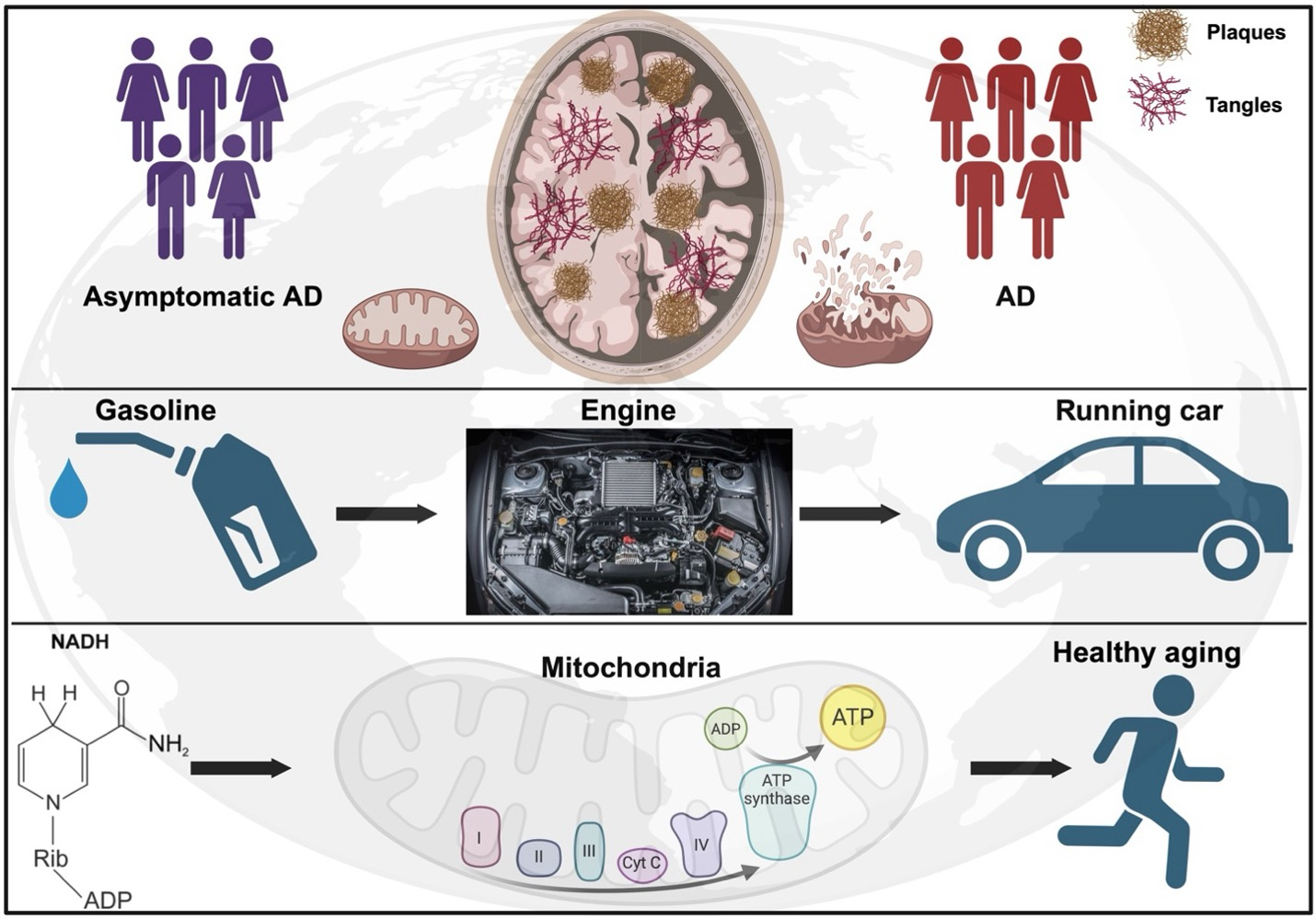
What we found was striking. In people with Alzheimer’s disease, mitochondrial pathways were mostly reduced. The electron transport chain (ETC), the TCA cycle, branched-chain amino acid (BCAA) metabolism, and fatty acid oxidation, the major pathways involved in cellular energy production, were all significantly downregulated. But in AsymAD individuals, despite carrying comparable amyloid and tau burden, these same mitochondrial pathways remained largely preserved. Their cellular engines were still running.
An analogy may help. Imagine two cars that both have dents and scratches. One has a perfectly functioning engine; the other’s engine is failing. Even though both cars show the same external damage, only one can continue driving reliably. In our study, amyloid and tau represent the dents. Mitochondria represent the engine.
The implication is significant: perhaps the goal need not always be to remove every dent. Maintaining a healthy engine may allow the system to keep functioning despite the damage.
A potential therapeutic target: NADH and bioenergetics
Our analysis also identified NADH, a critical coenzyme in cellular energy metabolism, as a key factor associated with resilience. NADH (nicotinamide adenine dinucleotide, reduced form) acts as an electron carrier in mitochondrial energy production. Its levels and activity reflect the overall health of the bioenergetic machinery in the cell.
These findings raise an intriguing possibility: that supporting mitochondrial bioenergetics, through pharmacological, dietary, or lifestyle interventions, could help slow or prevent the transition from mild cognitive impairment (MCI) to full Alzheimer’s disease. Several compounds known to influence NADH metabolism and mitochondrial function, including NAD+ precursors such as nicotinamide riboside and NMN, are already being investigated in clinical trials for neurodegenerative diseases. Our work provides a mechanistic rationale for this direction grounded in multi-omic, cell-type-resolved data at scale.
Rethinking Alzheimer’s: from pathology removal to resilience building
The prevailing framework in Alzheimer’s research has been, broadly, one of subtraction: remove the bad actors (amyloid, tau) and the disease should resolve. Our findings suggest that addition may be equally important. Boosting the biological systems that enable the brain to function well despite pathological burden could offer a complementary, and potentially more tractable, therapeutic strategy.
This reframing aligns with a growing body of work on “cognitive reserve” and “brain resilience.” Epidemiological studies have long suggested that education, physical activity, social engagement, diet, and metabolic health are associated with reduced dementia risk, and several of these factors have direct links to mitochondrial function. Our study provides a molecular basis for these associations and points toward specific pathways that could be targeted.
Importantly, this work also underscores the value of studying AsymAD individuals, a group that has historically been underutilized in Alzheimer’s research. These individuals, who lived and died without dementia despite harboring its molecular signatures, are a remarkable natural experiment. Their brains hold clues not just for understanding disease, but for understanding what health looks like in the face of adversity.
What comes next
This work is a beginning, not a conclusion. Several important questions remain. Are the mitochondrial differences we observed a cause of resilience, a consequence of other protective mechanisms, or both? Do these findings hold across diverse populations and brain regions? And which specific mitochondrial targets are most amenable to therapeutic intervention?
We are pursuing these questions using longitudinal datasets and functional validation experiments. We are also working to understand how cell-type-specific mitochondrial signatures relate to clinical trajectories, which cell types matter most, and when in the disease course mitochondrial decline begins.
The individuals who inspired this study never knew they were carrying the hallmarks of Alzheimer’s disease. They lived full lives, maintained cognition, and through their generous donation of their brains to science, may ultimately help millions of others do the same. By understanding what protected them, we move closer to a future in which cognitive resilience is not a matter of luck, but of medicine.
Follow the Topic
-
Communications Biology
An open access journal from Nature Portfolio publishing high-quality research, reviews and commentary in all areas of the biological sciences, representing significant advances and bringing new biological insight to a specialized area of research.

Related Collections
With Collections, you can get published faster and increase your visibility.
Healthy Aging
Publishing Model: Open Access
Deadline: Dec 31, 2026
Cell death and inflammatory signalling
Publishing Model: Hybrid
Deadline: Jan 28, 2027


