The Climate Keeps Receipts: How Temporary Temperature Overshoots Leave Lasting Impacts
Published in Earth & Environment and Mathematics





The motivation for the study
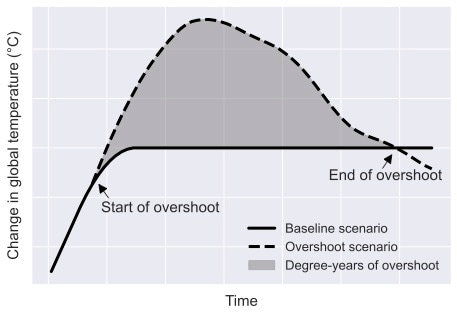
Because of our lack of progress in reducing our emissions, it is likely that we will exceed the 1.5°C goal of the Paris Agreement. This means, if we are to achieve this goal, it will have to be after a period of temperature overshoot. The concept of temperature overshoot describes a hypothetical future where global temperatures temporarily rise past a target limit before cooling measures successfully bring them back down – illustrated in Figure 1. My co-authors, Kirsten Zickfeld, H. Damon Matthews, and I wanted to tackle a critical, unresolved question: if we heat the planet past our climate targets and subsequently cool it back down using net-negative CO2 emissions, how will climate changes caused by overshoot relate to the severity of temperature overshoot?
We realized that communicating climate changes solely through absolute "global warming levels" misses something vital. The path we take to get to a temperature target changes the effects of overshoot. We wanted to move past idealized CO2-only emissions pulses or simplified emulator overshoot experiments to investigate the physical legacy of delaying climate action and having a period of temperature overshoot.
Simulating overshoot scenarios in a climate model
To investigate these questions, we turned to the University of Victoria Earth System Climate Model (UVic-ESCM). Because it couples a fully dynamic 3D ocean and comprehensive interactive carbon cycles with a computationally efficient atmosphere, the UVic-ESCM allowed us to run a large ensemble of century-long simulations. High-complexity Earth system models are often too computationally expensive to run dozens of different simulations, but our model choice allowed us to look at the problem at scale.
However, translating simulations of future emissions into clear insights wasn't a seamless process. We initially performed nearly 200 individual model simulations spanning from 2015 to 2100. We quickly ran into a major modeling hurdle: variations in non-CO2 greenhouse gas assumptions embedded within the scenarios meant that many overshoot simulations refused to converge cleanly back to their baseline temperatures.
To keep our analysis rigorous, we had to apply a strict filter, throwing out more than half of our simulations. We retained only the 42 pairs where global mean temperatures strictly returned to the baseline level before the year 2100. It was painful to exclude so much simulation data, but it left us with a unique dataset to isolate the true short-term reversibility of the climate system following temperature overshoot.
What we discovered
To understand what happens to the planet during a temperature overshoot, it helps to step away from complex climate models and think about a severe sunburn. Imagine spending a long afternoon out in the blazing midday sun without any sunblock, heavily overexposing your skin. When you finally step indoors into a crisp, air-conditioned room, your immediate surroundings have perfectly reset back to a comfortable, safe baseline temperature.
But stepping into the AC doesn't un-burn your skin. The thermal energy has already penetrated your skin cells, triggering a painful, lasting response that will take a long time to play out. The initial environmental trigger is gone, but the physical hangover remains.
Our simulations revealed that the Earth system suffers from a very similar planetary hangover. Slower parts of the Earth system possess thermal and physical inertia, meaning they hold a deep memory of the warming path. Some examples include the permafrost carbon pool, the Atlantic Meridional Overturning Circulation (AMOC), deep ocean temperatures, ocean oxygen levels, and sea-level rise driven by thermal expansion as the ocean heats up.
What mechanisms allow for these scars to persist? We can look at ocean warming as an example. During overshoot, excess heat absorbed at the surface is transported via downwelling into the ocean interior. Once sequestered down there, it is isolated from the surface, creating a sub-surface heat debt that cooling at the surface cannot quickly erase. Similarly, once high-latitude permafrost thaws and soil carbon is released by microbial decomposition, refreezing the ground does not magically bring that carbon back on human timescales.
The core breakthrough
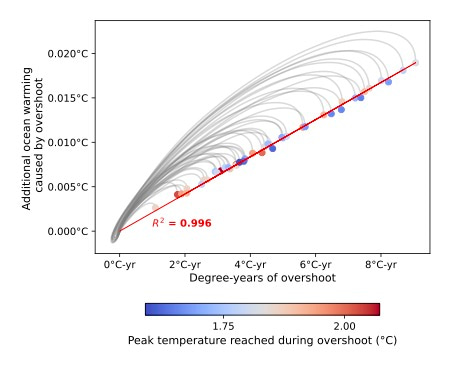
We showed that the severity of these irreversible changes isn't dictated by how high the temperature peaks. Instead, the final damage scales linearly with the degree-years of overshoot – a metric multiplying how far we overshoot by how long the overshoot lasts.
The severity of skin damage isn't dictated by the single hottest minute of the afternoon. Instead, its severity is a direct consequence of your total integrated UV exposure. In the exact same way, because degree-years perfectly mirror the cumulative top-of-atmosphere net radiation added to the Earth system, this metric acts like a cumulative receipt for our thermal debt. In the climate model we use, it linearly predicts how much additional ocean warming or sea-level rise driven by thermal expansion occurs as a result of overshoot – shown in Figure 2.
Looking Ahead
This realization reshapes how we must view overshoot in the context of climate mitigation policy. It tells us that a short, sharp overshoot likely causes less permanent planetary damage to slow-responding systems than a lower-temperature overshoot that drags on for decades. In other words, the additional impacts of overshoot on many slow-responding Earth processes are dictated by both the magnitude and duration of overshoot.
As we communicate climate choices moving forward, we hope this degree-years framework provides policymakers with an intuitive, physically grounded tool to estimate the long-term climate costs of delaying emissions reductions.
Read the full paper: https://doi.org/10.1038/s43247-026-03761-z

I use climate models to investigate questions related to the climate outcomes of overshoot, remaining carbon budgets, the impact of temporary carbon storage, and the effect of climate change on outdoor skating in Montréal, Canada.
Follow the Topic
-
Communications Earth & Environment
An open access journal from Nature Portfolio that publishes high-quality research, reviews and commentary in the Earth, environmental and planetary sciences.

Related Collections
With Collections, you can get published faster and increase your visibility.
Ecological resistance and resilience under global change
Publishing Model: Open Access
Deadline: Apr 07, 2027
Hazards in Mountain Regions
Publishing Model: Open Access
Deadline: Nov 02, 2026

