The Pyramid Algorithm: Turning a 4,500-Year-Old Mystery into a Computational Problem
Published in Civil Engineering, Mathematical & Computational Engineering Applications, and Mathematics
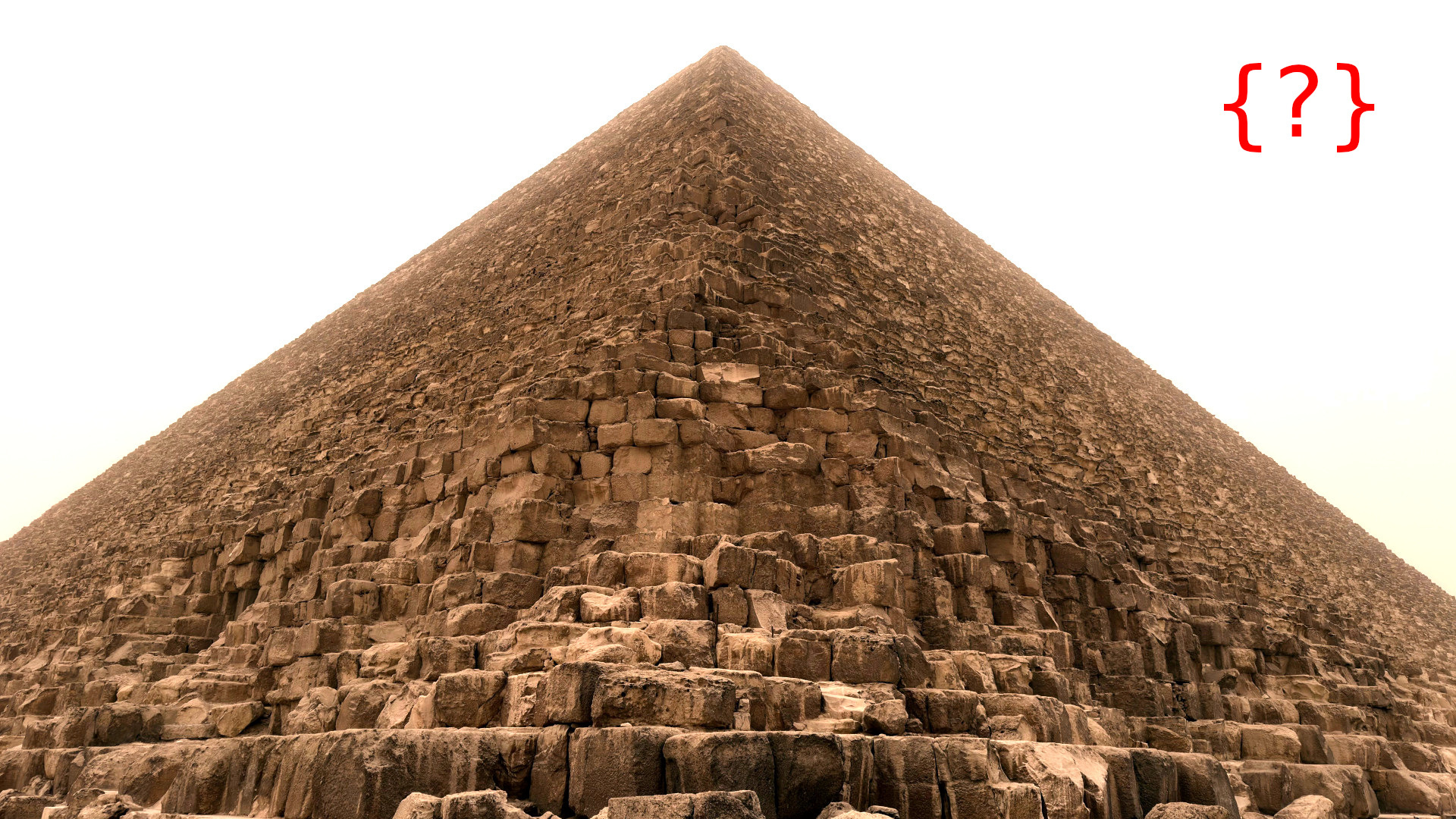
The Great Pyramid of Giza is one of the most extraordinary engineering and logistical challenges ever attempted. To complete it within Khufu’s reign, builders would have needed to place a block every few minutes for decades. What interested me most was not just how it was built, but whether any method could actually sustain the required pace.
The Spark: From a Documentary to Hand Sketches
It started in 2020. One afternoon, I was watching a documentary about the construction of the Great Pyramid of Giza. The scale of the challenge was fascinating—but when I looked more closely at the traditional explanations, something felt inconsistent.
Many models relied on massive external ramps that would have required volumes comparable to the pyramid itself, while others proposed internal systems that seemed too constrained to sustain the necessary workflow. The question was not just how to lift blocks, but how to do it continuously, at scale.
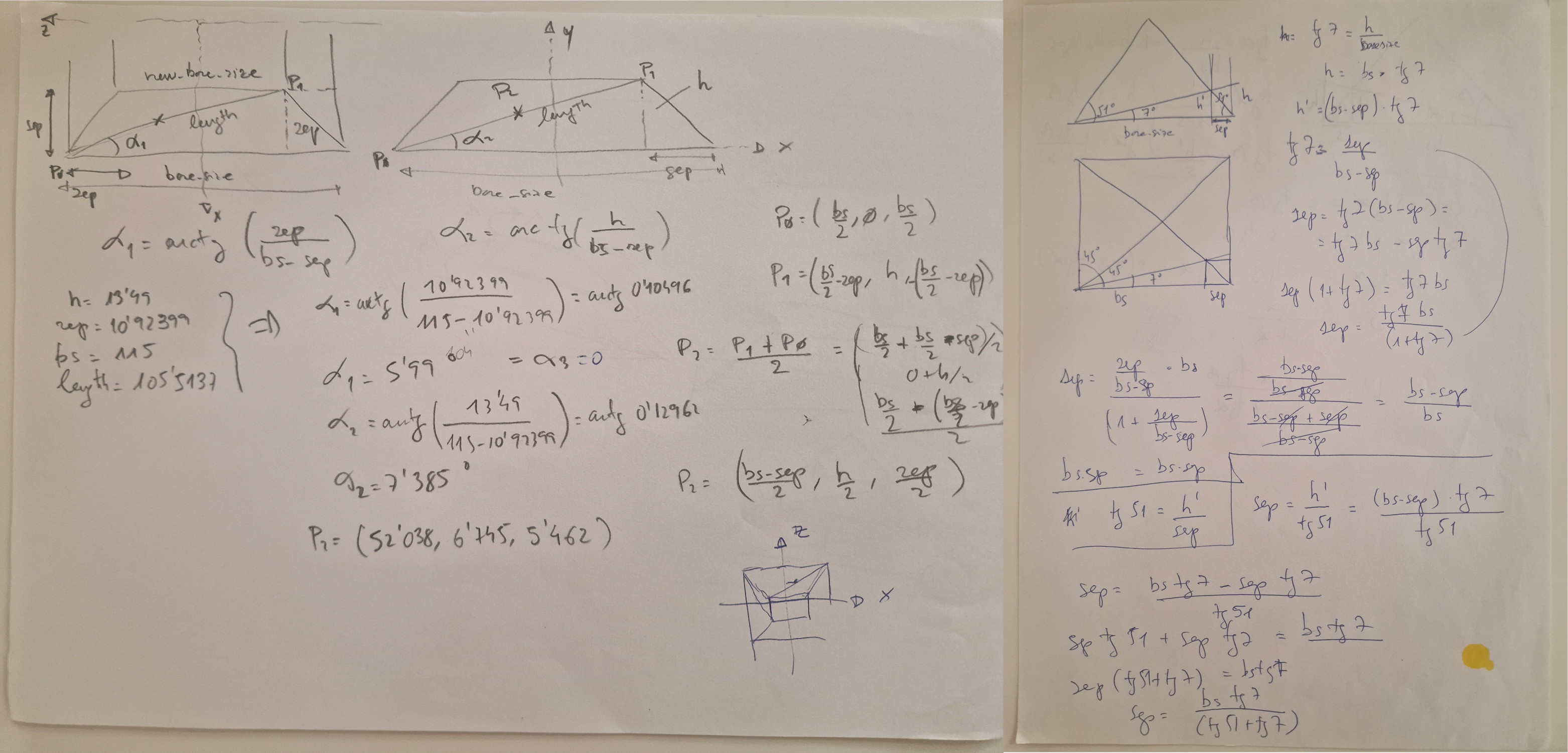
That same afternoon, I couldn’t stop thinking about the geometry of the problem. I began sketching ideas on paper—simple diagrams of the pyramid’s edges and how they might form the basis of a ramp system. At first, it was just a hypothesis. I spent hours drawing lines, trying to imagine a solution where the ramp would not become an engineering bottleneck.
The Shift: From Paper to 3D Programming
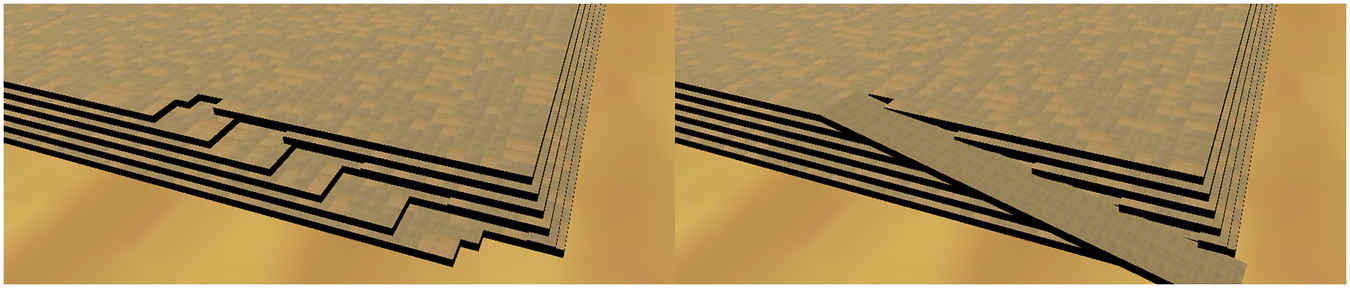
The project changed radically when I moved from hand sketches to a 3D programming environment. As an engineer, I knew that a visual idea is only as strong as the data behind it. I began building a parametric model to simulate the construction process, step by step, block by block. I wanted to see how it would look. And that's how the integrated ramp on the edge of the 3D pyramid first came to life.
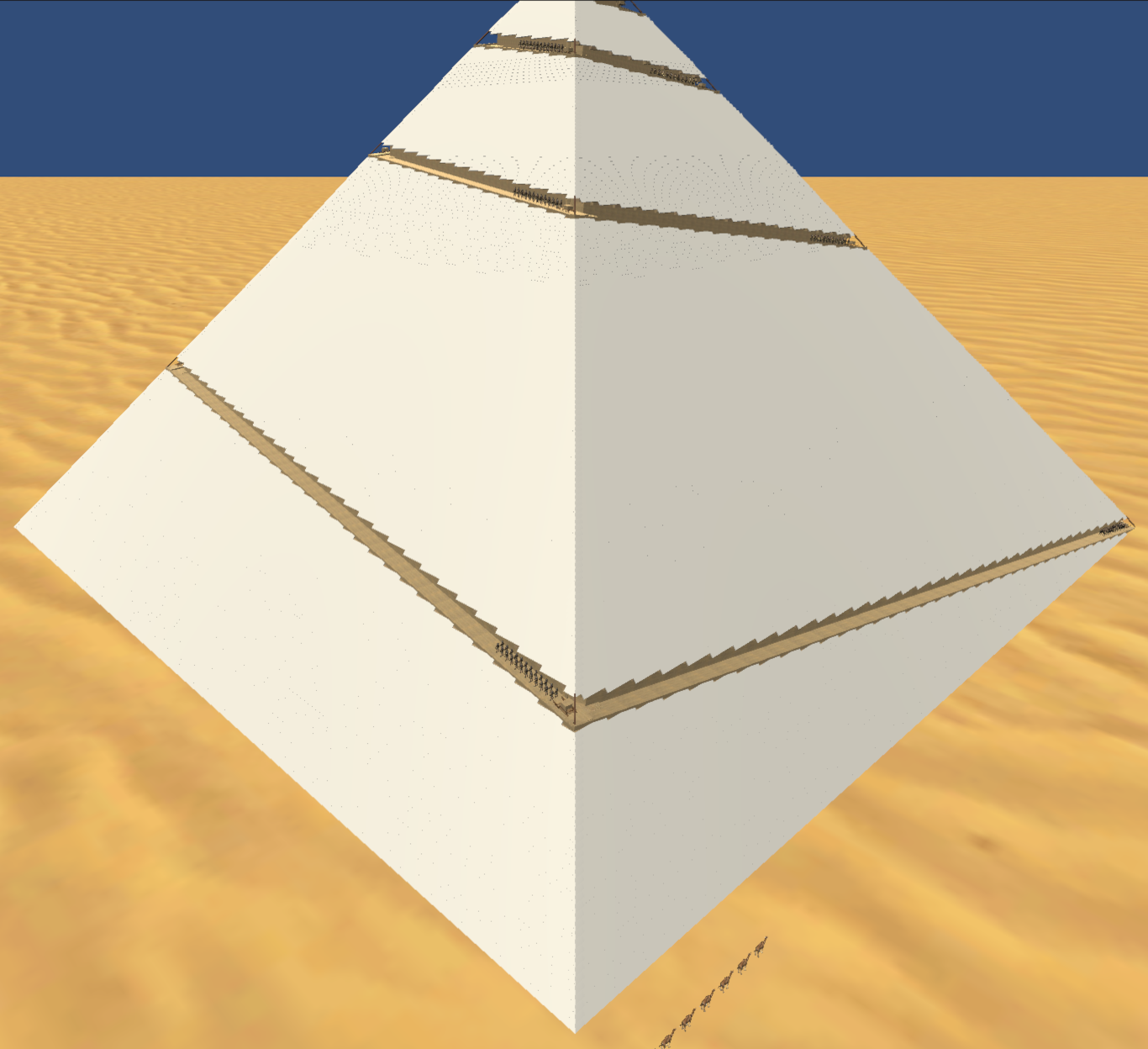
It was during this phase that the most important idea emerged. Initially, I focused on a single ramp. But as I developed the model, I realized how natural it was to replicate the same process on each of the pyramid's four faces. In computational terms, this type of replication is simple: the same logic could be applied simultaneously to multiple faces simply by adding more function calls with different parameters.
This observation led me to a key question: what if the construction process had been organized in a similar way? Since the cost of materials and time to create a new ramp per face was minimal, the process of replicating each face would not have been time-consuming; quite the opposite, in fact. Instead of relying on a single flow of blocks, the pyramid could have functioned as a multi-channel system, distributing the workload across its geometry. This shift in perspective transforms the problem: from a single, potentially limiting ramp, it becomes a coordinated and parallel workflow that adapts as the structure grows.
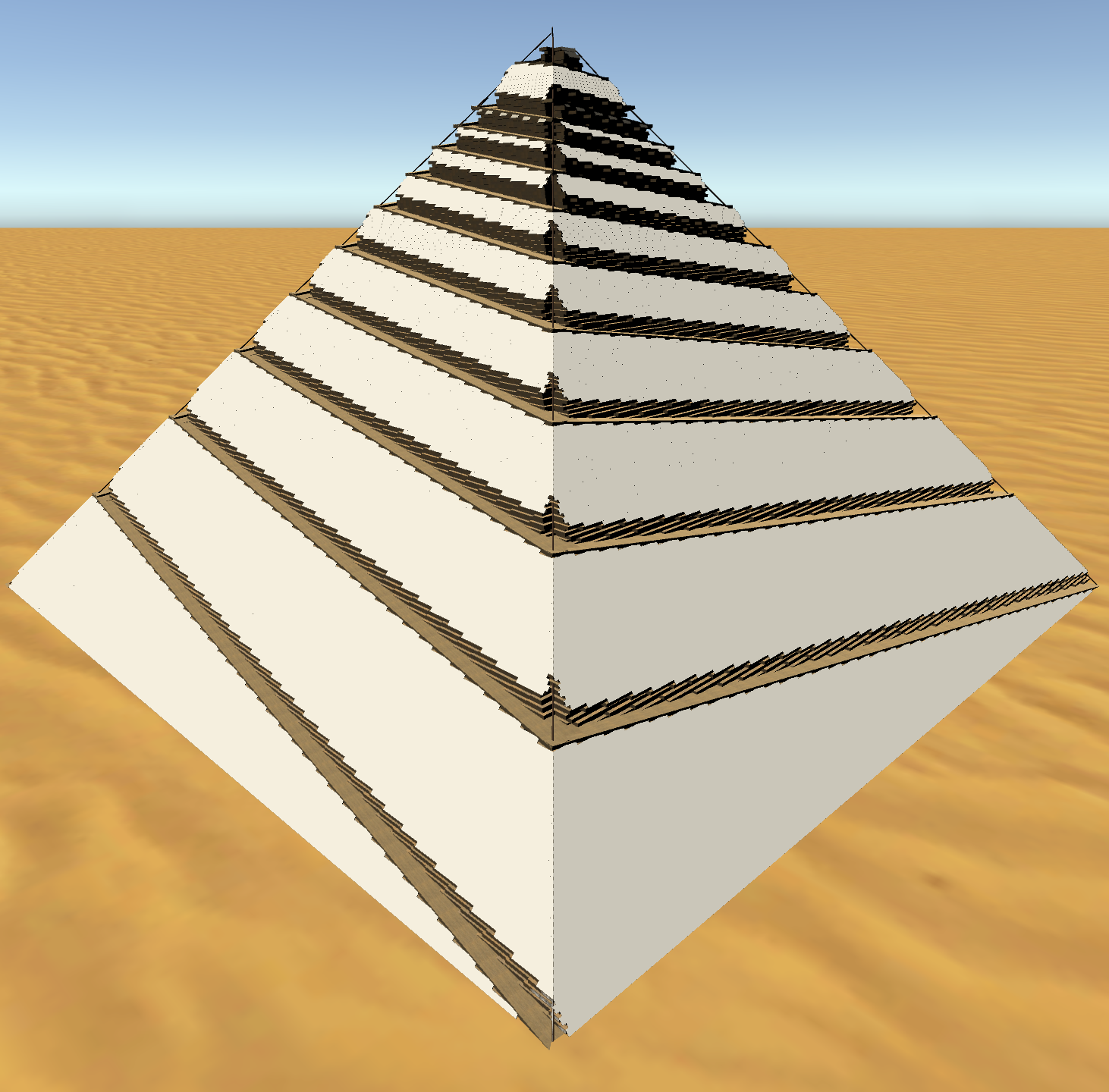
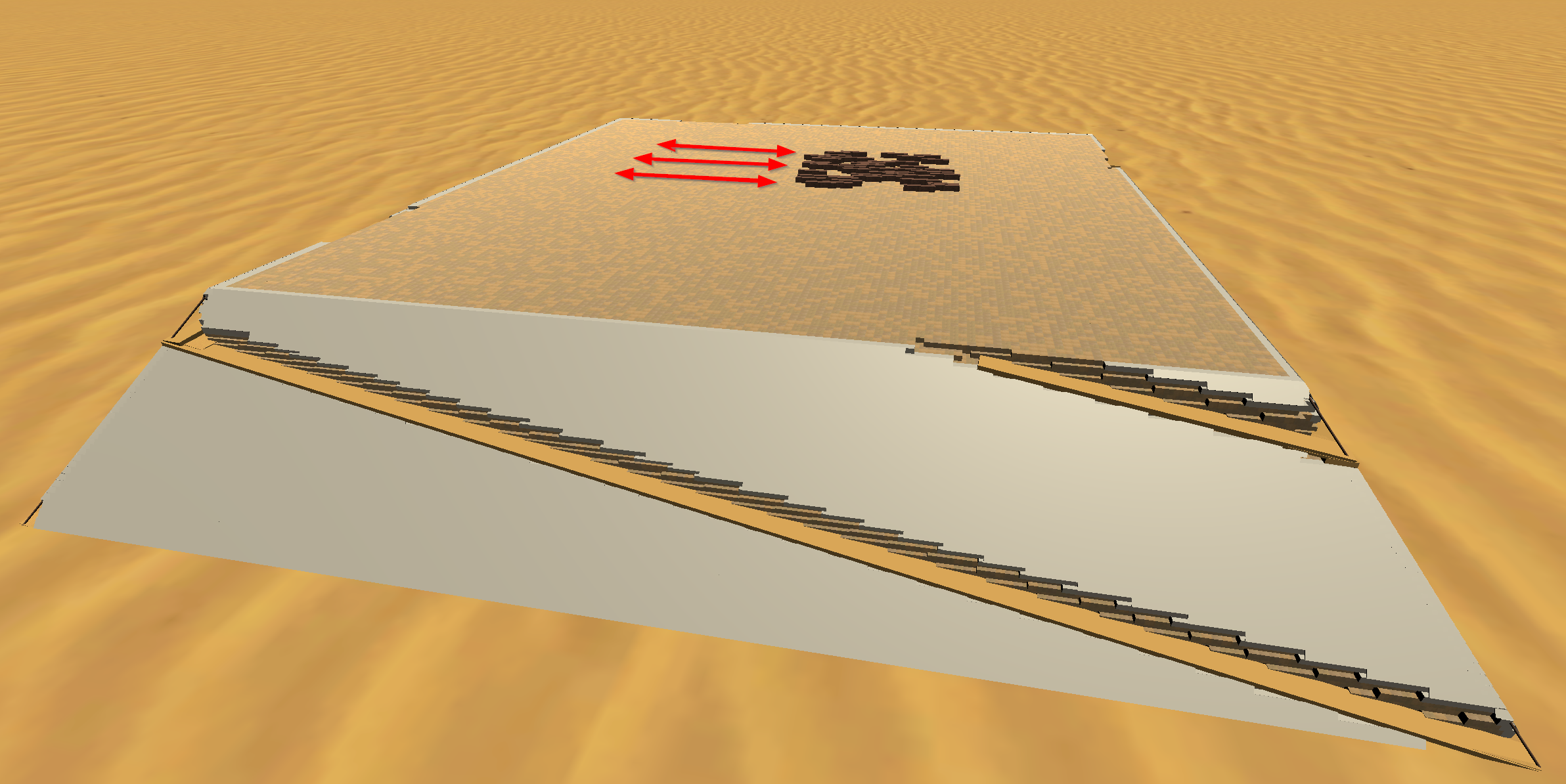
To further optimize efficiency, a study was conducted of the work required for both phases: the vertical movement up the ramp and the horizontal movement across the terrace. This analysis revealed something unexpected: in the lower courses, most of the effort is not vertical but horizontal. That insight naturally led to the idea of using multiple ramps early on, when distribution across wide terraces dominates the workload. And from this came the idea of the adaptive method, which adds more integrated ramps at minimal cost when they are most needed.
Solving the Granite challenge. As the model became more sophisticated, I had to address one of the biggest engineering challenges: transporting enormous granite blocks for the King's Chamber. The key lay in a terrace-to-terrace transport strategy using short ramps that could be dismantled and reused. And the space on the terrace was large enough to accommodate everyone needed, without interfering with the flow of limestone.
The "Eureka" Moment: Sustainability and Alignment with ScanPyramids.
Incorporating these real-world constraints into the model was crucial. I had to ensure that the parallel ramps wouldn't compromise the pyramid's structural integrity. One of the main concerns in this pyramid theory is whether leaving gaps for ramps would cause the structure to collapse. My simulations showed that these channels integrated into the edges wouldn't compromise the core's stability.
The real “Eureka” moment—the one that stayed with me—came when I overlaid the model with data from the ScanPyramids project. I was not trying to force a match; I was simply checking for consistency with certain ramp slope ranges. When the geometry of the proposed ramp paths at a given angle began to match the cavities, notches, and north face corridor (NFC) that had been described, it suggested that the model was capturing relevant information about the internal structure.
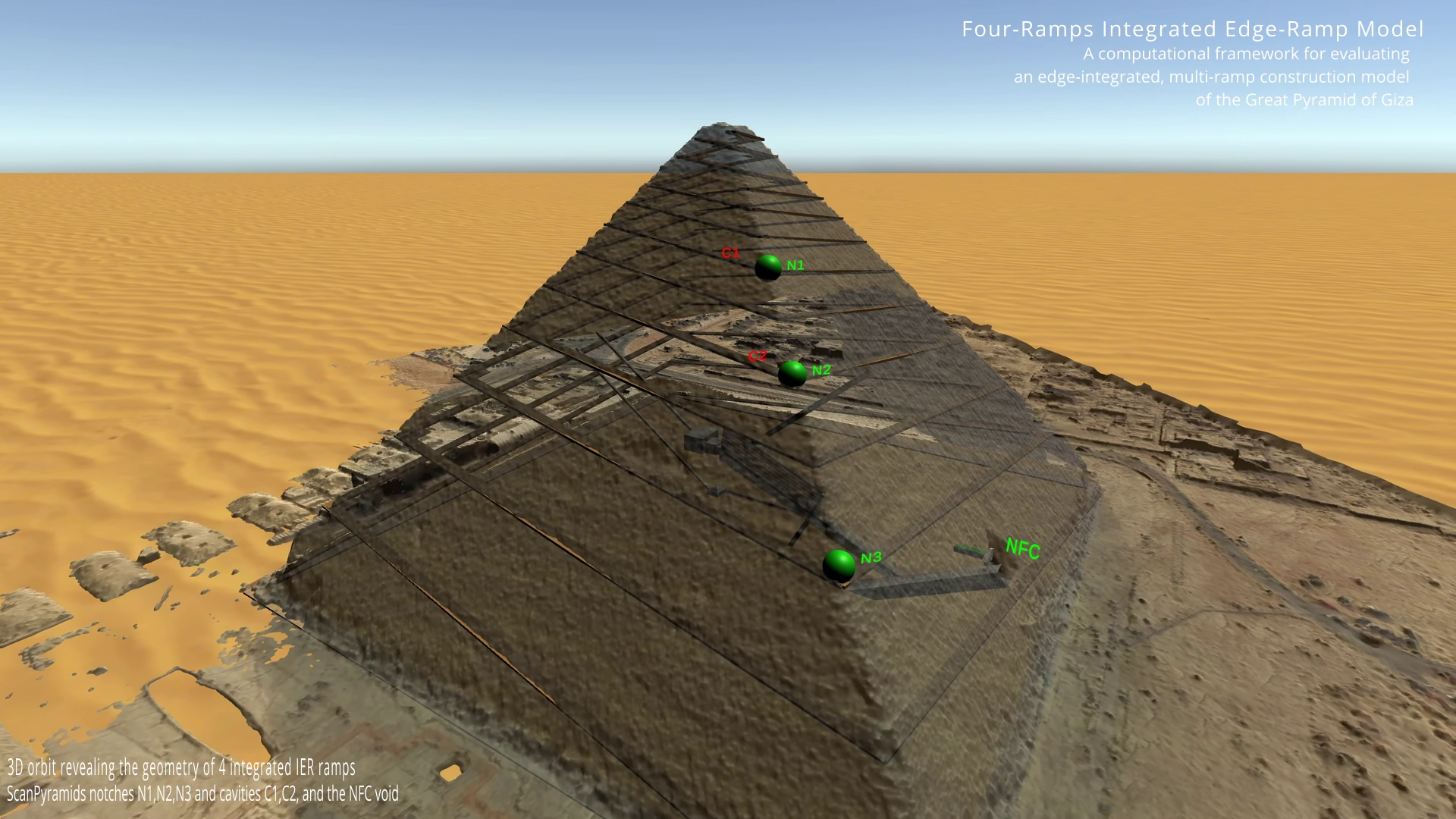
Some of the most compelling confirmations of the IER model came from other sites. At the Hatnub quarries, the Egyptians carved ramps directly into the mountain, without raised slopes, incorporating postholes to distribute the load. The Sinki pyramid goes even further: it features four simultaneous perpendicular ramps, one for each face. Parallelism is not a modern computer concept; they were already practicing it. Back at Giza, the corner turns predicted by the model coincide with some of the elevations where the thickness of the stone courses changes. Even the intense wear at the corners, especially the southeast corner, finally makes sense: it could mark the exact entry points where the greatest flow of blocks occurred and the backfilled structure was most weakened.
It was no longer just a conceptual reconstruction, but a framework capable of generating testable correspondences with observed data.
A Scalable Tool for Heritage Science
What surprised me most is how flexible the framework turned out to be. While I focus on Giza, this framework is entirely parametric. This means it can be adapted with minimal variations to other pyramidal structures or alternative construction theories. By simply adjusting the input parameters—such as slope, configuration, location, and other proposed methods—other researchers can use this tool to test and validate different engineering hypotheses. This adaptability transforms my model from a theory for a single monument into a scalable tool for heritage science, capable of providing rigorous technical analysis to a wider range of archaeological enigmas.
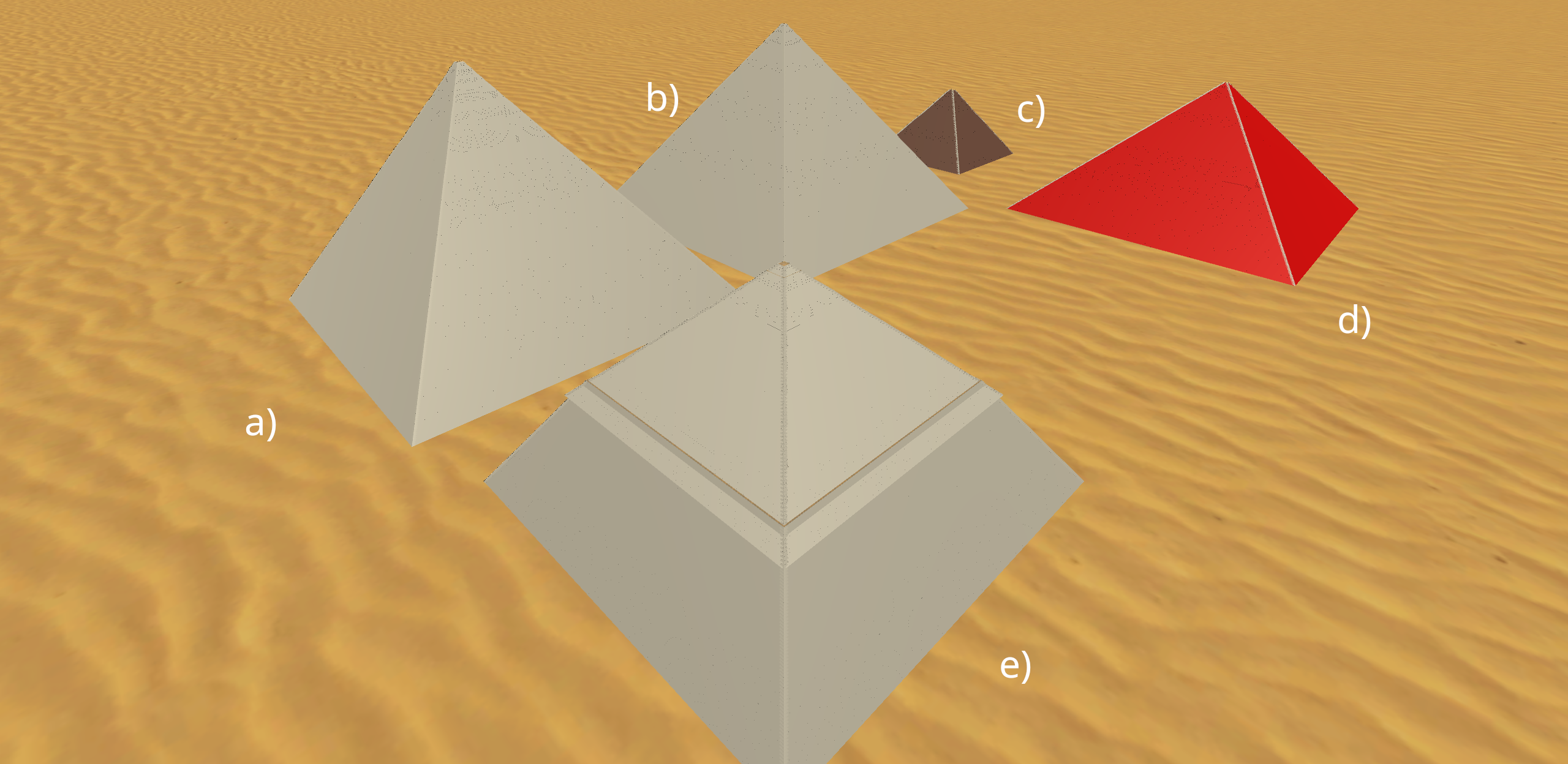
(e). The Bent Pyramid includes a break in slope
Bridging science and history. What started with a documentary and a few sketches on paper in 2020 ended up somewhere I never expected: a peer-reviewed computational framework that could actually put numbers on a 4,500-year-old question. The simulations showed that, under realistic assumptions, the construction fits within the 20–27 year historical window — giving technical grounding to records like Merer's Diary that had always been treated as context, not evidence.
That shift stayed with me. The ancient builders were not just moving stones — they were solving a complex optimization problem.
I have made the entire computational framework and datasets available on Zenodo. I believe that transparency and reproducibility are the only ways to move heritage science forward. By sharing the code, I hope to invite fellow researchers, engineers, and Egyptologists to test, critique, and build upon this or other models. We are no longer limited to guessing how the Great Pyramid was built; we now have computational tools to explore, test, and compare how it could have been done.
Time-lapse video simulation of the adaptative Integrated Edge-Ramp (IER) model

PhD in Pattern Recognition and Artificial Intelligence,
Universitat Politècnica de València (UPV), Spain.
Computer Engineer and Project Manager in the technology sector. I currently work at a multinational company.
I have specialized experience in Virtual Reality (VR), Augmented Reality (AR), and physics simulation engines (Unity), applying these tools to solve complex problems and recreate 3D environments.
Follow the Topic
-
npj Heritage Science
This journal will consider original research papers for the scientific study of heritage, based primarily on physical, chemical and biological measurements and / or computations.