The Single-Atom Catalyst Conundrum: Are We Designing Perfect Active Sites for the Wrong Reaction Pathways?
Published in Bioengineering & Biotechnology, Earth & Environment, and Materials

The Atomic Precision Revolution
The progress in single-atom catalyst (SAC) engineering has been extraordinary. Researchers are now controlling catalytic microenvironments at the level of individual atoms—creating isolated Fe-N₄, Co-N₄, Cu-N₃, and dual-site architectures capable of steering oxidant activation toward highly selective pathways.
Recent studies have demonstrated SACs that preferentially generate sulfate radicals (SO₄•⁻), hydroxyl radicals (•OH), singlet oxygen (¹O₂), or even non-radical electron-transfer pathways simply by modifying the local coordination environment. This level of mechanistic tuning would have been unimaginable a decade ago.
The field has moved far beyond "does the catalyst work?" toward a much deeper question: "Which reactive species does this exact atomic configuration generate—and why?" That shift represents a major scientific achievement. But it also exposes a growing vulnerability in the literature.
The Credibility Gap in SAC-Enabled AOPs
The problem begins when highly controlled laboratory chemistry collides with environmental complexity. In pristine water, pathway assignment often appears clean and convincing. Researchers deploy quenching experiments, EPR spin trapping, and kinetic analyses to identify dominant oxidants.
But growing evidence suggests many of these conclusions are far less definitive than they appear:
-
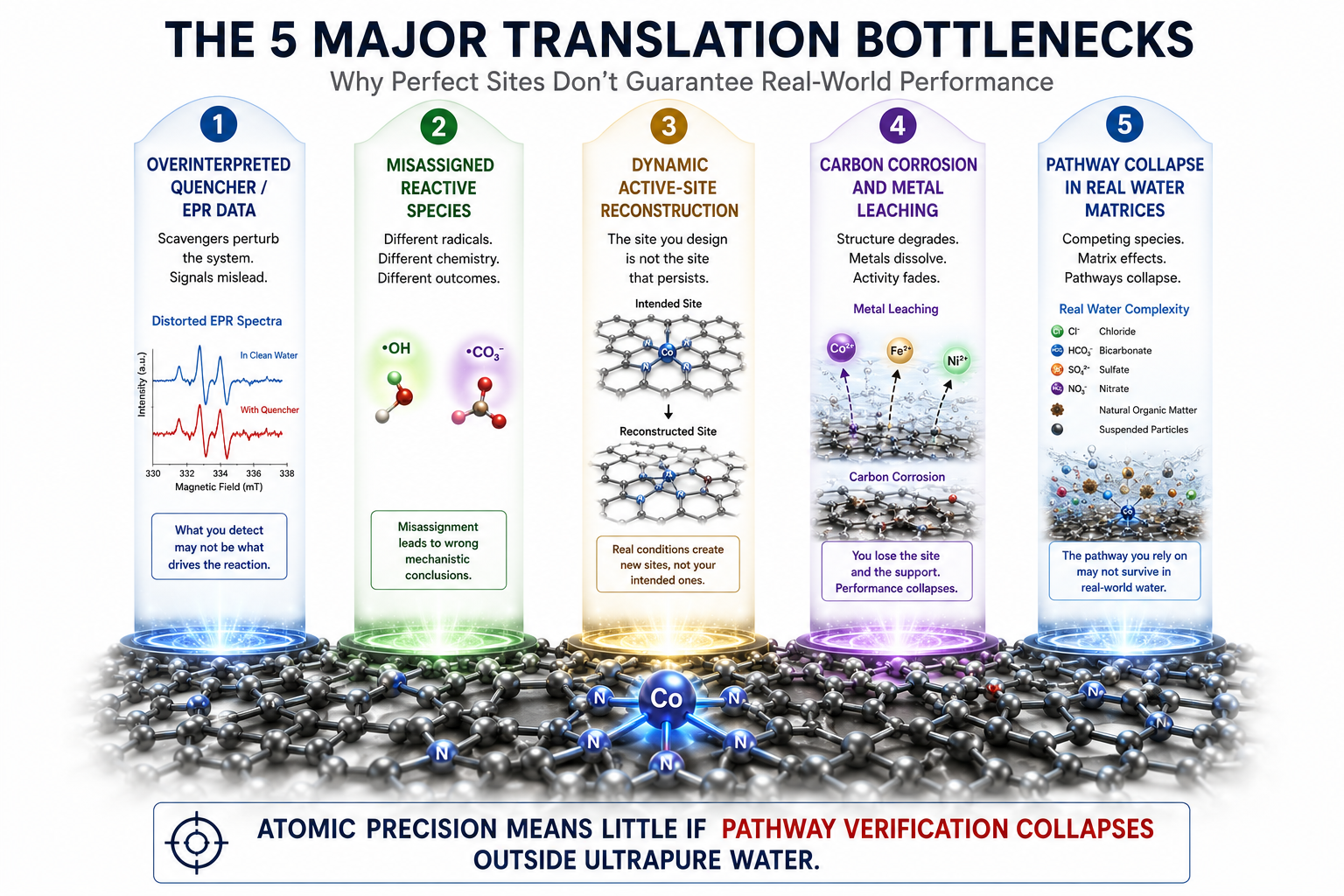
Overinterpreted Quenching: Methanol and tert-butanol quenching tests routinely overestimate radical contributions because they inherently interfere with non-radical pathways and surface electron transfer.
-
Ambiguous EPR Data: Spin-trapping experiments frequently detect intermediates that can form through multiple mechanisms simultaneously.
-
Dynamic Reconstruction: Under highly oxidative conditions, carbon supports undergo corrosion. Oxygen functional groups emerge dynamically. Metal centers shift coordination environments, and minor metal leaching triggers homogeneous Fenton chemistry indistinguishable from heterogeneous catalysis.
The "single active site" we proudly characterize before a reaction may no longer exist after several operational cycles. Yet, many studies continue discussing these systems as if the catalyst surface were structurally frozen. It is not.
Real Water Changes Everything
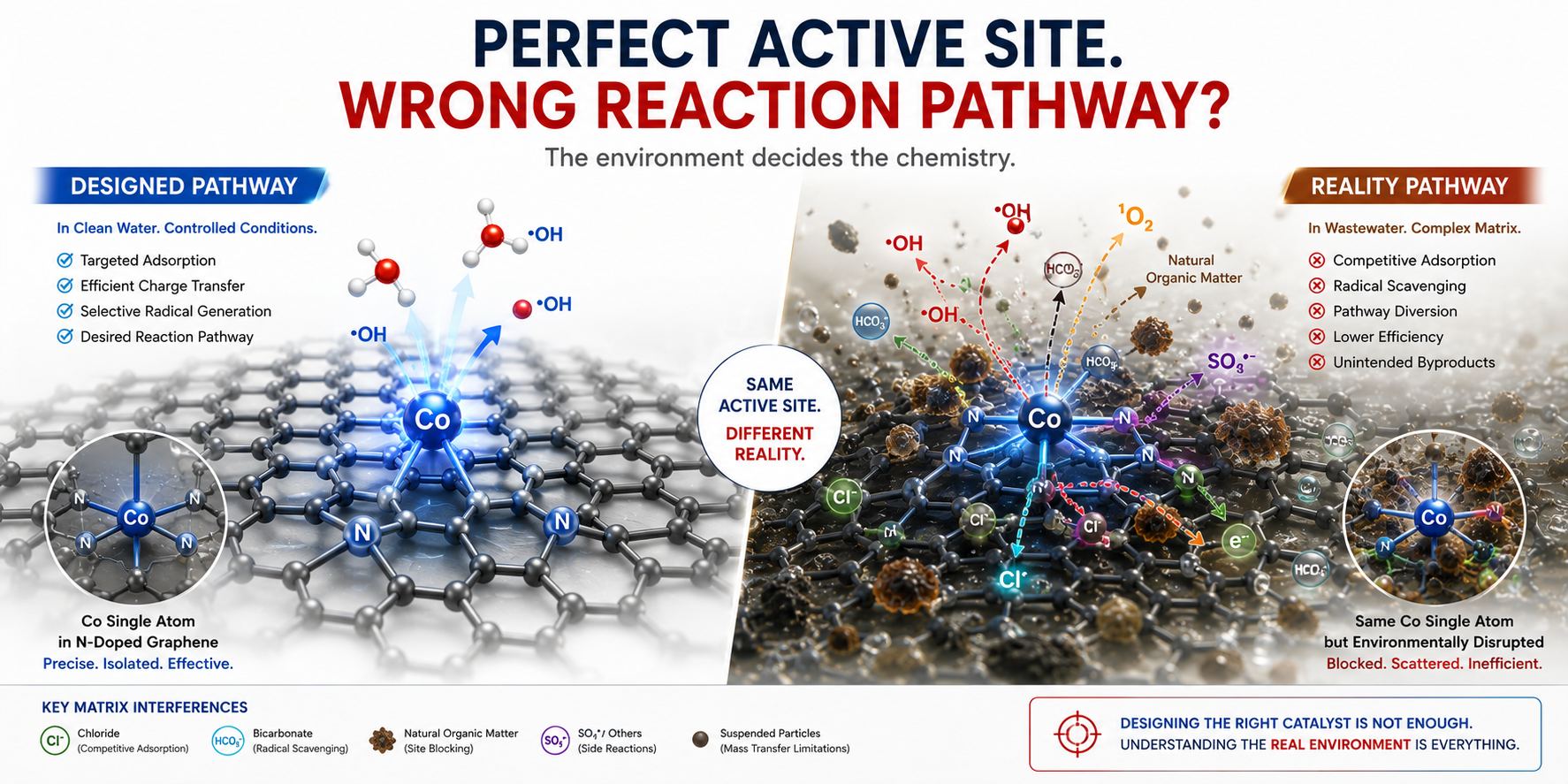
The greatest challenge, however, is not catalyst instability; it is matrix complexity. Real wastewater fundamentally rewrites reactive-species chemistry.
Chloride ions convert sulfate radicals into reactive chlorine species. Bicarbonate rapidly transforms •OH into carbonate radicals (•CO₃⁻). Natural organic matter scavenges radicals while simultaneously acting as an inner optical filter in photo-assisted systems. Heavy metals, phosphate, and sulfide all compete for active sites.
The result is profound: A SAC that appears exquisitely selective for SO₄•⁻ generation in ultrapure laboratory water may operate through an entirely different reactive portfolio in municipal effluent. Characterizing pathway selectivity under simplified matrices creates a dangerous illusion of mechanistic certainty.
From Activity-Centric to Evidence-Centric Catalysis
This does not mean SACs are overhyped. Single-atom catalysis remains one of the most promising directions in environmental chemistry because it maximizes atom efficiency and enables unprecedented electronic control. But the field must evolve.
We can no longer evaluate catalysts solely by degradation percentages under idealized conditions. The next phase of SAC research must prioritize:
-
Real-water validation and matrix testing
-
Pathway verification across varying pH and salinity profiles
-
Long-term structural stability mapping
-
Mandatory homogeneous-catalysis (leaching) controls
-
Post-reaction active-site characterization
In other words: less pathway mythology, more pathway accountability.
Conclusion
The single-atom catalyst is arguably the most elegant architecture in modern environmental catalysis. But elegance alone is not enough. If we truly want scalable, defensible AOP technologies, catalyst design must move beyond maximizing reactivity in pristine water toward maintaining mechanistic integrity under environmental reality.
The future winners in this field will not necessarily be the catalysts with the highest degradation percentages. They will be the systems that retain pathway control when the chemistry becomes messy. And real water is always messy.
#SingleAtomCatalysts #AdvancedOxidationProcesses #EnvironmentalCatalysis #WaterTreatment #Peroxymonosulfate #MaterialsScience #Nanotechnology #Electrocatalysis #Catalysis #SpringerNature

Dr. Akeem Adeyemi Oladipo is a globally recognized Research Professor of Materials and Environmental Chemistry at Eastern Mediterranean University. Ranked among the world's Top 2% Scientists, his expertise bridges nanotechnology, renewable energy, and electro-analytical chemistry. He specializes in advanced materials synthesis for wastewater treatment, highly sensitive electrochemical biosensors, and solar energy conversion. By integrating machine learning and artificial neural networks, his research drives scalable deep-tech innovations in environmental sustainability and energy storage.