Towards precise and real-time immunodiagnostics through electrochemical sensing of immune checkpoint proteins
Published in Cancer, Materials, and Immunology




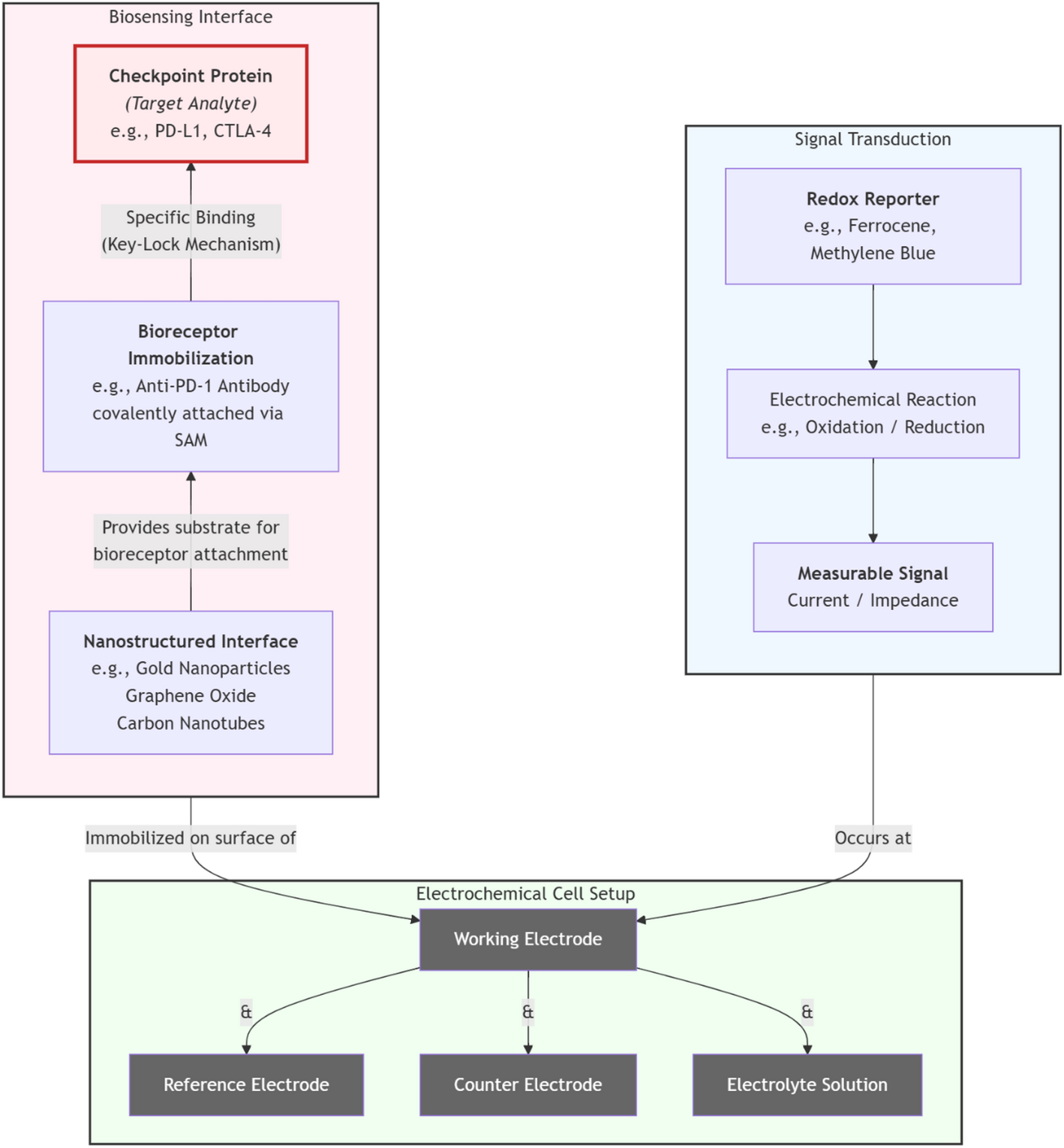

When I was working on my first project regarding the electrochemical monitoring of immunotherapy patients, I faced the fact that actually the work I was working on was not as simple as I thought. I was trying to quantify the biomarker granzyme B level in patients with cancer. The challenges were coming when the enzyme-linked immunosorbent assay data did not match the electrochemical device-derived data. Perhaps, dynamic changes of the corresponding marker might affect the analytical data. Indeed, other factors might be involved. Trials and errors for hundreds of samples of blood patients were carried out. An intensive study had also been done. Still, the results did not match expectations. I discovered one interesting thing: the biomarker granzyme B, which is among the immune checkpoint proteins, is not the only biomarker to investigate the progress of cancer. The immune checkpoint proteins may correlate with one another, which makes them interesting to study.
Immune checkpoint proteins are defined as regulatory molecules on immune cells (and sometimes cancer cells) that act as brakes or accelerators for the immune system. Their normal job is to maintain immune balance to prevent autoimmunity and to limit tissue damage after an immune response. Cancer exploits these checkpoints to evade immune attack, which is why they are central to modern immunotherapy. With this basis, I developed a new yet similar to previously developed sensing device, however, focusing on the detection of interferon gamma and programmed death ligand 1, independently. Expectedly, I got the better results. Additionally, I proposed another research scheme for cytotoxic T-lymphocyte associated protein 4, but due to limited time, this work was never executed.
After finishing the project, I thought about preparing a perspective article related to this research. But I had difficult times. I should be back in my home country to take a gap year prior to continuing my research journey. One year later, when I was back, I was busy with another project. Although still working on cancer, the focus was different. The whole year, I was forgotten due to the new, different project, but that thought was always stuck in my mind. Until I decided to permanently return to my home country, to work at a national research institute. In my busy schedule, I tried my best to draft the perspective article on the topic of electroimmunodiagnostics. And yes, I did, and then published it in “Discover Sensors” under the title “Towards precise and real-time immunodiagnostics through electrochemical sensing of immune checkpoint proteins.” This idea resurfaced once more when I found the Discover Series journal for the first time.
I realized my research journey was not easy, particularly towards my beloved wife and son, who always missed me from afar. Every single day, never stop thinking about them while busy with the research. In early 2025, I was very grateful that we could be together once more, building the family that I have always dreamed of. At this time, which was the turning point in both my research and life, I was surfing the internet, looking for the development of sensors/biosensors journals. I found Discover Sensors, an open-access journal publishing research from all fields relevant to sensors.
Discover Sensors might be the best platform to disseminate this research idea, which will eventually inspire other investigators further. I am very thankful to the editor who proceeded with the manuscript. Also, to the reviewers who help improve the quality of the work to meet the standard of the journal. I expect this work to drive the investigators to develop a better research scheme to achieve satisfactory results/data. Ultimately, it can be a solution to the challenges we are facing in the monitoring outcomes of immunotherapy for cancer patients. Once more, thank you very much to the editor and the reviewers.
As the closing remark, I want to say what I said in the acknowledgement section of the article as follows:
“This article is based on the author’s doctoral research. The author sincerely acknowledges the guidance, encouragement, and support of his supervisors and colleagues throughout his PhD studies. The author is also profoundly grateful to his family for their patience and understanding, which made the completion of both the thesis and this work possible. The author would like to express his deepest gratitude to his beloved wife, whose patience, unwavering support, and endless understanding sustained him throughout his years of PhD studies abroad. Her encouragement and sacrifices made it possible for the author to pursue this path, and this achievement is as much hers as it is the author’s.”

Follow the Topic
-
Discover Sensors
A fully open access, peer-reviewed journal supporting multidisciplinary research and policy developments across all fields relevant to sensors.

Related Collections
With Collections, you can get published faster and increase your visibility.
Next-Generation Intelligent Sensors: Materials, AI Integration, and Emerging Applications
This collection aims to highlight cutting-edge advancements in the design, fabrication, and deployment of next-generation sensors that integrate intelligent functionalities through artificial intelligence (AI) and machine learning (ML). With the growing demand for real-time, autonomous, and adaptive sensing systems across fields such as healthcare, environmental monitoring, smart manufacturing, and defense, this collection will explore the convergence of advanced materials, novel fabrication techniques, and data-driven intelligence.
We welcome contributions that span a wide range of interdisciplinary domains including, but not limited to:
• AI/ML-enabled sensor design and signal processing
• Multimodal sensing systems with autonomous decision-making capabilities
• Additive and hybrid manufacturing techniques for intelligent sensors
• Smart materials and functional nanocomposites for sensor applications
• Edge computing, data fusion, and digital twins in sensor networks
• Applications in Industry 4.0, Internet of Things (IoT), and biomedical diagnostics
The collection seeks to foster dialogue among researchers from materials science, electrical and mechanical engineering, computer science, and applied physics. By showcasing original research, reviews, and case studies, this initiative aims to shape the future landscape of intelligent sensing technologies and inspire innovative solutions to complex real-world challenges.
Publishing Model: Open Access
Deadline: Oct 31, 2026
Wireless Sensor Networks and Intelligent Monitoring Systems for Sustainable Smart Infrastructures
This Collection aims to engage researchers across energy, water, gas utilities, transportation and mobility, environmental monitoring, and public safety. It focuses on the core enablers for using wireless sensor networks in Intelligent monitoring of critical infrastructures: optimal sensor deployment, multihop networking, IoT/LPWAN and 5G/6G integration, edge/fog intelligence, data-driven analytics, and resiliency.
We welcome Research Articles, Reviews, Perspectives, and Brief Communications that address algorithmic and systems-level advances, including optimization for large-scale deployments, routing and backhauling strategies, anomaly detection and forecasting, energy efficiency, interoperability, and real-world case studies in urban and rural settings.
This Collection supports and amplifies research related to: SDG 9, SDG 11
Publishing Model: Open Access
Deadline: Jan 31, 2027