Troubling Heroes: Why We Keep Returning to Odysseus
Published in Arts & Humanities
Explore the Research
 Springer Nature Switzerland
Why Odysseus?
This book examines Odysseus’ enduring appeal from Homer’s Odyssey to ancient philosophical understandings of Greek myth and Cavafy’s poetry.
The last twenty-five years or so have brought audiences many different versions of the mythical Hero Odysseus. Whether it is George Clooney’s buffoonish Ulysses in O Brother Where Art Thou? Ralph Fiennes’s menacing veteran in 2024’s The Return, or Matt Damon’s reluctant warrior in Christopher Nolan’s Odyssey, we keep returning to a figure whose meaning shifts depending on how we look at him. Why?
There are different ways of answering this question. As a cunning hero with roots in mythical trickster traditions, Odysseus is adaptable and even funny. But his traditional associations with traveling, homecoming, and storytelling also speak to modern concerns of identity and belonging. Odysseus also occupies an interesting position of transition. He is a fully mortal hero, a survivor of a war that was meant to end the race of heroes, according to some, and his journey takes audiences from a place of myth to one closer to the mundane paths of history.
So, Odysseus appeals to our modern sense of things ending and very modern concerns about the construction of our identity in a time when fact can be very hard to distinguish from fiction. But I suspect part of the attraction—if not obsession—with the figure is rooted in the word I have used several times without defining it: hero.
When we use that term today, it carries a connotation of someone who upholds or represents certain values and who acts on behalf of others. This is not a definition that would have been familiar to ancient audiences. The word heros in Greek points to someone in the prime of their life or a member of the generation before ours, the last generation of humans to mix in (and with) the gods.
Ancient Greeks saw their heroes the way they saw their gods: as characters who explored the extremes of reality as a way to help them better understand their world. Homeric heroes like Odysseus and Achilles in the Iliad stand out for their capacity to suffer and cause suffering in turn. Achilles famously prays for his own people to suffer to make up for the slight to his honor; Odysseus fails to bring his own companions home and then murders his own people (the suitors) upon his return.

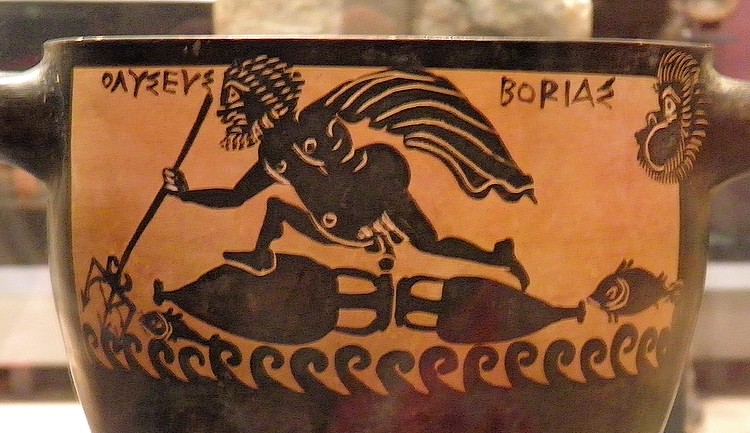
Odysseus with the kind stabbing giant Polyphemus in his single eye. Vase painting from archaic (or late geometric) time. Archaeological Museum of Argos
The fundamental question for heroes—and their audiences—posed by the Homeric Odyssey is how they make their own suffering worse than it has to be because of their own recklessness. The answer the epic gives for Odysseus is that his moment of great glory—when he uses his intelligence to trick and blind the Cyclops Polyphemos and escape from his cave—is also the root of his troubles. It is because of this act and his boasting over it that Odysseus fails to get home directly, ending up stranding his men on the island of Helios where they anger the god and leaving his wife and son alone for years before the suitors even arrive.
In modern entertainment, we find ourselves obsessed with the antihero, with criminals, and questionable characters who don’t exhibit the qualities we might associate with a savior figure or a Superman. We are drawn to them because the trouble they make for the world and the troubles they make for themselves effectively echo our experiences and anxieties about our own lives. We are drawn to Odysseus in part because he is the original antihero. He is a clever liar who will do anything to get home again. His story is not one we ought to imitate, but instead one we should use to think about the cost of our own accomplishments and the complex nature of being human.

Follow the Topic
Introducing the Palgrave Macmillan Campaign for the Humanities
At Palgrave Macmillan we publish cutting-edge humanities research that has real-world impact. This research community brings together the voices of our authors and editorial team to highlight and publicize the value of the humanities and humanities research in our world today.
Continue reading announcement