


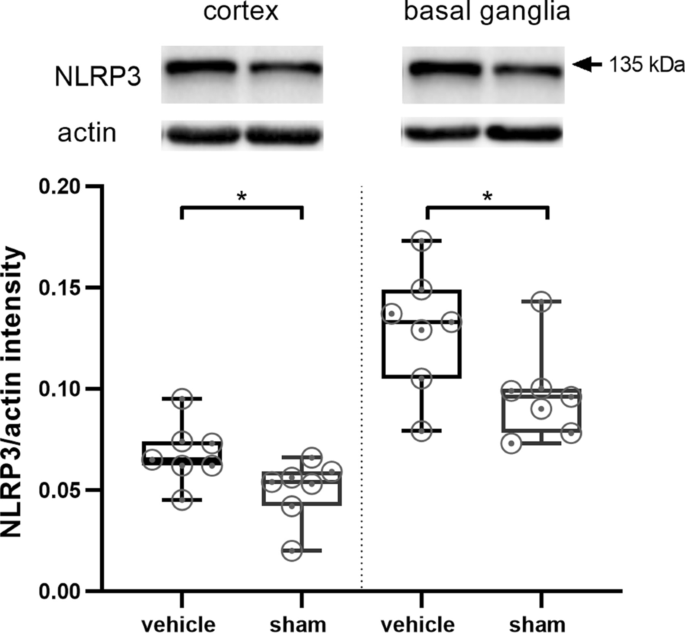

NLRP3 inflammasome activation is increasingly recognized as an important contributor to secondary brain injury after ischemic stroke, but most preclinical studies of NLRP3 inhibition have focused on young animals and short-term outcomes. In this study, Kamat and colleagues investigated the NLRP3 inhibitor MCC950 in 14–15-month-old mice subjected to transient middle cerebral artery occlusion, examining both acute outcomes at 72 hours and longer-term recovery over approximately 30 days. MCC950 treatment reduced acute brain injury and inflammasome signaling and was associated with improved blood–brain barrier integrity and longer-term functional recovery. We invited the authors to discuss what these findings tell us about targeting post-stroke inflammation in the aging brain.
TSR: First, congratulations on this interesting study. What do you see as the central take-home message of your work for the stroke field?
Dr. David Hess: The central message is that pharmacological targeting of NLRP3 is effective in aged mice with acute stroke in the short term and long term (30 days), suggesting that targeting NLRP3 has potential as a treatment for acute stroke. MCC950 has liver toxicity in clinical trials, limiting its use in humans, but pharmaceutical companies have developed brain-permeable NLRP3 inhibitors that are already in non-stroke clinical trials.
TSR: NLRP3 inhibition has previously shown protective effects in experimental stroke. What motivated you to specifically test MCC950 in an aging stroke model, and did aging change how you think about the therapeutic potential of targeting NLRP3?
Dr. David Hess: Most strokes occur in older humans but most testing in experimental models in rodents is performed in young animals. Our work with the Stroke Preclinical Assessment Network (SPAN) has shown us the importance of testing interventions in rodents with comorbidities including aging. We wanted to determine if targeting NLRP3 was effective in aged mice. This is especially important as aging is associated with increased sterile inflammation.
TSR: In your long-term experiment, MCC950 treatment was continued for four weeks. Given that much of the work on NLRP3 after stroke has focused on the acute and subacute phases, what was the rationale for prolonged treatment, and do you think sustained NLRP3 inhibition throughout recovery is necessary, or might a shorter treatment window be sufficient to preserve the long-term benefits?
Dr. David Hess: There is evidence that the inflammatory cascade is prolonged for weeks after stroke, suggesting that prolonged inhibition of inflammation may be necessary to maximize the therapeutic effect. The exact duration of NLRP3 activation in rodent and human stroke is less clear, as most studies do not go beyond 7 days. Interestingly, NLRP3 inhibition in stroke with MCC950 is effective when delayed to 24 hours (Bellut et al., 2023), allowing for a later time window for treatment, attractive for translation to humans. In preclinical stroke studies, there is a lack of data on the optimal duration of therapy, which may explain some of the failures in clinical translation. We did not answer the question whether long-term treatment (e.g., 4 weeks) is superior to shorter-term treatment (e.g., 3-5 days). This would require randomizing mice to these different treatment durations, which we have not done yet.
The full article, “Therapeutic Potential of NLRP3 Inhibitor MCC950 in Aging Mice Stroke Outcomes,” is published in Translational Stroke Research (2026).
Reference
Bellut, M., Bieber, M., Kraft, P., Weber, A. N. R., Stoll, G., & Schuhmann, M. K. (2023). Delayed NLRP3 inflammasome inhibition ameliorates subacute stroke progression in mice. Journal of Neuroinflammation, 20(1). https://doi.org/10.1186/s12974-022-02674-w

Follow the Topic
-
Journal of Neuroinflammation
This is a fully open access journal that focuses on interactions of the immune system (and especially the innate immune system) with the nervous system.
-
Translational Stroke Research
A journal committed to the development of new strategies for prevention, assessment, treatment, and repair after stroke and neurotrauma.