


Ultrafast Laser Shock Straining in Chiral Chain 2D Materials: Mold Topology‑Controlled Anisotropic Deformation

Published in Chemistry, Materials, and Physics

Ultrafast Laser Shock Straining in Chiral Chain 2D Materials: Mold Topology‑Controlled Anisotropic Deformation
Like

Share this post

Choose a social network to share with, or copy the URL to share elsewhere

This is a representation of how your post may appear on social media. The actual post will vary between social networks

Explore the Research

Springer Nature Singapore
Springer Nature Singapore Springer Nature Singapore

Ultrafast Laser Shock Straining in Chiral Chain 2D Materials: Mold Topology-Controlled Anisotropic Deformation - Nano-Micro Letters

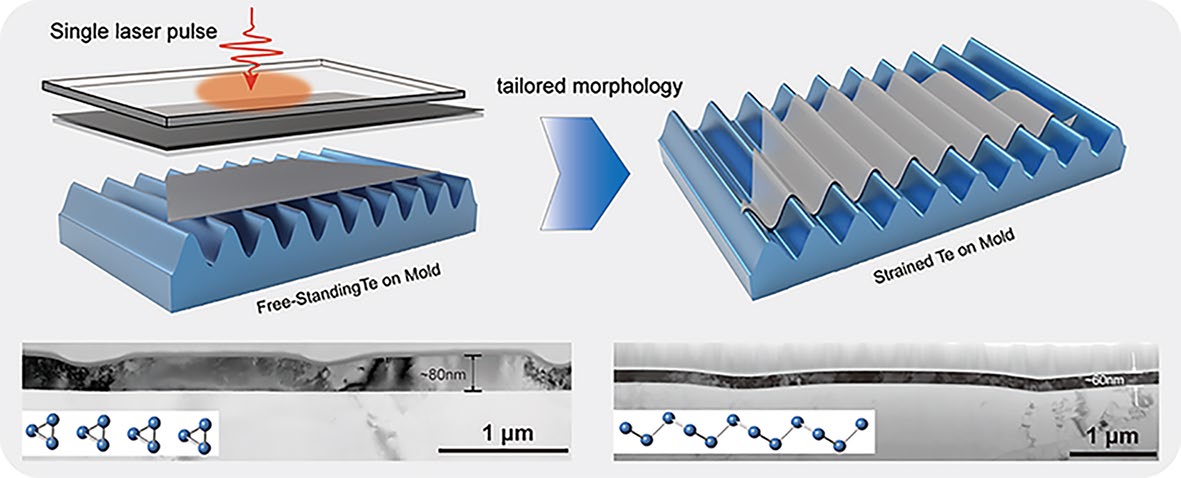
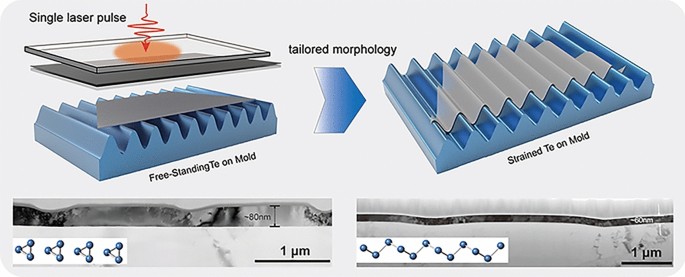
Tellurene, a chiral chain semiconductor with a narrow bandgap and exceptional strain sensitivity, emerges as a pivotal material for tailoring electronic and optoelectronic properties via strain engineering. This study elucidates the fundamental mechanisms of ultrafast laser shock imprinting (LSI) in two-dimensional tellurium (Te), establishing a direct relationship between strain field orientation, mold topology, and anisotropic structural evolution. This is the first demonstration of ultrafast LSI on chiral chain Te unveiling orientation-sensitive dislocation networks. By applying controlled strain fields parallel or transverse to Te’s helical chains, we uncover two distinct deformation regimes. Strain aligned parallel to the chain’s direction induces gliding and rotation governed by weak interchain interactions, preserving covalent intrachain bonds and vibrational modes. In contrast, transverse strain drives shear-mediated multimodal deformations—tensile stretching, compression, and bending—resulting in significant lattice distortions and electronic property modulation. We discovered the critical role of mold topology on deformation: sharp-edged gratings generate localized shear forces surpassing those from homogeneous strain fields via smooth CD molds, triggering dislocation tangle formation, lattice reorientation, and inhomogeneous plastic deformation. Asymmetrical strain configurations enable localized structural transformations while retaining single-crystal integrity in adjacent regions—a balance essential for functional device integration. These insights position LSI as a precision tool for nanoscale strain engineering, capable of sculpting 2D material morphologies without compromising crystallinity. By bridging ultrafast mechanics with chiral chain material science, this work advances the design of strain-tunable devices for next-generation electronics and optoelectronics, while establishing a universal framework for manipulating anisotropic 2D systems under extreme strain rates. This work discovered crystallographic orientation-dependent deformation mechanisms in 2D Te, linking parallel strain to chain gliding and transverse strain to shear-driven multimodal distortion. It demonstrates mold geometry as a critical lever for strain localization and dislocation dynamics, with sharp-edged gratings enabling unprecedented control over lattice reorientation. Crucially, the identification of strain field conditions that reconcile severe plastic deformation with single-crystal retention offers a pathway to functional nanostructure fabrication, redefining LSI’s potential in ultrafast strain engineering of chiral chain materials.

As 2D materials race toward flexible electronics, precisely tailoring their strain fields without cracking crystals remains a grand challenge. Now, a Purdue team led by Prof. Gary J. Cheng and Prof. Wenzhuo Wu demonstrates the first laser-shock imprinting (LSI) on chiral-chain tellurene, revealing orientation-dependent deformation that retains single-crystal integrity while generating dense dislocation networks—offering a universal route for nanoscale strain engineering of anisotropic 2D systems.

Why LSI on Tellurene Matters

  • Ultrafast & High-Resolution: 5-ns, 0.4 GW cm-2 pulse delivers smooth 3-D nanoshaping with sub-micron feature control.
  • Orientation-Sensitive Mechanics: Parallel strain drives chain gliding/rotation; transverse strain triggers multimodal shear—tuning bandgap and carrier mobility on demand.
  • Single-Crystal Retention: Severe plastic zones coexist with pristine lattice, enabling functional device integration without loss of crystallinity.

Innovative Design & Features

  • Mold-Topology Control: Sharp-edged gratings produce localized shear > homogeneous CD-mold fields, forming dislocation tangles and 6.37° lattice rotations.
  • Dual Deformation Regimes: MD-validated models show chain sliding (‖) versus chain twisting (⊥) at 460 MPa shear stress—matching HR-TEM observations.
  • Raman Fingerprint: Perpendicular strain red-shifts A₁ mode to 117 cm-1 (tensile); parallel strain blue-shifts to 121.5 cm-1 (compressive), providing non-destructive strain read-out.

Applications & Outlook

  • Strain-Tunable Photodetectors: Anisotropic absorption edges promise CMOS-compatible, bendable IR sensors.
  • Flexible Thermoelectrics: Controlled defect networks scatter phonons while preserving σ, boosting ZT in wearable energy harvesters.
  • Scalable Manufacturing: Roll-to-roll LSI molds compatible with 4-inch wafers; team targets cm2 tellurene TEG arrays delivering >1 mW cm-2.

This work establishes LSI as a precision tool for sculpting 2D chiral semiconductors, bridging ultrafast mechanics with optoelectronic property design. Stay tuned for more advances from Prof. Cheng & Prof. Wu’s labs!

Please sign in or register for FREE

If you are a registered user on Research Communities by Springer Nature, please sign in

Follow the Topic

Two-dimensional Materials
Physical Sciences > Physics and Astronomy > Condensed Matter Physics > Nanophysics > Nanomaterial > Two-dimensional Materials
Crystal Field Theory
Physical Sciences > Chemistry > Inorganic Chemistry > Crystal Field Theory
Topological Material
Physical Sciences > Materials Science > Condensed Matter > Topological Material
  • Nano-Micro Letters Nano-Micro Letters

    Nano-Micro Letters is a peer-reviewed, international, interdisciplinary and open-access journal that focus on science, experiments, engineering, technologies and applications of nano- or microscale structure and system in physics, chemistry, biology, material science, and pharmacy.